
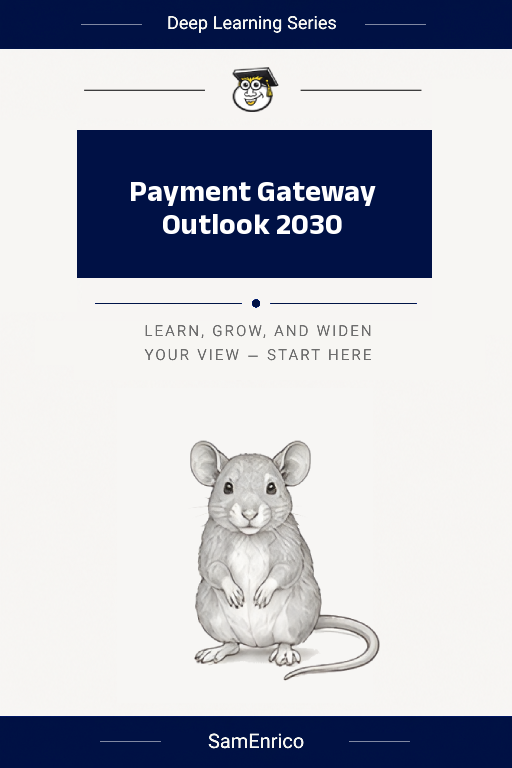
Non-FictionForecast & OutlookGateways
Payment Gateway Outlook 2030
Forecast gateway consolidation, feature commoditiz
by Ayala Kizzy
Forecast gateway consolidation, feature commoditization, and differentiation via smart routing and analytics.
Formats
About this book
Free sample
Chapter 1: The Dumb Pipe Trap--–- Every time a customer clicks “pay,” a silent robbery occurs. The merchant loses 5-10% of their revenue. The customer experiences frustration they can’t name. And the payment gateway—the supposed engine of modern commerce—quietly pockets its fee while delivering a service so undifferentiated it might as well be electricity. The industry calls this “normal.” This book will call it what it is: a systemic failure that will define winners and losers by 2030.The $180 Billion Illusion The global online payment gateway market is projected to exceed $180 billion by 2030.
That number, repeated breathlessly at fintech conferences and in investor pitch decks, creates an illusion of abundance. A rising tide lifts all boats, the thinking goes. More digital commerce means more transactions, and more transactions mean more fees. The gateway providers, from legacy acquirers to agile fintechs, are supposedly sailing toward a golden horizon.But beneath that surface-level optimism lies a brutal reality that most industry participants either ignore or misunderstand. The $180 billion figure is a measure of volume, not profitability.
It counts every transaction processed, every authorization request routed, every settlement batch finalized. What it does not reveal is how razor-thin the margins on those transactions have become—and how much thinner they will be by the end of this decade.Consider the math. A typical online payment transaction carries an interchange fee (paid to the card-issuing bank), a scheme fee (paid to Visa or Mastercard), an acquiring fee (paid to the merchant’s bank), and a gateway fee (paid to the processor). Two decades ago, each of these layers had healthy margins. Acquirers competed on service, gateways competed on features, and merchants paid a premium for reliability.Today, interchange and scheme fees are largely fixed by regulation or network rules.
The European Union’s Interchange Fee Regulation capped consumer credit card interchange at 0.3% and debit at 0.2% in 2015, and similar pressures are spreading globally. The Durbin Amendment in the United States capped debit interchange for large issuers. India’s central bank has repeatedly slashed merchant discount rates. The trajectory is unmistakable: the regulatory…
This is the end of the free sample. Get the eBook to keep going. Buy now
Contents
- Chapter 1
- Chapter 2
- Chapter 3
- Chapter 4
- Chapter 5
- Chapter 6
- Chapter 7
- Chapter 8
- Chapter 9
- Chapter 10
- Chapter 11
- Chapter 12
Details
- Author
- Ayala Kizzy
- Publisher
- SamEnrico
- Language
- English
- Genre
- Non-Fiction, Forecast & Outlook, Gateways
- Released
- 2026-06-01
- Pages (approx.)
- 151
- Available as
- eBook, Audiobook

Read better in the ZLOADR app
Your eBooks on your phone or tablet. Sign in with your SamEnrico account and start reading.
More by Ayala Kizzy
 IBS Elderly Patient Management HandbookAyala Kizzy$11.99
 The Housing MayorAyala Kizzy$11.99
 Scaling Company Culture ManualAyala Kizzy$11.99
 Debt Stress Coping WorkbookAyala Kizzy$11.99
 The Silk Road Healers: Mold, Medicine, and the Mongol FrontierAyala Kizzy$11.99
 The Labors of Heracles: A Hero’s Burden and the Birth of MythAyala Kizzy$11.99
 Nvidia LatAm AI ManualAyala Kizzy$12.99
 Understanding Hydronephrosis Peculiar Facial ExpressionAyala Kizzy$17.99
 Systems EngineerAyala Kizzy$11.99
 How to Become a ScrapperAyala Kizzy$11.99
You may also like
 Hong Kong Handover 1997Dunn Johnnie$11.99
 Zumba For Postnatal Recovery CourseNeal Christian$11.99
 Zumba for BeginnersLadner Nikia$11.99
 YouTube Comment Mining GuideHumes Pandora$12.99
 Worry Box MeditationCarlin Rudy$11.99
 Workplace Stress MeditationNguyen Lynn$11.99
 Workplace Stress and Sleep RepairHawley Ivory$11.99
 Workplace Perfectionism CureDelaney Jeffry$11.99
 Workplace Injustice Anger GuideWallen Isabelle$11.99
 Work Addiction and Burnout LinkGreenwood Ester$11.99
 Women in Yoga and WellnessBeattie Galina$11.99
 Women in Stand Up ComedyChun Evangeline$11.99