
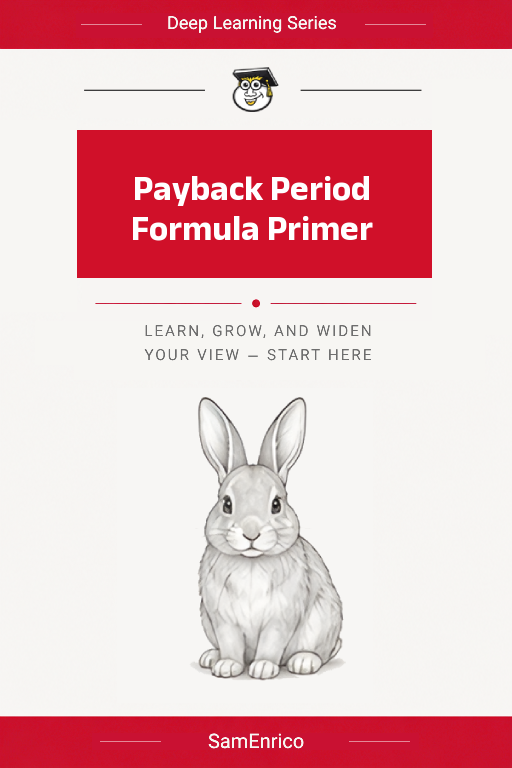
Non-FictionPrimerCapital Budgeting
Payback Period Formula Primer
Calculate simple and discounted payback periods fo
Calculate simple and discounted payback periods for investment decisions. A quick tutorial for capital budgeting students.
Formats
About this book
Free sample
Chapter 1: The Survival Question-- Every great investment begins with a question that has nothing to do with profit. Before an entrepreneur asks, “How much money will this make?” Before a CFO asks, “What is the internal rate of return?” Before a venture capitalist asks, “What is the net present value?” — they all ask the same quiet, urgent, almost primal question: “When do I get my money back?”This chapter is about that question. It is about why that question comes first, why it matters more than most finance textbooks admit, and how a single number — the payback period — has silently shaped more investment decisions than any other metric in the history of commerce. If you understand nothing else from this book, understand this: the payback period is not an academic relic. It is the survival instinct of capitalism.The Million-Dollar Mistake That Wasn’t a Mistake at All In 2017, a mid-sized manufacturing company in Ohio faced a choice.
Two machines. Same price: 400,000.Machine Apromisedsteady,predictablereturnsof400,000. Machine A promised steady, predictable returns of 400,000.Machine Apromisedsteady,predictablereturnsof100,000 per year for ten years. Machine B promised 50,000inyearone,50,000 in year one, 50,000inyearone,75,000 in year two, then 200,000inyearthree,anddecliningreturnsthereafter.Thefinanceteamranthenumbers.Netpresentvaluefavored Machine Bbyawidemargin—nearly200,000 in year three, and declining returns thereafter. The finance team ran the numbers.
Net present value favored Machine B by a wide margin — nearly 200,000inyearthree,anddecliningreturnsthereafter.Thefinanceteamranthenumbers.Netpresentvaluefavored Machine Bbyawidemargin—nearly80,000 more in lifetime value. Internal rate of return also favored Machine B.The CEO, a woman who had started the company in her garage thirty years earlier, asked one question: “Which machine pays back faster?” Machine A paid back in four years. Machine B paid back in nearly five and a half years. She chose Machine A.The finance team was frustrated. They had spreadsheets.
They had models. They had discounted cash flows. The CEO had a gut feeling.Two years later, a sudden downturn in their industry squeezed credit lines. Banks tightened lending. Customers paid late.
Machine A’s steady $100,000 per year kept the company alive. Machine B — with its back-loaded, lumpy cash flows — would have forced…
This is the end of the free sample. Get the eBook to keep going. Buy now
Contents
- Chapter 1
- Chapter 2
- Chapter 3
- Chapter 4
- Chapter 5
- Chapter 6
- Chapter 7
- Chapter 8
- Chapter 9
- Chapter 10
- Chapter 11
- Chapter 12
Details
- Author
- Mcclung Tanisha
- Publisher
- SamEnrico
- Language
- English
- Genre
- Non-Fiction, Primer, Capital Budgeting
- Released
- 2026-05-30
- Pages (approx.)
- 151
- Available as
- eBook, Audiobook

Read better in the ZLOADR app
Your eBooks on your phone or tablet. Sign in with your SamEnrico account and start reading.
More by Mcclung Tanisha
 Assertive Communication for TherapistsMcclung Tanisha$11.99
 Senior Listening Esteem GuideMcclung Tanisha$11.99
 Rural Poverty FamilyMcclung Tanisha$11.99
 The Joy of RainMcclung Tanisha$11.99
 Mindfulness for Anger Beginners GuideMcclung Tanisha$11.99
 Blood and Silk: The Opium King of CantonMcclung Tanisha$11.99
 Understanding Myopathy Tubular AggregatesMcclung Tanisha$17.99
 Chanel Beauty SpecialistMcclung Tanisha$11.99
 Twilio SWOT Library GuideMcclung Tanisha$12.99
 How to Become a Laboratory AssistantMcclung Tanisha$11.99
You may also like
 Hong Kong Handover 1997Dunn Johnnie$11.99
 Zumba For Postnatal Recovery CourseNeal Christian$11.99
 Zumba for BeginnersLadner Nikia$11.99
 YouTube Comment Mining GuideHumes Pandora$12.99
 Worry Box MeditationCarlin Rudy$11.99
 Workplace Stress MeditationNguyen Lynn$11.99
 Workplace Stress and Sleep RepairHawley Ivory$11.99
 Workplace Perfectionism CureDelaney Jeffry$11.99
 Workplace Injustice Anger GuideWallen Isabelle$11.99
 Work Addiction and Burnout LinkGreenwood Ester$11.99
 Women in Yoga and WellnessBeattie Galina$11.99
 Women in Stand Up ComedyChun Evangeline$11.99