
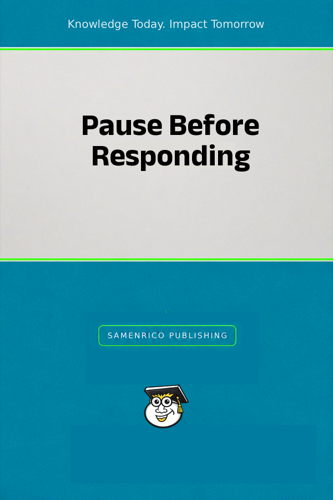
Pause Before Responding eBook
undefined
by Sales Lashay
undefined
Formats
Free sample
Chapter 1: The Millisecond Monster--–- You are not in control of your mouth. For the first half-second after any trigger, you are a reptile with a smartphone. The limbic system doesn’t care about your values, your reputation, or your New Year’s resolution to “communicate better.” It cares about surviving a tiger. Except there is no tiger. There’s just a passive-aggressive email from Karen in accounting.
And you just sent back: “Per my last email…” Congratulations. You have been hijacked.This is the opening reality check of Pause Before Responding. Before we build any skills, before we learn a single technique, we must first confront an uncomfortable truth: the gap between what happens to you and how you respond is far smaller than you think. In fact, neuroscientists have measured it. The moment a trigger occurs—a critical comment, a sudden interruption, a memory that springs out of nowhere—your amygdala (the brain’s smoke detector) can initiate a full-body reaction in as little as 74 milliseconds.
That is faster than the blink of an eye. By the time you feel angry, your body has already been angry for nearly a tenth of a second. By the time you speak, your nervous system has already decided what to say before your conscious mind has even been notified.This chapter is about naming the enemy. We call it the Millisecond Monster—not because it is evil, but because it is ancient, automatic, and utterly indifferent to your goals. The Millisecond Monster is the name we give to the reactivity loop: the lightning-fast sequence of trigger → amygdala activation → physical arousal → automatic reaction.
It evolved to save your ancestors from saber-toothed cats. It works just as hard to save you from… a slightly raised eyebrow from your partner. And that is the problem. The monster cannot tell the difference between a life-threatening predator and a text message left on read. To the limbic system, both are emergencies.
Both require immediate action. Both bypass your better judgment.By the end of this chapter, you will understand exactly how the Millisecond Monster operates inside your own nervous system. You will learn the critical distinction between a reaction (automatic, emotional, often regretted) and a response (chosen, values-aligned, deliberate). And you will complete your first guided practice—not yet a full pause, but the foundation upon which all pauses are built: interoceptive awareness, the skill of noticing the physical precursors to a reaction before it explodes out of your mouth. This single skill, practiced daily, is the first chisel mark against the monster’s armor.The 74-Millisecond Hijack Let us walk through what actually happens inside your brain during a trigger.
You are having a calm conversation with your partner about weekend plans. They say, “You never listen to me.” Four words. Harmless on the surface. But your brain does not process these words as harmless. It processes them as data, and that data runs through a series of filters before it reaches your conscious awareness.First, your auditory cortex registers the sound.
That takes about 10 milliseconds. Then, within another 20 milliseconds, the information is shunted to the amygdala. The amygdala does not analyze nuance. It does not consider context. It does not ask, “Is my partner tired?
Did they have a bad day? Are they using hyperbole for emphasis?” The amygdala asks one question, and one question only: Is this a threat?If the answer is even remotely “maybe,” the amygdala hits the alarm. It sends a signal to your hypothalamus, which activates your sympathetic nervous system. Within 40 more milliseconds, your adrenal glands release adrenaline and cortisol. Your heart rate accelerates.
Your breath becomes shallow. Blood shifts away from your prefrontal cortex (the thinking brain) and toward your large muscle groups (for fighting or fleeing). Your pupils dilate. Your digestion slows. By the time your conscious mind catches up—at roughly 300 to 500 milliseconds—you are already in a state of physiological readiness for combat.And what triggered this full-body war mobilization?
Four words: “You never listen to me.” There is no tiger. There is no physical danger. But your nervous system does not know that. It only knows that a pattern has been detected: criticism. And for most human beings, criticism is filed under “potential social threat,” which the brain treats almost identically to a physical threat.This is the Millisecond Monster in action.
It is fast. It is powerful. And it is completely indifferent to the long-term consequences of what you say or do next. Your partner may have been about to say, “You never listen to me when I’m talking about my mother, but I know you’re trying.” You will never hear that sentence, because you interrupted them in your head at 200 milliseconds and snapped back, “That’s not true!” by 600 milliseconds. The conversation is now a fight.
The monster has won.Reaction vs. Response: The Fundamental Distinction Throughout this book, we will use two words with very specific meanings. They are not interchangeable, and learning to tell them apart in real time is the entire point of the practice.A reaction is automatic, emotional, and driven by the limbic system. It happens to you rather than being chosen by you. Reactions are fast (milliseconds to a few seconds).
They are often followed by regret. They tend to escalate conflict rather than resolve it. And they are highly stereotyped—meaning your reactive patterns look remarkably similar each time. If you tend to snap sarcastically when criticized, you will snap sarcastically 90 percent of the time. If you tend to shut down and go silent, you will go silent.
The monster has a favorite weapon, and it uses the same one every time.A response, by contrast, is chosen, values-aligned, and driven by the prefrontal cortex. Responses are slower (seconds to minutes to hours). They require a pause—even a tiny one. They tend to de-escalate conflict or at least prevent escalation. And they are flexible: a response can change based on context, because the prefrontal cortex can consider nuance in ways the amygdala cannot.Here is a concrete example.
Your child spills juice on the carpet five minutes before guests arrive. A reaction might be: “What is wrong with you? I told you not to bring juice in here!” The words come out before you have even decided to speak. Your child cries. You feel guilty.
The guests arrive to chaos.A response might be: You feel the surge of anger in your chest. You notice your jaw tightening. You take one breath. You say, “Oh no, we have a spill. Grab some paper towels while I get the stain spray.” The words are chosen.
The anger is still there—you haven’t suppressed it—but you have not let it drive the bus. Your child learns how to handle mistakes calmly. The mess gets cleaned. The guests arrive to a parent who seems grounded, not hysterical.Same trigger. Different outcome.
The only difference is a pause. Not a long pause. Not a meditation retreat. A pause measured in seconds—sometimes less than two seconds. But in that pause, you moved from the fast, reactive limbic system to the slower, more deliberate prefrontal cortex.…
This is the end of the free sample. Get the eBook to keep going. Buy now
About this book
Details
- Author
- Sales Lashay
- Publisher
- SamEnrico
- Language
- English
- Genre
- Non-Fiction, Self-Help / Pause
- Released
- 2026-06-07
- Pages (approx.)
- 152
- Available as
- eBook, Audiobook

Read better in the ZLOADR app
Your eBooks on your phone or tablet. Sign in with your SamEnrico account and start reading.
More by Sales Lashay
 Senior Companion ProgramSales Lashay$11.99
 Loneliness Recovery Using Bumble BFFSales Lashay$11.99
 NYC Holiday Pop UpsSales Lashay$11.99
 Workplace Sleep RecoverySales Lashay$11.99
 Morning Exercise RoutineSales Lashay$11.99
 Grit for MarketersSales Lashay$11.99
 Cross-Functional Creativity GuideSales Lashay$11.99
 The Pistol Prince of Eton: The 18th Century Shooting Scandal That Shook the British EliteSales Lashay$11.99
 The Gates of Susa: Darius the Great's Empire in FlamesSales Lashay$11.99
 Service Providers Guide to Employment AgenciesSales Lashay$11.99
 How to Start a Coin Operated Games Business (Beginners Guide)Sales Lashay$11.99
 How to Produce a Lawn MowerSales Lashay$11.99