
Non-FictionBiographyBiochemistry
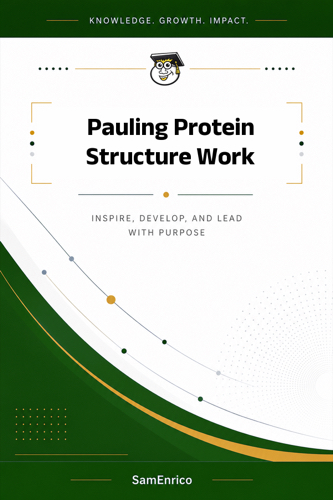
Pauling Protein Structure Work eBook
Explains alpha helix and beta sheet discoveries.
by Tolbert Kati
Explains alpha helix and beta sheet discoveries.
Formats
Free sample
Chapter 1: The Linear Cage...--–- In the winter of 1948, a young biochemist named Dorothy Wrinch stood before a blackboard at the University of Cambridge, drawing what looked like a child’s interpretation of a honeycomb. Her diagram consisted of interlocking hexagons, each representing a cage of amino acids linked by impossible bonds. She called it the cyclol hypothesis, and for nearly a decade, it was the most famous wrong idea in biology. Wrinch was brilliant, mathematically trained, and relentless. She had graduated from Cambridge with a doctorate in philosophy—not biology—and she approached the protein problem the way a pure geometer might approach a tiling puzzle.
Proteins, she argued, must fold into regular, repeating, cage-like structures. The cyclol was elegant. It was symmetrical. It was, unfortunately, physically impossible.Yet Wrinch’s failure was not a waste. It proved something essential: the scientific community had become desperate.
By the late 1930s, biochemists had sequenced a few short proteins. They knew that proteins were chains of amino acids, but they had no idea how those chains folded into the three-dimensional machines that carried oxygen, fought infection, and built tissues. The dominant assumption of the era—what historians would later call the “linear dogma”—held that if you knew the sequence of amino acids, you essentially knew the protein. This was a comforting fiction, but a fiction nonetheless. A string of beads does not explain why a needle sews or a sword cuts.
Shape mattered, and shape was a mystery.The cyclol hypothesis failed because Wrinch prioritized mathematical elegance over chemical reality. Her cages required bond angles that violated the basic rules of organic chemistry. Carbon atoms cannot bend into pretzels. Yet the cyclol dominated protein science for nearly a decade because no one had a better answer. It appeared in textbooks.
It inspired experiments. It wasted years of effort. And then, in 1939, a thirty-eight-year-old chemist from Pasadena published a book that would quietly dismantle the cyclol and everything it represented. That book was The Nature of the Chemical Bond, and its author was Linus Pauling.The Fog Before the Dawn To understand what Pauling accomplished, one must first understand the fog through which he saw. In the 1930s and 1940s, structural biology did not exist as a discipline.
There were crystallographers who took X-ray photographs of protein crystals, producing patterns of spots that contained information about atomic arrangements—but interpreting those patterns required solving complex equations that were, for all practical purposes, unsolvable. There were biochemists who could digest proteins into their constituent amino acids, revealing sequences but not shapes. And there were physical chemists like Pauling who understood quantum mechanics but had never held a protein in their hands. The three groups barely spoke to one another.The central problem was this: proteins are invisible. Even the most powerful electron microscopes of the era could not resolve individual atoms.
X-ray crystallography offered a workaround—crystals diffract X-rays, producing patterns that encode atomic coordinates—but the mathematics of decoding those patterns (Fourier transforms) was so laborious that a single protein structure could take a decade to solve. By the late 1940s, only a handful of small protein structures had been determined, and none of them revealed the underlying rules of folding.Into this gap poured theories. Some, like Wrinch’s cyclol, were mathematically elegant but chemically absurd. Others were merely vague: proteins, some scientists suggested, might fold like crumpled paper, randomly and irreproducibly. Still others proposed that proteins were essentially featureless colloids, their shapes determined by solvent conditions rather than internal rules.
The one thing everyone agreed upon was that proteins were important. No one agreed on how they worked.The Man Who Read the Fine Print Linus Pauling was not a biologist. He had never taken a course in biochemistry. His doctorate was in chemical engineering, and his early work focused on the quantum mechanical nature of chemical bonds—a subject so abstract that it seemed to have no connection to the messy world of living things. But Pauling possessed a rare combination of traits: a photographic memory for numerical data, an almost arrogant confidence in his own physical intuition, and a willingness to ignore disciplinary boundaries.
He read papers from crystallography, organic chemistry, and physiology with equal attention, and he remembered every bond length and angle he encountered.By the late 1930s, Pauling had become convinced that the protein-folding problem was not a biological problem at all. It was a problem of geometry constrained by physics. If you knew the precise bond lengths and angles of the amino acids (the building blocks of proteins), and if you knew how those amino acids linked together (via the peptide bond), then the possible folds of a protein chain were not infinite. They were limited by the laws of quantum mechanics and thermodynamics. The question was not “How does a protein fold?” The question was “Which folds are physically possible?”This perspective—reductionist, almost austere—set Pauling apart from nearly everyone else in the field.
Most biologists thought about proteins in terms of function: this protein carries oxygen, that one digests food, a third fights infection. Pauling thought about them in terms of geometry: this bond has a length of 1.32 angstroms, that angle is 123 degrees, and if you try to bend it further, the electron clouds will repel. He was not trying to explain life. He was trying to explain matter. And he suspected that if he could explain the matter correctly, the life would take care of itself.The Planar Peptide Bond: The Keystone The first breakthrough came in the late 1940s, from a collaboration between Pauling and a meticulous crystallographer named Robert Corey.
Corey was Pauling’s opposite in temperament: slow, cautious, painstaking, and obsessed with accuracy. While Pauling generated hypotheses at a dizzying rate, Corey tested them with a patience that bordered on monastic. Together, they solved the crystal structures of a series of simple molecules—glycine, alanine, the dipeptide glycylglycine—each one a stepping stone toward the protein chain.What they discovered was deceptively simple, and it changed everything. The bond that links one amino acid to the next—the peptide bond—is not a single bond, free to rotate like a hinge. It is a partial double bond, rigid and flat.
The carbon, nitrogen, and associated oxygen atoms all lie in the same plane. This planarity, which Pauling predicted from quantum mechanical principles and Corey confirmed with X-ray crystallography, meant that the protein chain was not a flexible string. It was a series of flat, rigid planes connected by swivels. The chain could bend only at the alpha carbon atoms, and those bends were constrained by the need to maintain stable hydrogen bonds.This discovery, published in a series of papers between 1947 and 1950, was the keystone of Pauling’s entire approach. If the peptide bond were free to rotate, the number of possible protein folds would be astronomically large—effectively infinite, with no predictable patterns.
But the planar peptide bond cut that number down dramatically. The chain could no longer twist arbitrarily. It had to fold in ways that respected the flatness of the peptide units. And that constraint, Pauling realized, pointed toward repeating, regular structures.The…
This is the end of the free sample. Get the eBook to keep going. Buy now
About this book
Details
- Author
- Tolbert Kati
- Publisher
- SamEnrico
- Language
- English
- Genre
- Non-Fiction, Biography, Biochemistry
- Released
- 2026-06-06
- Pages (approx.)
- 114
- Available as
- eBook, Audiobook

Read better in the ZLOADR app
Your eBooks on your phone or tablet. Sign in with your SamEnrico account and start reading.
More by Tolbert Kati
 Reducing Emotional IntensityTolbert Kati$11.99
 Persuasive Sales ScriptsTolbert Kati$11.99
 NASCAR Overtaking MasteryTolbert Kati$11.99
 Media ExploitationTolbert Kati$11.99
 Self Esteem for Large NosesTolbert Kati$11.99
 Herbal Cigarette AlternativeTolbert Kati$11.99
 Solo Travel Divorce GuideTolbert Kati$11.99
 The Algorithm & The Oracle: How a Teen’s Code Reshaped Human ConnectionTolbert Kati$11.99
 The Forgotten Gridiron: Britain’s 18th-Century Football Pioneers and the Birth of Modern AthleticsTolbert Kati$11.99
 A Collector's Handbook to the BMW 2002 CabrioletTolbert Kati$11.99
 10 Ways to Use Apple Juice (Recipe Book)Tolbert Kati$11.99
 VAT Registration for New BusinessTolbert Kati$12.99
You may also like
 Hong Kong Handover 1997Dunn Johnnie$11.99
 Zumba For Postnatal Recovery CourseNeal Christian$11.99
 Zumba for BeginnersLadner Nikia$11.99
 YouTube Comment Mining GuideHumes Pandora$12.99
 Worry Box MeditationCarlin Rudy$11.99
 Workplace Stress MeditationNguyen Lynn$11.99
 Workplace Stress and Sleep RepairHawley Ivory$11.99
 Workplace Perfectionism CureDelaney Jeffry$11.99
 Workplace Injustice Anger GuideWallen Isabelle$11.99
 Work Addiction and Burnout LinkGreenwood Ester$11.99
 Women in Yoga and WellnessBeattie Galina$11.99
 Women in Stand Up ComedyChun Evangeline$11.99