
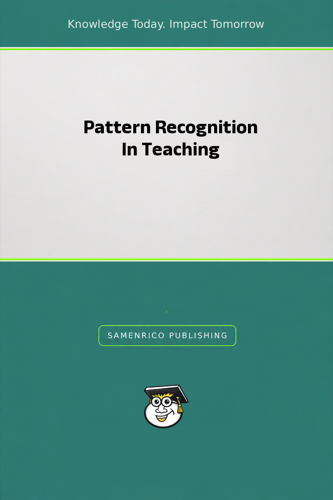
Pattern Recognition In Teaching eBook
Identify student misconceptions by detecting error
Identify student misconceptions by detecting error patterns.
Formats
Free sample
Chapter 1: The Grading Lie--–- Every week, millions of teachers around the world perform a ritual that is deeply familiar, utterly exhausting, and almost completely useless for actual teaching. They take a stack of student papers. They read each answer. They mark some as correct and others as incorrect. They tally the points.
They write a score at the top—maybe a letter grade if they are feeling generous—and then they hand the stack back to the students, who glance at the score, crumple the paper into their backpacks, and forget everything about it within eleven seconds.This is the Grading Lie. It is the assumption that the primary purpose of evaluating student work is to assign a score that reflects what the student knows. And it is a lie not because the score is inaccurate—though often it is—but because the score tells you almost nothing about how to actually teach the student next.Consider two students. Student A solves twenty fraction addition problems and gets fourteen correct, six incorrect. Student B solves the same twenty problems and gets exactly the same score: fourteen correct, six incorrect.
According to traditional grading, these two students have the same understanding of fractions. They both receive a 70%, a C, a "proficient" checkmark on the standards-based rubric.But here is what the score hides. Student A's six incorrect answers are random: sometimes she adds numerators, sometimes she adds denominators, sometimes she multiplies by accident, sometimes she just writes a guess. There is no pattern. Student B's six incorrect answers, however, are perfectly systematic.
Every single one is a fraction addition problem where the two denominators are different, and in every single case, Student B adds the numerators and adds the denominators: 1/2 + 1/3 = 2/5, 3/4 + 1/2 = 4/6, 2/5 + 1/3 = 3/8. The pattern is flawless. Student B has constructed a rule: to add fractions, add the top numbers and add the bottom numbers. It is a wrong rule, but it is a rule.These two students do not have the same understanding. Student A is confused, inconsistent, and has no stable mental model.
Student B has a clear, logical, internally consistent mental model that happens to be incorrect. The first student needs a complete rebuild of fraction concepts. The second student needs a single surgical intervention that targets one specific misconception. But if you are only looking at scores—fourteen out of twenty, 70%, a C—you cannot tell the difference. The score has lied to you.The Diagnostic Window This book is built on a single premise: every wrong answer is a diagnostic window into the student's mind.
Not a failure. Not a deficit. Not evidence of laziness or lack of ability. A window. Behind that window is a student who is trying to make sense of the world using the tools they have.
Sometimes those tools are incomplete. Sometimes they are being applied in the wrong context. Sometimes they have been constructed incorrectly from the beginning. But the student is always doing something logical—something that makes sense to them, given what they believe to be true.This is not a feel-good platitude. It is a rigorously researched cognitive phenomenon.
Drawing on the foundational work of Ryan and Williams in their study of children's mathematics from ages four to fifteen, we now understand that what teachers call "mistakes" are almost always what researchers call "intelligent generalizations." A child who writes 1/2 + 1/3 = 2/5 is not being stupid. They have correctly learned that when you add whole numbers, you add the digits. They have correctly noticed that when you write a fraction, there are two numbers. They have made a logical leap: adding fractions probably works the same way as adding whole numbers, using both numbers. The generalization is intelligent.
It is just applied to the wrong domain.A Brief History of How We Got Here To understand why most teachers are trained to ignore diagnostic windows, we need to understand the history of educational assessment. In the early twentieth century, standardized testing emerged from the field of psychometrics—the science of measuring mental capacities. The goal was efficiency. Researchers like E.L. Thorndike wanted to measure thousands of students quickly and objectively.
The multiple-choice test was born. And with it, the assumption that a correct answer is a correct answer, regardless of how the student arrived at it.This assumption was never true. A student can get the right answer for the wrong reason. A student can guess correctly on a multiple-choice question while understanding nothing. A student can solve 1/2 + 1/3 correctly by memorizing a procedure ("find the common denominator, convert, add") without having any idea why that procedure works.
That student will pass the test and then fail every subsequent unit that depends on fraction understanding—which is almost all of middle and high school mathematics.But the psychometric tradition left a deep imprint on teacher training. Most teacher preparation programs spend dozens of hours on how to design assessments, how to calculate grades, how to use rubrics, and how to interpret standardized test scores. They spend almost no time on how to look at a wrong answer and see a pattern. The result is that teachers enter the classroom armed with red pens and grading scales, but completely unequipped to do the one thing that matters most: diagnose what their students actually understand.The Clinical Interview: A Better Way There is an alternative, and it comes from a completely different intellectual tradition: the clinical interview. Pioneered by the Swiss psychologist Jean Piaget and refined by generations of mathematics education researchers, the clinical interview is a one-on-one conversation in which the teacher asks the student to explain their thinking without interruption, correction, or judgment.
The goal is not to teach. The goal is to understand.Here is what a clinical interview sounds like in practice. The student has written 1/2 + 1/3 = 2/5. Instead of marking it wrong and moving on, the teacher sits next to the student and asks: "Talk me through how you solved this."The student might say: "I added the top numbers, one plus one is two. And I added the bottom numbers, two plus three is five.
So it's two fifths."The teacher then asks: "Does that rule always work?"The student thinks for a moment. "Yeah. For all fractions."The teacher asks: "What about one half plus one half? Does your rule work for that?"The student computes: one plus one is two, two plus two is four. Two fourths.
Then their face changes. "Wait. That's not right. One half plus one half is one whole. Not two fourths."The teacher has not corrected the student.
The teacher has not provided the right answer. The teacher has simply asked a question that creates cognitive conflict—a moment where the student's own rule produces a contradiction. And in that moment, the student has become open to learning. They have discovered, on their own, that their rule is incomplete.This is the power of the diagnostic window. It turns a wrong answer from an endpoint into a starting point.
It transforms the teacher from a grader into a clinical interviewer. And it opens up the possibility of teaching that is precise, efficient, and respectful of the student's intelligence.Why This Book Is Different There…
This is the end of the free sample. Get the eBook to keep going. Buy now
About this book
Details
- Author
- Paquette Savanna
- Publisher
- SamEnrico
- Language
- English
- Genre
- Non-Fiction, Self-Help, Teaching
- Released
- 2026-06-11
- Pages (approx.)
- 135
- Available as
- eBook, Audiobook

Read better in the ZLOADR app
Your eBooks on your phone or tablet. Sign in with your SamEnrico account and start reading.
More by Paquette Savanna
 The Environmental Purchase IntentPaquette Savanna$11.99
 Listening to Elderly Parents and GrandparentsPaquette Savanna$11.99
 Elder Care Benefit GuidePaquette Savanna$11.99
 Pre Workout Meal GuidePaquette Savanna$11.99
 Social Anxiety Conversation GuidePaquette Savanna$11.99
 Morning Routine Journal PromptsPaquette Savanna$11.99
 Remote Daily Shutdown RitualPaquette Savanna$11.99
 The Bookstore That Defied the Dictators: How a Bogotá Café Became a Beacon of ResistancePaquette Savanna$11.99
 Kali's Shadow: The Dark Mother and the Dance of DestructionPaquette Savanna$11.99
 A Collector's Handbook to the Mercedes-benz 250cePaquette Savanna$11.99
 Service Providers Guide to Home Plan DesignersPaquette Savanna$11.99
 How to Start a Metal Frameworks for Blast Furnaces Business (Beginners Guide)Paquette Savanna$11.99
You may also like
 Teacher Student Anger GuideHagan Davina$11.99
 Chunking for TeachersSherrill Marshall$11.99
 Teacher Growth Mindset GuideHammons Jovan$11.99
 Flow in TeachingSnipes Toccara$11.99
 Educational Lecture SkillsAlbright Mandi$11.99
 Teaching Improv GuideSargent Kathaleen$11.99
 Teacher Breath GuideHerzog Warner$11.99
 Flow State for TeachersMontez Susannah$11.99
 Fear Of Failure In TeachingCerda Drucilla$11.99
 Breath for TeachersStephens Jasmine$11.99
 Teaching Self Talk for EducatorsTorrence Ena$11.99Teaching Self Talk for EducatorsTorrence Ena$11.99