
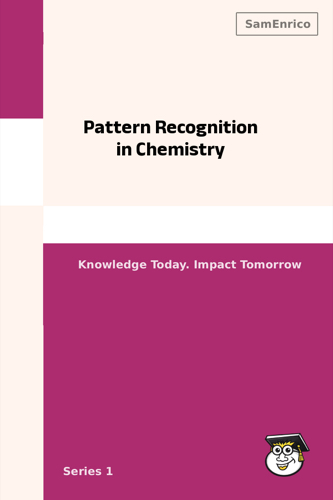
Pattern Recognition in Chemistry eBook
Spot periodic trends and reaction mechanisms easil
Spot periodic trends and reaction mechanisms easily.
Formats
Free sample
Chapter 1: The Chemical Glitch--–- Every aspiring chemist knows the feeling. You stare at a page filled with lines, numbers, and arrows—an NMR spectrum, a multi-step mechanism, a periodic table dense with data—and your brain freezes. The symbols are familiar. You memorized the definitions. But somehow, the expert sitting next to you glances at the exact same page and immediately says, “Oh, that’s clearly an aldehyde, and the mechanism is nucleophilic addition followed by proton transfer.” You stare harder.
You still don’t see it.This gap between novice and expert is not about intelligence. It is not about how many hours you studied or how many flashcards you drilled. It is about something far more specific and far more trainable: pattern recognition.This book exists because of one simple truth that most chemistry textbooks never say out loud: expert chemists do not solve problems by reasoning through first principles every single time. They do not calculate every p Ka from scratch. They do not derive every NMR splitting pattern from the Schrödinger equation.
Instead, they have trained their brains to see visual signatures, logical families, and predictable electron choreography so efficiently that the answer appears to them almost instantly. They have built what cognitive scientists call an “internal library” of chemical archetypes. And the central argument of this book is that you can build that same library—faster than you think—without memorizing a single additional fact.But before you can build that library, you need to understand why your current approach feels so difficult. You need to see the glitch in how most students are taught to think about chemistry. And you need a roadmap for replacing that glitch with a system that actually works.The Memorization Trap Most introductory chemistry courses are taught backwards.
They present the periodic table as a grid of numbers to memorize. They present spectroscopy as a list of peaks to recall. They present reaction mechanisms as sequences of arrows that must be committed to memory for each individual reaction. This approach creates a fragile kind of knowledge. It works well enough for the first exam, when you have memorized twenty facts.
It begins to crack by the second exam, when you have memorized fifty. And it collapses entirely by the final, when you are expected to recognize patterns across a hundred different reactions and spectra.Here is the glitch: human brains are not designed for brute-force memorization of disconnected facts. They are designed for pattern matching. Your brain can learn to recognize a familiar face in a fraction of a second, not because you memorized the exact position of every pore on that face, but because your visual cortex has built a neural template for “friend.” Your brain can learn to understand spoken language at hundreds of words per minute, not because you memorized every possible sentence in advance, but because you internalized the patterns of grammar, syntax, and vocabulary.Chemistry is no different. The expert who glances at an NMR spectrum and says “aldehyde” is not counting protons or calculating coupling constants.
She has seen so many aldehydes that the 9–10 ppm signal has become as recognizable as the face of a close friend. The expert who looks at a reaction and predicts the product is not reasoning step by step through every possible pathway. He has internalized the four basic moves of electron flow so deeply that they feel like instinct.The problem is that most textbooks never teach you how to build these neural templates. They give you the facts—the p Ka values, the chemical shifts, the arrow-pushing rules—but they leave you to discover pattern recognition on your own, through painful trial and error. This book closes that gap.
Every chapter is designed to train your chemical eye deliberately, systematically, and without wasted effort.What Pattern Recognition Actually Means Before we go further, we need a precise definition. Pattern recognition in chemistry is the ability to identify meaningful regularities in chemical data—whether that data is a periodic table, a spectrum, or a mechanism—without conscious, step-by-step reasoning. It is what allows you to look at a molecule and instantly know which proton is most acidic. It is what allows you to glance at a reaction coordinate diagram and predict whether the kinetic product or the thermodynamic product will dominate. It is what allows you to see a carbonyl stretch at 1700 cm⁻¹ and immediately think “nucleophilic attack possible here.”Pattern recognition operates at three levels, and this book trains all of them:Level 1: Visual Signatures.
These are the raw sensory patterns that your brain learns to detect automatically. A sharp peak at 1700 cm⁻¹ in an IR spectrum. A doublet of doublets in an NMR spectrum. The shape of the s-block, p-block, d-block, and f-block on the periodic table. These are the chemical equivalent of recognizing the letter “A” in a printed font—you do not sound out its features; you just see it.Level 2: Logical Families.
These are the conceptual groupings that allow you to generalize from one example to an entire class. Recognizing that lithium behaves like magnesium (the diagonal relationship) rather than like its Group 1 neighbor cesium. Recognizing that hard electrophiles (small, highly charged) react differently from soft electrophiles (large, polarizable). These families allow you to predict the behavior of an element or compound you have never seen before, simply because it belongs to a family you already understand.Level 3: Predictive Choreography. This is the highest level of chemical pattern recognition—the ability to see electron flow as a dance with a limited set of moves.
Instead of memorizing two hundred individual reaction mechanisms, you learn the four basic moves (nucleophilic attack, loss of leaving group, proton transfer, rearrangement) and how they combine. Every mechanism, no matter how complex, is just these moves in a specific sequence. Once you see that choreography, you no longer need to memorize mechanisms. You simply read them.The Signal vs. The Noise One of the most important skills in pattern recognition is learning to ignore irrelevant information.
Every spectrum contains artifacts. Every reaction has side products. Every mechanism has steps that cancel out or never occur under the conditions given. Novices try to explain everything they see; experts know what to ignore.This is called differentiating signal from noise, and it is the first skill this book will train. Consider an NMR spectrum of a typical organic molecule dissolved in CDCl₃.
The spectrum contains the solvent peak (chloroform at 7.26 ppm), possibly a water peak (around 1.5 ppm), and sometimes trace impurities from the NMR tube or the synthesis. A novice sees all of these peaks and tries to assign every single one to the molecular structure. The expert glances at the spectrum, mentally deletes the solvent peak, ignores the water, recognizes the impurity as grease from the lab, and focuses only on the peaks that actually come from the molecule.Similarly, when you look at a reaction mechanism drawn with curved arrows, you will see many arrows. But only a subset of those arrows represents bond-forming or bond-breaking events that determine the product distribution. The others might be proton transfers that happen automatically in protic solvents…
This is the end of the free sample. Get the eBook to keep going. Buy now
About this book
Details
- Author
- Lindquist Cleopatra
- Publisher
- SamEnrico
- Language
- English
- Genre
- Non-Fiction, Self-Help, Chemistry
- Released
- 2026-06-09
- Pages (approx.)
- 160
- Available as
- eBook, Audiobook

Read better in the ZLOADR app
Your eBooks on your phone or tablet. Sign in with your SamEnrico account and start reading.
More by Lindquist Cleopatra
 The Ten Minute Meditation ManualLindquist Cleopatra$11.99
 GH and Metabolic AgingLindquist Cleopatra$11.99
 Parenting Stress for Stay at Home MomsLindquist Cleopatra$11.99
 China Sourcing Agents for Small Dropshipping VolumesLindquist Cleopatra$12.99
 How to Produce BrakesLindquist Cleopatra$11.99
 How to Start a Area Operation Business (Beginners Guide)Lindquist Cleopatra$11.99
 CounselorLindquist Cleopatra$11.99
You may also like
 Hong Kong Handover 1997Dunn Johnnie$11.99
 Zumba For Postnatal Recovery CourseNeal Christian$11.99
 Zumba for BeginnersLadner Nikia$11.99
 YouTube Comment Mining GuideHumes Pandora$12.99
 Worry Box MeditationCarlin Rudy$11.99
 Workplace Stress MeditationNguyen Lynn$11.99
 Workplace Stress and Sleep RepairHawley Ivory$11.99
 Workplace Perfectionism CureDelaney Jeffry$11.99
 Workplace Injustice Anger GuideWallen Isabelle$11.99
 Work Addiction and Burnout LinkGreenwood Ester$11.99
 Women in Yoga and WellnessBeattie Galina$11.99
 Women in Stand Up ComedyChun Evangeline$11.99