
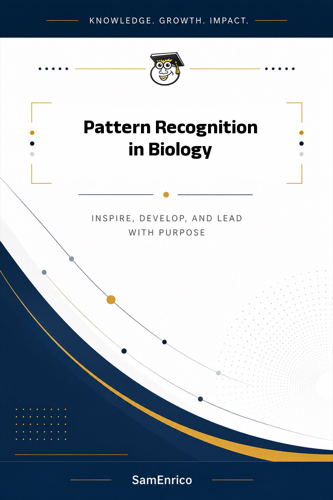
Pattern Recognition in Biology eBook
Recognize taxonomic ranks and physiological cycles
by Gale Quiana
Recognize taxonomic ranks and physiological cycles.
Formats
Free sample
Chapter 1: The Detective Within--Every human being is a pattern recognition machine of staggering sophistication, yet almost no one knows how it works. You are using it right now. Your eyes are scanning these words, converting dark squiggles on a light background into meaning. Your brain is effortlessly ignoring the sensation of your clothes against your skin, the hum of any background noise, and the position of your tongue in your mouth—until I mentioned them, at which point your pattern recognition system dutifully flagged each as worthy of attention. You did not decide to do any of this.
It simply happened.That is the first and most important lesson of this book: pattern recognition is not something you do. It is something your biology does, constantly, whether you want it to or not. And once you understand how it works—at every scale from the molecules inside your cells to the ecosystems that surround you—you will see the living world differently. You will see the hidden order beneath apparent chaos. You will spot the signal in the noise.
And in some cases, you will see what everyone else has missed.Consider this: In 2014, a young woman walked into a hospital emergency department in Connecticut. She had a fever, a headache, and fatigue. The doctors ran the standard panel of tests. Everything came back negative. She was sent home with a diagnosis of "probable viral syndrome" and told to rest.Three days later, she was back.
This time she was confused, struggling to speak, and her blood pressure was dangerously low. A different physician noticed something the others had missed: the pattern of her fever spikes. They occurred like clockwork every 48 hours. He had seen that pattern once before, during a fellowship in West Africa. He ordered a specific test.
The woman had relapsing fever, caused by the bacterium Borrelia miyamotoi, a pathogen so rare in Connecticut that most doctors had never encountered a single case.The pattern was there. It was present on the first visit. Three physicians had looked at the same data and seen nothing. The fourth saw everything. What made the difference?
Not intelligence, not experience with rare diseases, not better equipment. The difference was that the fourth physician had been trained to recognize a specific temporal pattern: the two-day febrile cycle.That is what this book will teach you. Not medicine, not microbiology specifically, but the fundamental skill of seeing patterns in biological data. You will learn to recognize the signatures of species in fragments of DNA, the rhythms of health and disease in heartbeats and hormone pulses, and the hidden structures of ecosystems in networks of who-eats-whom. By the end, you will think like a biological detective.But before we can solve any mysteries, we need to understand what a biological pattern actually is—and why recognizing it is so much harder than you might think.The Three Lies Your Senses Tell You Your brain evolved to see patterns that were useful for survival on the African savanna.
It is excellent at spotting a lion hiding in tall grass, predicting where a thrown spear will land, and reading the emotional state of another human from the slightest twitch of facial muscles. But it is terrible at statistics, easily fooled by coincidences, and actively hostile to uncertainty.This creates a fundamental problem for anyone trying to do rigorous pattern recognition in biology. Your intuition will lie to you. Repeatedly. Systematically.
And the only defense is to replace intuition with method.Let me give you an example. Look at the following sequence of events: a person eats a bowl of yogurt every morning for a month. At the end of the month, they feel healthier. What is the pattern? Your brain screams that the yogurt caused the improved health.
That is a satisfying story. But maybe they also started sleeping better that month. Maybe they were recovering from a cold that lasted the first week. Maybe the "feeling healthier" is just the natural variation of human mood and the yogurt had nothing to do with it.Your brain does not want to consider these alternatives. It wants the simple, causal pattern.
This is called apophenia—the tendency to perceive meaningful patterns within random data—and it is the single greatest enemy of biological pattern recognition.The three specific ways your intuition will betray you are: heterogeneity, noise, and evolution. Understanding these three challenges is the foundation of everything that follows.Heterogeneity: The Problem of Apples and Oranges Biological data comes in forms so different that comparing them is like comparing a symphony to a skyscraper. A DNA sequence is a string of four letters (A, C, G, T) arranged in a linear chain. A microscope image is a grid of pixels, each with a color value. An ECG recording is a voltage changing over time.
A field observation of animal behavior is a categorical record of events.Each of these data types requires a completely different approach to pattern recognition. The mathematical tools that work brilliantly for DNA sequences—alignment algorithms, k-mer counting, substitution matrices—are meaningless when applied to images. The convolutional filters that extract features from photographs have no analog in time-series analysis.And yet, all of these data types are "biological patterns." A pattern is not a property of the data itself. It is a relationship within the data that carries information about the underlying biology. The same information—say, "this organism is a member of species X"—can be encoded in its genome, its shape, its electrical activity, or its behavior.
The pattern is invariant across these representations. The challenge is extracting it from each.This book will teach you to handle all of these data types, but more importantly, it will teach you to translate between them. By the time you finish Part II, you will understand how a pattern in a DNA sequence corresponds to a pattern in a fossil's skull shape. By the end of Part III, you will see how the 24-hour rhythm in a gene's expression is the same pattern as the 24-hour rhythm in a person's body temperature. The data are different.
The pattern is the same.Noise: The Signal That Hides in Static Every biological measurement contains error. This is not a bug. It is a feature. But it is a feature that makes your life difficult.There are two kinds of noise in biological data. The first is measurement noise: the instrument added something that wasn't there.
A DNA sequencer miscalls a base. An ECG electrode picks up interference from a nearby power line. A microscope lens has a smudge. This noise is random and, in principle, can be reduced by better equipment or statistical averaging.The second kind is much more insidious: biological noise. This is genuine variation that is not relevant to the pattern you are trying to find.
Two genetically identical mice raised in identical environments will have different body temperatures at any given moment. The same human, measured twice in the same minute, will have two slightly different heart rates. This is not measurement error. This is life.Biological noise follows statistical distributions, but they are rarely the nice, tidy normal…
This is the end of the free sample. Get the eBook to keep going. Buy now
About this book
Details
- Author
- Gale Quiana
- Publisher
- SamEnrico
- Language
- English
- Genre
- Non-Fiction, Self-Help, Biology
- Released
- 2026-06-10
- Pages (approx.)
- 142
- Available as
- eBook, Audiobook

Read better in the ZLOADR app
Your eBooks on your phone or tablet. Sign in with your SamEnrico account and start reading.
More by Gale Quiana
 Jim Crow Segregation LawsGale Quiana$11.99
 Meditation for Cynical BeginnersGale Quiana$11.99
 Working Parent Self Care GuideGale Quiana$11.99
 The Symphony of the Sun: Chevalier de Saint-Georges and the Birth of Classical BrillianceGale Quiana$11.99
 Ghana E-commerce Platforms and Dropshipping IntegrationGale Quiana$12.99
 How to Start a Production Riser Tie-back Equipment Business (Beginners Guide)Gale Quiana$11.99
 How to Produce BrandyGale Quiana$11.99
 Coworking Center ManagerGale Quiana$11.99
You may also like
 Hong Kong Handover 1997Dunn Johnnie$11.99
 Zumba For Postnatal Recovery CourseNeal Christian$11.99
 Zumba for BeginnersLadner Nikia$11.99
 YouTube Comment Mining GuideHumes Pandora$12.99
 Worry Box MeditationCarlin Rudy$11.99
 Workplace Stress MeditationNguyen Lynn$11.99
 Workplace Stress and Sleep RepairHawley Ivory$11.99
 Workplace Perfectionism CureDelaney Jeffry$11.99
 Workplace Injustice Anger GuideWallen Isabelle$11.99
 Work Addiction and Burnout LinkGreenwood Ester$11.99
 Women in Yoga and WellnessBeattie Galina$11.99
 Women in Stand Up ComedyChun Evangeline$11.99