
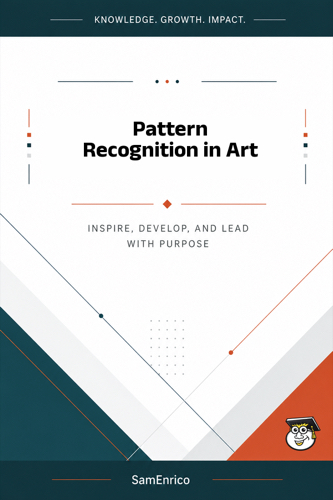
Pattern Recognition in Art eBook
undefined
by Godfrey Eve
undefined
Formats
Free sample
Chapter 1: The Coolhunter Within...--Your brain is a conspiracy theorist.Not the kind that haunts internet forums with laminated printouts and red string. The kind that cannot help itself. The kind that looks at a scattering of dots and sees a face. The kind that hears static and strains to find a melody. The kind that stares at a canvas covered in seemingly random drips and splatters and whispers, there is something in there.
This is not a flaw in your cognitive hardware. It is the feature. It is the reason you are reading this book instead of sitting on a savanna, trying not to be eaten by something with too many teeth.Pattern recognition is the oldest art form. It predates painting, predates language, predates humanity itself. The first creature that looked at a set of rustling leaves and perceived not just motion but a predator was practicing pattern recognition.
The first hominid that noticed that certain cloud shapes reliably preceded rain was practicing pattern recognition. The first artist who realized that a smear of charcoal could stand for a bison, and that a repeated curve could stand for a horn, was practicing pattern recognition. We are, all of us, walking pattern-detection engines wrapped in skin. And art—all art, from the caves of Lascaux to the infinite scroll of Tik Tok—is the conversation we have with ourselves about what those patterns mean.This book is about that conversation. It is about the geometry hidden in plain sight, the algorithms that see what you cannot, the cultural codes baked into every tile and textile, and the strange, beautiful fact that two people can look at the same painting and see utterly different things.
But before we get to any of that—before the mathematics of wallpaper groups, before the forensic gaze of neural networks, before the glitch and the fractal and the forgery—we have to understand the machine that makes it all possible. We have to understand you.The Brain’s Desperate Need for Order Let us begin with an uncomfortable truth. The world does not arrive in your consciousness as a tidy, well-labeled catalog of objects. It arrives as noise. Electromagnetic radiation of various wavelengths bounces off surfaces and hits your retina.
Your brain has to turn that into a coffee cup. Pressure waves travel through the air and vibrate your eardrum. Your brain has to turn that into the sound of rain. And somewhere in the messy middle, your brain has to decide what matters and what does not. It has to find the signal in the static.
It has to find the pattern.This is computationally absurd. By some estimates, the human visual system processes roughly ten million bits of information per second. Your conscious mind can handle about fifty. That means your brain is discarding 99.9995 percent of what your eyes take in. It is not trying to see everything.
It is trying to see what might be a pattern, what might be relevant, what might keep you alive or get you laid or help you find dinner. Everything else is noise. The brain is not a camera. It is a filter.And filters, by their nature, introduce bias.The Gestalt psychologists of the early twentieth century were among the first to map this filtering system systematically. They noticed that the brain does not process visual information piece by piece, like a computer reading a spreadsheet.
It processes it holistically, looking for wholes before parts. This is why you see a triangle in a set of three Pac-Man shapes oriented toward each other, even though no triangle is actually drawn. This is why you see a continuous line behind an obstruction, even though half of it is missing. Your brain completes. It closes.
It continues. These are not choices you make. They are reflexes.The Gestalt principles—closure, continuity, similarity, proximity, figure-ground—are the operating system of human vision. They are the rules your brain follows automatically, involuntarily, before you have any conscious say in the matter. And they are, at their core, pattern-recognition heuristics.
They are shortcuts. They are the brain saying, I don't have time to process every photon. I am going to assume that things that are close together belong together. I am going to assume that things that look similar are the same kind of thing. I am going to assume that the world is orderly enough that these shortcuts will work most of the time.Most of the time, they do.
When they do not, you get an optical illusion. And optical illusions are not curiosities. They are the shadow of your brain's pattern-recognition machinery at work. When you look at the famous rabbit-duck illusion and see first one, then the other, you are not seeing a flaw in your vision. You are seeing the pattern detector flipping between two equally plausible interpretations of the same sensory data.
The pattern is ambiguous. Your brain hates ambiguity. So it picks one. Then, if forced, it picks the other. But it never sees both at once.
It cannot. The machinery does not work that way.The Reward of Recognition Why does finding a pattern feel good?This is not a philosophical question. It is a neurochemical one. When your brain successfully predicts something—when it sees a pattern and uses that pattern to anticipate what comes next—it rewards itself with a small hit of dopamine. This is the same neurotransmitter involved in pleasure, motivation, and addiction.
You are, quite literally, addicted to finding patterns. Every time you solve a puzzle, every time you guess the punchline before the joke ends, every time you recognize a face in a crowd, your brain gives you a little pat on the head. Good job. You figured it out. Here is a cookie.This system evolved for survival.
Predicting where prey will be, predicting when the dry season will end, predicting which berry is safe to eat—these are not abstract intellectual exercises. They are life and death. The hominid who could see the pattern in the migration of the wildebeest ate. The one who could not, did not. Over hundreds of thousands of years, natural selection sculpted the human brain into a pattern-recognition machine of terrifying efficiency.
We do not just recognize patterns. We cannot stop recognizing patterns. Even when there are no patterns to recognize.This is why we see faces in clouds, in burnt toast, in the grain of wood paneling. This is why we hear hidden messages when records are played backward. This is why conspiracy theories are so seductive—they offer a pattern, a hidden order, a secret hand moving the pieces on the board.
The alternative—that the world is random, that bad things happen for no reason, that there is no pattern to find—is neurologically unbearable. Your brain would rather believe in a false pattern than believe in no pattern at all.The phenomenon has a name. It is called apophenia. The experience of seeing meaningful patterns in random or meaningless data. And it is not a disorder.
It is a design feature. Apophenia is the price we pay for a pattern-detection system that works as well as…
This is the end of the free sample. Get the eBook to keep going. Buy now
About this book
Details
- Author
- Godfrey Eve
- Publisher
- SamEnrico
- Language
- English
- Genre
- Non-Fiction, Self-Help / Art
- Released
- 2026-06-09
- Pages (approx.)
- 132
- Available as
- eBook, Audiobook

Read better in the ZLOADR app
Your eBooks on your phone or tablet. Sign in with your SamEnrico account and start reading.
More by Godfrey Eve
 Sexual Addiction and DepressionGodfrey Eve$11.99
 Empowerment Communication GuideGodfrey Eve$11.99
 Opioid Recovery and RelationshipsGodfrey Eve$11.99
 Gacy's Political ConnectionsGodfrey Eve$11.99
 FCPA Government Procurement CasesGodfrey Eve$11.99
 The Catholic Miracle ClaimsGodfrey Eve$11.99
 TM For TeenagersGodfrey Eve$11.99
 Depression Workplace FunctioningGodfrey Eve$11.99
 The Second Son of the Space Race: How Yuri Gagarin’s Brother Fought a Shadow WarGodfrey Eve$11.99
 The Frozen Code: Ancient Arctic DNA and the Secrets of the First PeoplesGodfrey Eve$11.99
 The Culper Spies: Washington's Shadow War in the RevolutionGodfrey Eve$11.99
 Advanced Forex Trade ManagementGodfrey Eve$11.99
You may also like
 Spouse Grief Art TherapyCardona Misti$11.99
 Caregiver Art TherapyCasillas Ulysses$11.99
 Joyful Art TherapyMoses Chance$11.99
 Procreate Artist ComparisonHarwell Becki$11.99
 Pet Loss Art TherapyEllington Crissy$11.99
 Goal Setting for ArtistsPond Morgan$11.99
 DeviantArt Followers ComparePearce Eldon$11.99
 Affirmations for ArtistsGoodwin Sheldon$11.99