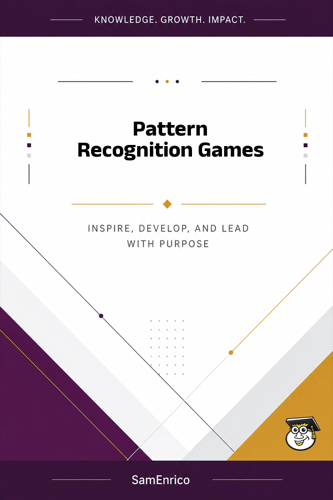
Pattern Recognition Games eBook
Practice spotting sequences with fun exercises usi
Practice spotting sequences with fun exercises using this workbook.
Formats
Free sample
Chapter 1: The Cognitive Gymnasium...--–- You are already a pattern recognition machine. You just don’t know it yet.Every morning, without thinking, you wake up and recognize the shape of your phone against your nightstand. You glance at your reflection and instantly know it’s you—not a stranger wearing your face. You hear the first three notes of a song and immediately hum the fourth. You read these words not as individual letters but as familiar shapes strung together in sequences your brain has seen thousands of times before.Pattern recognition is not a superpower reserved for geniuses, detectives, or chess grandmasters.
It is the operating system of your own mind.The problem is that most people never train this muscle deliberately. They rely on it constantly but strengthen it accidentally. The result is a brain that works well enough for everyday life but never reaches its potential for spotting connections, anticipating outcomes, or solving problems with elegance and speed.This chapter is your warm-up. Think of it as stretching before a workout—not the heavy lifting itself, but the essential preparation that prevents injury and primes your nervous system for performance. By the time you finish these pages, you will understand three things that will transform how you approach every puzzle in this book and every problem in your life.First, you will learn the crucial difference between looking and seeing.
Looking is passive. Your eyes capture light and send signals to your brain, but without active engagement, those signals remain raw data. Seeing is active. It is the process of asking questions, forming hypotheses, and searching for confirmation. The exercises in this chapter will force you to see, not merely look.Second, you will discover that every pattern has a hidden rule.
Your job is not to memorize sequences but to uncover the logic that generates them. Once you find the rule, prediction becomes effortless. Without the rule, you are just guessing.Third, you will establish a baseline. The self-assessment at the end of this chapter gives you a starting score. After completing all twelve chapters, you will return to a similar assessment and measure exactly how far you have come.
Progress is invisible without measurement. This chapter provides the ruler.Let us begin.The Myth of the Born Puzzle-Solver Every puzzle book you have ever seen makes the same implicit promise: "Some people are naturally good at this. Buy this book to become one of them." That promise is built on a lie.The truth is that no one is born knowing how to solve a Sudoku, recognize a hidden sequence, or spot the odd one out in a grid of shapes. These skills are learned. They are practiced.
They are built layer by layer, mistake by mistake, until what once felt impossible becomes automatic.Consider the game of chess. A grandmaster can look at a board for five seconds and remember the exact position of every piece. A beginner struggles to remember where the knights were placed a moment ago. This difference is not because the grandmaster was born with a photographic memory. It is because the grandmaster sees chunks—familiar patterns of pieces that repeat across thousands of games.
The beginner sees thirty-two individual objects. The grandmaster sees five or six meaningful clusters. The grandmaster has simply spent more time building the library of patterns stored in long-term memory.Your brain is not a computer that came pre-programmed with puzzle-solving software. It is a muscle that grows stronger with use. Every exercise you complete in this book physically changes your brain, strengthening connections between neurons and creating new pathways that make future pattern recognition faster and more efficient.
This is called neuroplasticity, and it is the single most important fact about your brain that most people never learn.The implication is liberating. You are not stuck with the puzzle-solving ability you have today. You can improve it. The exercises in this book are designed to produce measurable improvement in a matter of weeks. But the first step is believing that improvement is possible.
If you enter this chapter thinking "I have never been good at this kind of thing," you will unconsciously sabotage your own performance. If you enter thinking "I am about to train a skill that will serve me for life," you will succeed.So here is your first pattern recognition challenge, and it is the most important one in the entire book:Recognize the pattern of your own self-doubt and choose to ignore it.Looking vs. Seeing: The Active Eye Place a book on your desk. Look at it. What do you see?If you are like most people, you see a book.
That is looking. It requires almost no cognitive effort. Your brain identifies the object, matches it to a stored category ("book"), and moves on to the next thing.Now look again, but this time, ask questions. What color is the cover? Is the spine perfectly vertical or slightly tilted?
How many pages can you estimate from the thickness? Is the font serif or sans-serif? Does the title contain more vowels than consonants? Is the book closer to the left edge of the desk or the right? If you had to describe this book to someone who has never seen it, which three features would you choose?That is seeing.
It is active. It requires effort. And it is the fundamental skill upon which all pattern recognition is built.Most people walk through life looking at the world, not seeing it. They miss patterns because they never bother to look for them. They fail to notice that their coworker wears a blue shirt every Tuesday, that their coffee shop always runs out of almond milk by 10 a.m., that their child hums the same off-key note before asking a difficult question.
These patterns are not hidden. They are simply invisible to passive observation.The exercises in this chapter are designed to force you into active seeing. You will not be able to solve them by glancing and guessing. You will need to slow down, examine details, form hypotheses, and test them. This will feel uncomfortable at first.
That discomfort is the feeling of learning. Embrace it.One trick that expert puzzle-solvers use is to pretend they are explaining the pattern to someone who cannot see it. This forces you to articulate the rule in words, which clarifies your thinking. Try it now with a simple example. Look at this sequence: red, blue, red, blue, red, blue.
What comes next? You probably said red. But why? Explain it to an imaginary friend. "The pattern alternates between red and blue.
Since the last one was blue, the next must be red." That explanation—articulating the rule—is the difference between guessing and understanding.Throughout this book, whenever you feel stuck, pause and say out loud: "The rule might be..." Speaking the words forces your brain to organize scattered observations into a coherent hypothesis. It is a simple technique, but it works.What Is a Pattern, Really?Before we dive into exercises, we need a working definition. A pattern is a recurring structure or sequence that follows a predictable rule. That definition has three components…
This is the end of the free sample. Get the eBook to keep going. Buy now
About this book
Details
- Author
- Romano Malissa
- Publisher
- SamEnrico
- Language
- English
- Genre
- Non-Fiction, Self-Help, Brain Games
- Released
- 2026-06-07
- Pages (approx.)
- 142
- Available as
- eBook, Audiobook

Read better in the ZLOADR app
Your eBooks on your phone or tablet. Sign in with your SamEnrico account and start reading.
More by Romano Malissa
 Morning Commute Anger ControlRomano Malissa$11.99
 Meditation for AgoraphobiaRomano Malissa$11.99
 Postpartum Prolapse GuideRomano Malissa$11.99
 Operational Processes SummaryRomano Malissa$11.99
 Breast Pain Causes GuideRomano Malissa$11.99
 Constraints for StartupsRomano Malissa$11.99
 Boundary Setting for VeterinariansRomano Malissa$11.99
 The Silent Heist: How the Russian Mafia Hijacked Britain's HospitalsRomano Malissa$11.99
 The Poisoned Lovers: The Deadly Duet of the 19th CenturyRomano Malissa$11.99
 Chow-chows: The Fluffy Lion DogRomano Malissa$11.99
 A Collector's Handbook to the Triumph 1500 (1970-73)Romano Malissa$11.99
 How to Produce Packing OrganizersRomano Malissa$11.99