
Non-FictionSelf-HelpDisruption
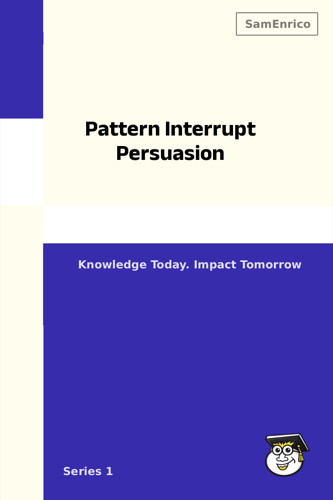
Pattern Interrupt Persuasion eBook
Breaks habitual thinking to make person receptive
by Babin Jude
Breaks habitual thinking to make person receptive to new ideas.
Formats
Free sample
Chapter 1: The Cognitive Miser...–- Imagine you are driving home from work. You have taken this same route four hundred times. The radio is playing. Your mind drifts to what you will make for dinner, the email you forgot to send, the argument you had this morning. Then you blink, and you are in your driveway.
You do not remember the last ten miles. You do not remember the stop signs, the turns, the other cars. Your body drove the car. Your brain was somewhere else.This is not a flaw. This is not a failure of attention.
This is your brain working exactly as evolution designed it.You are a cognitive miser.The term comes from the social psychologist Susan Fiske and the neuroscientist Shelley Taylor, who argued that human beings are not the rational, deliberate thinkers we like to believe we are. Instead, we are biological organisms optimized for energy efficiency. The human brain accounts for only two percent of body weight but consumes twenty percent of daily calories. Conscious thinking is metabolically expensive. So the brain cheats.
It takes shortcuts. It relies on habits, assumptions, and automatic routines. It spends as little energy as possible on any given moment, because conserving energy today might mean surviving a famine tomorrow.This chapter will introduce you to the fundamental problem that the rest of this book solves. You cannot interrupt a pattern you do not recognize. And right now, you are sleepwalking through most of your life.The Default Trance The "Default Trance" is the name I give to the low-awareness state where most people spend the vast majority of their waking hours.
In this state, you are not thinking. You are reacting. You are running scripts written by habit, culture, and biology. You are not making decisions. You are watching decisions happen.Here is a simple test.
Think about your morning today. From the moment your alarm went off to the moment you walked out the door, how many conscious decisions did you actually make? Did you choose to hit snooze, or did your thumb do it before you were aware? Did you choose what to wear, or did you reach for the same style of clothing you always wear? Did you choose breakfast, or did you eat the same thing you have eaten for the last three hundred mornings?Most people cannot recall more than three or four conscious decisions in their entire morning routine.
The rest was the Default Trance.This is not laziness. This is efficiency. If you had to consciously decide every micro-behavior of your morning, you would be exhausted before you left the house. The brain automates the routine so it can save energy for novel threats, unexpected opportunities, and genuine emergencies. The problem is that, for most of us, most of our day contains no novel threats.
So the brain stays in the Default Trance.The psychology professor John Bargh demonstrated this beautifully in a series of experiments on automaticity. In one study, participants were given a sentence unscrambling task. Some were given words related to old age: "Florida," "forgetful," "wrinkled," "gray." Others were given neutral words. After the task, the researchers measured how quickly participants walked down the hallway. Those who had been primed with old-age words walked significantly slower.
They did not know why. They did not notice the priming. The words had activated the concept of old age, which activated the behavior of walking slowly, all without conscious awareness.You are being primed, triggered, and automated every moment of every day. You just do not notice.System One and System Two To understand the Default Trance, we must understand the two operating systems of the human brain. The Nobel Prize-winning psychologist Daniel Kahneman made these concepts famous in his book Thinking, Fast and Slow, but the distinction predates him by decades.System One is fast, automatic, instinctive, and unconscious.
System One is what pulls your hand from a hot stove before you feel the pain. System One is what recognizes a friend's face in a crowd. System One is what tells you that a person with a loud voice and angry eyes is dangerous. System One runs continuously, behind the scenes, without your permission and without your awareness. It processes millions of pieces of sensory information every second and makes split-second judgments that determine your survival.System Two is slow, deliberate, logical, and conscious.
System Two is what you use to calculate a tip, to solve a crossword puzzle, to learn a new language. System Two is effortful. It requires energy. It gets tired. And most importantly, System Two is lazy.
It defaults to whatever System One tells it, unless something forces it to wake up.Here is the key insight for this book: System Two believes it is in charge. It is not.System One runs the show. System Two is the press secretary who explains the president's decisions after they have already been made. You have a thought, and then your conscious mind invents a reason for that thought. You feel an emotion, and then your conscious mind finds evidence to justify that emotion.
You make a choice, and then your conscious mind constructs a narrative about why you chose what you chose.This is called confabulation, and it happens constantly.Kahneman and his colleague Amos Tversky spent decades documenting the cognitive biases that result from System One's shortcuts. Confirmation bias: you seek information that confirms what you already believe and ignore information that contradicts it. Anchoring bias: your judgment is influenced by whatever number you happened to see first. Availability bias: you overestimate the likelihood of events that are easy to remember. The list goes on.
There are over one hundred documented cognitive biases. Each one is a pattern interrupt waiting to happen. Each one is a door into the Default Trance.The Psychological Cost of Alertness Why does the brain default to the Trance? Because staying alert is expensive.In a famous study of decision fatigue, the social psychologist Roy Baumeister and his colleagues asked participants to make a series of trivial choices before attempting a difficult puzzle. Some participants had to choose between things like "pen or pencil" and "black or blue ink." Others made no choices.
Then everyone tried to solve the puzzle. Those who had made trivial choices gave up significantly faster. The act of choosing, even about meaningless options, depleted their cognitive resources.This is why the Default Trance exists. Your brain is rationing attention like food in a famine. Every conscious decision draws from a limited account.
When the account runs low, you default to autopilot. The rich and powerful, who make hundreds of important decisions every day, often simplify their trivial choices to conserve energy. Barack Obama wore only gray or blue suits so he would not waste decision-making bandwidth on what to wear. Steve Jobs wore the same black turtleneck every day. This is not eccentricity.
This is cognitive economics.The problem is that most of us are not making high-stakes decisions. We are making low-stakes decisions constantly, draining our accounts, and then wondering why we feel exhausted by 3:00 PM. We are spending our cognitive currency on what…
This is the end of the free sample. Get the eBook to keep going. Buy now
About this book
Details
- Author
- Babin Jude
- Publisher
- SamEnrico
- Language
- English
- Genre
- Non-Fiction, Self-Help, Disruption
- Released
- 2026-06-10
- Pages (approx.)
- 153
- Available as
- eBook, Audiobook

Read better in the ZLOADR app
Your eBooks on your phone or tablet. Sign in with your SamEnrico account and start reading.
More by Babin Jude
 Stress and Cancer ProgressionBabin Jude$11.99
 Russian Mafia in SlovakiaBabin Jude$11.99
 Major Depressive Disorder and Cancer CareBabin Jude$11.99
 Carrying Grocery BagsBabin Jude$11.99
 Ovarian Cancer SurvivorBabin Jude$11.99
 Purpose for EngineersBabin Jude$11.99
 Middle Passage Religious JustificationsBabin Jude$11.99
 The Lost Armada: A New World ReckoningBabin Jude$11.99
 Kicks & Kings: How Sneakers Crowned a New RoyaltyBabin Jude$11.99
 How to Produce MakeupBabin Jude$11.99
 How to Produce Weed Trimmer Blades and SpoolsBabin Jude$11.99
 A Collector's Handbook to the Morgan CompetitionBabin Jude$11.99
You may also like
 Hong Kong Handover 1997Dunn Johnnie$11.99
 Zumba For Postnatal Recovery CourseNeal Christian$11.99
 Zumba for BeginnersLadner Nikia$11.99
 YouTube Comment Mining GuideHumes Pandora$12.99
 Worry Box MeditationCarlin Rudy$11.99
 Workplace Stress MeditationNguyen Lynn$11.99
 Workplace Stress and Sleep RepairHawley Ivory$11.99
 Workplace Perfectionism CureDelaney Jeffry$11.99
 Workplace Injustice Anger GuideWallen Isabelle$11.99
 Work Addiction and Burnout LinkGreenwood Ester$11.99
 Women in Yoga and WellnessBeattie Galina$11.99
 Women in Stand Up ComedyChun Evangeline$11.99