
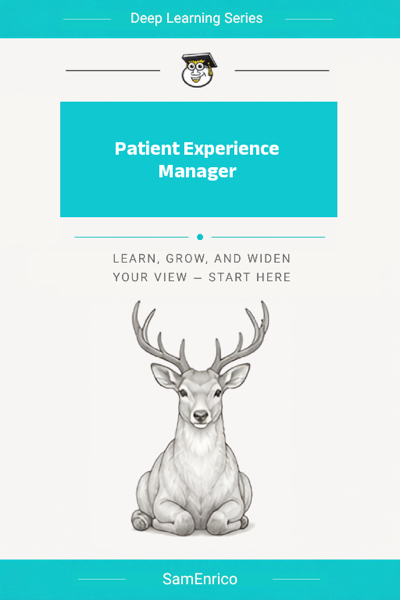
Non-FictionInformativeEducational
Patient Experience Manager eBook
A Coursebook on Patient Experience Manager
A Coursebook on Patient Experience Manager
Formats
Free sample
Chapter 1: The Loyalty Lie...--–- The first thing they don't tell you when you accept the role of Patient Experience Manager is that you will spend your first ninety days apologizing. You will apologize for cold food and warm Jell-O. You will apologize for parking garages that smell like regret and waiting rooms where the magazines are dated from the previous administration. You will apologize for nurses who are too busy to listen and doctors who are too important to sit down. You will apologize for billing errors that are not your fault, discharge instructions that no human could decipher, and call lights that hang unanswered for seventeen minutes—an eternity when you are the one pressing the button.
By the end of your first month, the word "sorry" will taste like ash in your mouth, and you will begin to suspect that you have been hired not to lead but to absorb. To stand between the angry family member and the overwhelmed nurse. To be the human shield for a system that seems designed to frustrate everyone who touches it.This is the hidden curriculum of patient experience work, and no one teaches it in graduate school.I spent my first three months as a Patient Experience Manager at a 400-bed community hospital believing I was failing. Every morning I walked the units with my clipboard and my scripted questions—"How is your pain?" "Did you feel respected?"—and every afternoon I returned to my office with a list of complaints I could not solve. The roof leaked in Building C.
The emergency department wait time was four hours. The night shift had only one working computer for six nurses. These were not problems of empathy or communication. These were problems of infrastructure, budget, and authority. And I had none of the latter.What I did not yet understand—what this book will teach you—is that I was measuring myself against the wrong metric.
I was chasing patient satisfaction as if it were a finish line, when I should have been cultivating something far more valuable. I was apologizing for symptoms when I should have been diagnosing the disease. I was trying to make people feel better about a broken system rather than helping to fix the system itself.This chapter is called "The Loyalty Lie" because the first and most dangerous misconception you must unlearn is that your job is to make patients happy. It is not. Your job is to earn their loyalty, and loyalty is not the same thing as satisfaction.
A satisfied patient may never come back. A loyal patient will drive past three other hospitals to reach yours, will defend you to their family and friends, and will forgive your inevitable mistakes because they trust your intent. Satisfaction is a transaction. Loyalty is a relationship. And relationships are built on a foundation that most patient experience programs ignore entirely.We will spend this chapter dismantling the satisfaction trap, building a new taxonomy that will serve as the backbone of your strategic thinking, and introducing the Human Experience Framework that connects patient, family, and staff into a single ecosystem.
By the end of this chapter, you will understand why your hospital's HCAHPS scores are a lagging indicator of past performance rather than a leading indicator of future success, and you will have a new North Star to guide your work. More importantly, you will stop apologizing for the wrong things and start fixing the right ones.The Satisfaction Trap: Why "Happy" Is Not the Goal Let us begin with a thought experiment. Imagine two patients. The first, Maria, is a fifty-two-year-old woman who comes to your emergency department with chest pain. She is seen within fifteen minutes.
The nurse is cheerful. The doctor orders tests quickly. The discharge process takes only forty-five minutes. Maria is given a warm blanket and a cup of tea. When she receives her survey, she checks every box as "Very Good." She is satisfied.
But Maria lives forty-five minutes away, and there is a hospital ten minutes from her home. She has no particular reason to return to yours. The experience was pleasant, but pleasant is a commodity. She will go wherever is convenient next time.The second patient, James, is a sixty-eight-year-old man admitted for a knee replacement. His surgery is delayed by three hours because the operating room ran over schedule.
His first night, his call light takes twenty minutes to be answered because the night shift is short-staffed. The food is bland. The physical therapist is rushed. On his discharge survey, James scores you poorly on multiple dimensions. He is not satisfied.
But James tells his golf partners that your hospital "saved his life" because the surgeon spent fifteen minutes explaining the procedure in detail, and the nurse remembered that he hates ice chips and brought him warm broth instead. When he needs his other knee done next year, he will drive past two closer hospitals to return to yours.What is the difference between Maria and James? Maria received a transactionally perfect experience but felt no particular connection. James received a flawed experience but felt seen. Satisfaction is about the delivery of expected services—did the food arrive on time, was the room clean, was the wait short?
These are hygiene factors. Their absence causes dissatisfaction, but their presence does not cause loyalty. Loyalty comes from something deeper: the sense that the people caring for you know who you are, care about what you care about, and will fight for you when things go wrong.The healthcare industry has spent two decades and billions of dollars chasing satisfaction scores, and what do we have to show for it? HCAHPS scores have largely plateaued. Patient complaints about "communication" remain the number one driver of low scores.
And despite all the training programs, scripting initiatives, and customer service campaigns, the fundamental trust between patients and providers continues to erode. This is because satisfaction is a lagging indicator—it tells you what already happened, not why it happened or how to prevent the next failure. You cannot manage your way to loyalty by optimizing satisfaction surveys any more than you can fly a plane by looking exclusively in the rearview mirror.The Three Concepts That Will Save Your Career: Experience, Satisfaction, and Affinity To escape the satisfaction trap, you need a clearer map. The confusion between patient experience, patient satisfaction, and patient loyalty (which I call affinity) is not merely semantic. It is strategic.
When you conflate these concepts, you build the wrong interventions, measure the wrong outcomes, and train your staff on the wrong behaviors. Let me draw the distinctions clearly.Patient experience is objective and factual. It answers the question: "Did specific events happen?" Did the nurse introduce themselves? Was the pain scale explained? Were discharge instructions provided in writing?
Were you asked about your medications? These are yes-or-no questions. They can be observed, measured, and audited. Patient experience is a process measure. It tells you whether your systems are functioning as designed.
A hospital can have excellent patient experience scores—meaning all the required behaviors occurred—and still have deeply unsatisfied patients. Because experience is about…
This is the end of the free sample. Get the eBook to keep going. Buy now
About this book
Details
- Author
- Oreilly Nilsa
- Publisher
- SamEnrico
- Language
- English
- Genre
- Non-Fiction, Informative, Educational
- Released
- 2026-05-11
- Pages (approx.)
- 150
- Available as
- eBook, Audiobook

Read better in the ZLOADR app
Your eBooks on your phone or tablet. Sign in with your SamEnrico account and start reading.
More by Oreilly Nilsa
 Upwork Contract Negotiation GuideOreilly Nilsa$11.99
 TikTok Child Creator FameOreilly Nilsa$11.99
 KC135 Tanker PilotOreilly Nilsa$11.99
 Exercise Energy ManagementOreilly Nilsa$11.99
 Career Transition Networking GuideOreilly Nilsa$11.99
 The Promotion Request ScriptOreilly Nilsa$11.99
 GST Registration for Works Contractors HandbookOreilly Nilsa$11.99
 Rockefeller GrandchildrenOreilly Nilsa$11.99
 The Cossack Storm: Stenka Razin’s Revolt (1670–1671)Oreilly Nilsa$11.99
 The Arctic Highway: The Untold Story of the Bar-Tailed Godwit's 7,000-Mile FlightOreilly Nilsa$11.99
 The Day the Sky Turned Purple: The Great London Smog of 1952Oreilly Nilsa$11.99
 Understanding Aphalangia Syndactyly MicrocephalyOreilly Nilsa$17.99
You may also like
 Hong Kong Handover 1997Dunn Johnnie$11.99
 Zumba For Postnatal Recovery CourseNeal Christian$11.99
 Zumba for BeginnersLadner Nikia$11.99
 YouTube Comment Mining GuideHumes Pandora$12.99
 Worry Box MeditationCarlin Rudy$11.99
 Workplace Stress MeditationNguyen Lynn$11.99
 Workplace Stress and Sleep RepairHawley Ivory$11.99
 Workplace Perfectionism CureDelaney Jeffry$11.99
 Workplace Injustice Anger GuideWallen Isabelle$11.99
 Work Addiction and Burnout LinkGreenwood Ester$11.99
 Women in Yoga and WellnessBeattie Galina$11.99
 Women in Stand Up ComedyChun Evangeline$11.99