
Non-FictionSelf-HelpExam Strategy
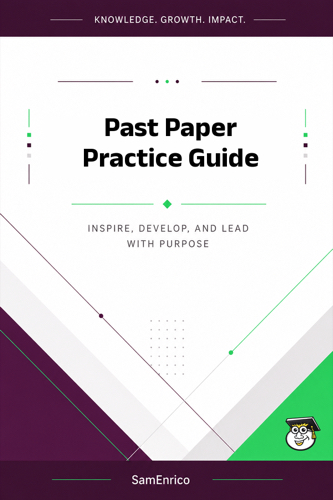
Past Paper Practice Guide eBook
Review and complete previous exams to understand q
by Durr Reina
Review and complete previous exams to understand question patterns and timing.
Formats
Free sample
Chapter 1: The 50/50 Lie--Most students believe that if they simply know the material, they will pass the exam. This is wrong.Let me tell you about Maria. She was a second-year law student at a respected university, and by every reasonable measure, she was prepared. She had attended every lecture. She had color-coded her notes across three different highlighters.
She had formed a study group that met twice weekly. In the three weeks before her Criminal Law final, she logged eighty-seven hours of review—reading, rereading, and rereading again. She could recite the elements of burglary in her sleep. She knew the difference between murder and manslaughter, the nuances of causation, the exceptions to the hearsay rule. On paper, Maria was the model student.She failed.Not because she didn't know the law.
She failed because she had never practiced applying that law under the specific conditions of the exam. She had never sat in a silent room with a ticking clock, forced to produce answers from memory without her notes. She had never encountered the peculiar phrasing that examiners use, the subtle traps hidden in multiple-choice distractors, the time pressure that turns confident knowledge into panicked confusion. On the day of the exam, her mind went blank. She spent twenty minutes on the first question—a five-mark short answer that should have taken six—and by the time she realized her mistake, it was too late.
She rushed through the remaining questions, left entire essay sections blank, and walked out knowing she had failed before the results even arrived.Maria's story is not unusual. It is, in fact, the most common exam tragedy in every discipline, every level, every country. Students mistake the feeling of recognition for the skill of recall. They confuse familiarity with mastery. They study hard but practice wrong.
And then they are shocked when the exam reveals the gap between knowing and doing.This book exists to close that gap.The 50/50 Rule After analyzing thousands of exam results across law, medicine, engineering, business, and the humanities, a clear pattern emerges: content knowledge accounts for approximately 50% of exam success. The other 50% is something most students never consciously develop. We call it test-wiseness—the ability to navigate the form, pressure, and hidden architecture of the exam itself.Let me be precise. Content knowledge is what you know: the facts, formulas, cases, dates, definitions, and theories you have studied. Test-wiseness is how you deploy that knowledge under constraint.
It includes your ability to read a question and understand what it is actually asking, not just what it appears to ask. It includes your ability to budget time across questions so you never leave easy points on the table. It includes your ability to manage anxiety, to recover from a mental block, to guess strategically when you are unsure, and to write answers that match what the examiner wants to see, not just what you want to say.Most students spend 100% of their preparation time on content knowledge. They read, highlight, summarize, and reread. They believe that if they just know the material one more time, the exam will take care of itself.
This is the 50/50 Lie—the false assumption that content is everything.The truth is that two students with identical content knowledge can score fifty points apart on the same exam, separated entirely by test-wiseness. I have seen it happen hundreds of times. The student who knows how to read a question, prioritize by points per minute, and write to the mark scheme will consistently outperform the student who knows more but practices less strategically.This chapter introduces the framework that will transform how you approach every past paper, every practice session, and eventually the exam itself. It is called T.E.A.M.S.—five levers you will learn to pull, each representing a dimension of test-wiseness that you can develop regardless of your current content knowledge.T – Time: The Clock Is a Resource, Not an Enemy Most students experience time as an adversary. They look at the clock and feel panic rising.
They rush through early questions, or they linger too long on difficult ones, or they glance up with fifteen minutes remaining and realize they have left half the paper unanswered. This is not a failure of character. It is a failure of training.Time is not your enemy. Time is a resource, and like any resource, it requires budgeting. When you receive a paycheck, you do not spend randomly until the money runs out.
You allocate: rent, groceries, savings, discretionary spending. The exam clock works exactly the same way. You need a budget.The fundamental unit of this budget is Points Per Minute, or PPM. You will spend an entire chapter on this later, but the core idea is simple: divide the marks available by the minutes you plan to spend. A question worth ten marks should receive roughly twelve minutes (assuming a standard 1.2 minutes per mark, though this varies by exam).
A question worth two marks should receive about two and a half minutes. Anything beyond that budget is a loss—you are spending time you could have used elsewhere.Most students violate this budget constantly. They spend fifteen minutes on a two-mark question because they are stubborn, or perfectionistic, or afraid to admit they do not know the answer. Meanwhile, a twelve-mark question sits untouched. This is the single most common timing error, and it is entirely preventable.The T lever of T.E.A.M.S.
teaches you to think in budgets before you ever enter the exam hall. During your past paper practice, you will calculate PPM for every question. You will practice abandoning a question when it exceeds its budget. You will learn to feel the difference between productive struggle and wasteful persistence. By the time you sit for the real exam, the clock will no longer provoke anxiety.
It will simply be another input to your decision-making.E – Energy: Your Brain Has a Fuel Gauge You have experienced this: after two hours of intense focus, your thinking becomes sluggish. Words blur. You read the same sentence three times without comprehension. You make careless mistakes on problems you could solve easily in the morning. This is not a personal weakness.
It is biology.Your brain runs on glucose, attention, and willpower—all finite resources. Research in cognitive psychology has demonstrated that decision fatigue is real. Every choice you make, every problem you solve, every moment of sustained attention depletes a limited reservoir. By the end of a long exam, you are not the same cognitive machine you were at the start.The E lever of T.E.A.M.S. acknowledges this reality and helps you work with it rather than against it.
The first step is mapping your personal energy cycles. Most people have a natural peak focus window of ninety to one hundred twenty minutes, typically in the morning for early risers and late morning or early afternoon for night owls. Within that window, you are capable of your best work. Outside it, you are compromised.Your task is to align your most demanding practice with your peak window. Do not take a full past paper at 10…
This is the end of the free sample. Get the eBook to keep going. Buy now
About this book
Details
- Author
- Durr Reina
- Publisher
- SamEnrico
- Language
- English
- Genre
- Non-Fiction, Self-Help, Exam Strategy
- Released
- 2026-06-08
- Pages (approx.)
- 143
- Available as
- eBook, Audiobook

Read better in the ZLOADR app
Your eBooks on your phone or tablet. Sign in with your SamEnrico account and start reading.
More by Durr Reina
 TMS for Depression GuideDurr Reina$11.99
 Uber Driver Fare CalculationDurr Reina$11.99
 Career Transition for ManagersDurr Reina$11.99
 Afghanistan A10 PilotDurr Reina$11.99
 Citation Rules for Anonymous Works GuideDurr Reina$11.99
 T-34: The Tank That Changed WarfareDurr Reina$11.99
 Weekly Review For BalanceDurr Reina$11.99
 Rockefeller Standard OilDurr Reina$11.99
 Solar Flare: The Race to Harness the Sun’s FuryDurr Reina$11.99
 The Silent War: How the Stuxnet Worm Nearly Sparked World War IIIDurr Reina$11.99
 The Last Heist of the Velvet Bandit: The Untold Story of the 1975 SeaGrass Bank RobberyDurr Reina$11.99
 Software ManagerDurr Reina$11.99
You may also like
 Hong Kong Handover 1997Dunn Johnnie$11.99
 Zumba For Postnatal Recovery CourseNeal Christian$11.99
 Zumba for BeginnersLadner Nikia$11.99
 YouTube Comment Mining GuideHumes Pandora$12.99
 Worry Box MeditationCarlin Rudy$11.99
 Workplace Stress MeditationNguyen Lynn$11.99
 Workplace Stress and Sleep RepairHawley Ivory$11.99
 Workplace Perfectionism CureDelaney Jeffry$11.99
 Workplace Injustice Anger GuideWallen Isabelle$11.99
 Work Addiction and Burnout LinkGreenwood Ester$11.99
 Women in Yoga and WellnessBeattie Galina$11.99
 Women in Stand Up ComedyChun Evangeline$11.99