
Non-FictionSelf-HelpCyber Hygiene
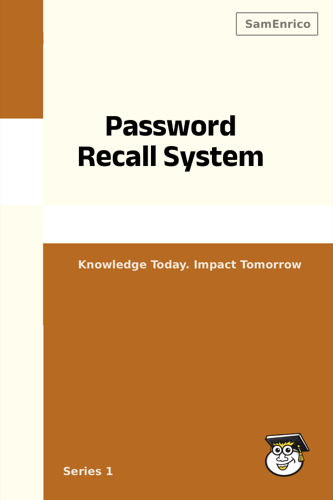
Password Recall System eBook
Create mnemonic peg systems for managing multiple
by Costa Shery
Create mnemonic peg systems for managing multiple complex passwords securely.
Formats
Free sample
Chapter 1: The $50,000 Sticky Note--–- The CEO of a small marketing firm, let’s call him Marcus, sat in his glass-walled office at 4:47 PM on a Friday. His bank’s fraud detection system had flagged a suspicious login attempt from an IP address in Belarus. To lock the account and reverse a $50,000 wire transfer that had been initiated three hours earlier, Marcus needed to confirm his identity. That required his password. Not the one he used for email.
Not the one for Salesforce. The one for the business banking portal. A sixteen-character, “strong” password generated by his IT consultant: `9!m K4@q R7&z P2#w L`. Marcus had it written on a yellow sticky note. The sticky note was supposed to be in his locked desk drawer.
But on that Friday, the sticky note was not there. It had fallen behind the desk two weeks ago, during a late-night paperwork shuffle, and had been swept up by the janitorial staff. Marcus spent the weekend on the phone with the bank’s automated recovery system. On Monday, the $50,000 was gone. The hacker had drained the account.
Marcus’s memory had not failed him. His system had.This is a book about the most valuable real estate you own that is not protected by any alarm, any firewall, or any insurance policy. That real estate is the space between your ears. And for the past twenty years, cybersecurity experts have been giving you advice that is scientifically backward. They told you to make passwords random.
They told you to make them complex. They told you to never write them down but also to never reuse them. They told you to change them every ninety days. And then they expected your brain—a biological organ optimized for remembering faces, locations, and stories—to behave like a solid-state drive. It does not.
It will not. And every day, millions of people prove this by clicking “Forgot Password” while staring at a login screen.The thesis of this book is simple, radical, and grounded in three centuries of mnemonic science: You do not have a bad memory. You have a bad encoding system. A random password is not forgotten because it is long. It is forgotten because it is meaningless.
The human brain did not evolve to store arbitrary strings of characters. It evolved to store images, spatial relationships, and emotionally charged events. A caveperson did not need to remember a7$k L9. They needed to remember which berry bush had the sweet fruit and which cave had the bear. The first rule of memory is not repetition.
The first rule of memory is association.What you are about to learn in this book is a complete replacement for every password manager, every sticky note, and every embarrassing “Reset Password” workflow you have ever suffered through. You will learn a Hybrid Recall System that combines two ancient techniques: the deterministic formula (so you never store a password, you recalculate it) and the mnemonic peg (so you never forget the formula). By Chapter 12, you will be able to recall one hundred unique, complex, site-specific passwords without writing down a single character. You will never need to reset a password again. And you will understand something that most cybersecurity professionals do not: the weakest link in security is not the user.
It is the advice given to the user.The Great Password Lie Let us name the lie directly. The lie is this: “Create a strong, random password that is difficult for others to guess and easy for you to remember.” This sentence contains a contradiction so fundamental that it would be laughable if it had not caused billions of dollars in losses. “Difficult for others to guess” means high entropy—randomness, length, unusual characters. “Easy for you to remember” means meaningful, patterned, familiar. You cannot have both.
No algorithm exists that generates a string that is simultaneously random for a computer and meaningful for a human brain. The two criteria are mutually exclusive.Consider the most famous study on password memorability, conducted by Joseph Bonneau at the University of Cambridge in 2012. Bonneau analyzed seventy million Yahoo passwords and found that the average user could reliably recall only about 4.6 distinct passwords across all their accounts. That is not a typo. The average person, when tested, could confidently retrieve fewer than five passwords from memory without a reset.
Yet the average person has more than one hundred online accounts. The math is impossible. Something has to give. What gives is security. People reuse passwords.
They write them down. They use predictable patterns like “Spring2024!” across every site. And then they are hacked.The security industry responded by inventing password managers—software that stores all your passwords in an encrypted vault protected by a single master password. This solves the memorability problem by outsourcing memory to a machine. But it creates a new problem: a single point of failure.
If you forget your master password, you lose every password. If the password manager company is breached (as Last Pass was in 2022, leaking encrypted vaults for 25 million users), your life’s credentials are in the hands of criminals who have years to decrypt them. A password manager is a locked box with the key taped to the side. The key is your master password. And you are right back to the original problem: how do you remember that master password without writing it down?The answer is not better software.
The answer is better memory.The Science of Forgetting: Ebbinghaus and the Decay Curve In 1885, a German psychologist named Hermann Ebbinghaus published a book that changed our understanding of memory. He was the first person to study forgetting systematically. He memorized lists of nonsense syllables—meaningless three-letter combinations like “ZOF” and “WUX”—and then tested himself at intervals. He discovered a pattern so consistent that it has been replicated thousands of times. It is called the Forgetting Curve.The curve looks like this: within one hour of learning something meaningless, you will forget about 50% of it.
Within 24 hours, you will forget about 70%. Within one week, you will forget about 90%. The only way to slow this decay is through spaced repetition—reviewing the information at increasing intervals. But here is the crucial insight that most people miss: Ebbinghaus also found that meaningful information—information that could be associated with existing knowledge, images, or emotions—decayed much more slowly. He did not forget a story about his childhood the way he forgot “ZOF.” The brain has a biological bias toward meaning.Now apply this to passwords.
A random password like Xq!4@b Z9 is functionally identical to Ebbinghaus’s nonsense syllables. It has no meaning. It has no association. It triggers no existing neural pathway. After one hour, you will have forgotten half of it.
After one week, you will need to reset it. That is not a moral failing. That is neuroscience. You are not lazy. You are not “bad with computers.” You are a human being with a normally functioning brain that is doing exactly what evolution designed it to do: discarding data that appears to have no survival value.The solution is not to fight the forgetting curve.
The solution is to exploit it by converting meaningless passwords into meaningful images. This is the core insight of every…
This is the end of the free sample. Get the eBook to keep going. Buy now
About this book
Details
- Author
- Costa Shery
- Publisher
- SamEnrico
- Language
- English
- Genre
- Non-Fiction, Self-Help, Cyber Hygiene
- Released
- 2026-06-08
- Pages (approx.)
- 134
- Available as
- eBook, Audiobook

Read better in the ZLOADR app
Your eBooks on your phone or tablet. Sign in with your SamEnrico account and start reading.
More by Costa Shery
 Procrastination to Productivity GuideCosta Shery$11.99
 Menopause Dream ShiftsCosta Shery$11.99
 The Gacy Clown MuseumCosta Shery$11.99
 Retirement Assets and MedicaidCosta Shery$11.99
 Collaborative Improv RulesCosta Shery$11.99
 Vertices of Victory MindsetCosta Shery$11.99
 Menstrual Migraine GuideCosta Shery$11.99
 Airplane RLS Survival GuideCosta Shery$11.99
 The Silent Summit: The Mysterious Ascents of the Pacific's Forgotten ClimbersCosta Shery$11.99
 The Silent Bid: How a Forgotten Auction Changed the GameCosta Shery$11.99
 Jolted: The Underground Race to Power the Electric FutureCosta Shery$11.99
 Growing RhodohypoxisCosta Shery$11.99
You may also like
 Hong Kong Handover 1997Dunn Johnnie$11.99
 Zumba For Postnatal Recovery CourseNeal Christian$11.99
 Zumba for BeginnersLadner Nikia$11.99
 YouTube Comment Mining GuideHumes Pandora$12.99
 Worry Box MeditationCarlin Rudy$11.99
 Workplace Stress MeditationNguyen Lynn$11.99
 Workplace Stress and Sleep RepairHawley Ivory$11.99
 Workplace Perfectionism CureDelaney Jeffry$11.99
 Workplace Injustice Anger GuideWallen Isabelle$11.99
 Work Addiction and Burnout LinkGreenwood Ester$11.99
 Women in Yoga and WellnessBeattie Galina$11.99
 Women in Stand Up ComedyChun Evangeline$11.99