
Non-FictionBusiness BriefReal Estate Tax
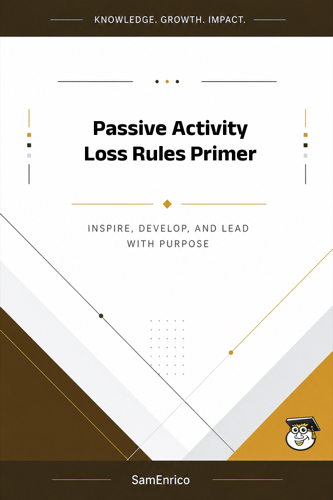
Passive Activity Loss Rules Primer
Apply real estate professional status and material
Apply real estate professional status and material participation tests to unlock suspended losses.
Formats
About this book
Free sample
Chapter 1: The Locked Box--–- Every year, thousands of real estate investors file tax returns showing tens of thousands of dollars in rental losses. They subtract depreciation, mortgage interest, repairs, and insurance from their rental income. The math produces a clean, satisfying loss. Then they watch in confusion and frustration as their tax preparer explains that none of that loss can be used against their W-2 salary or business income. The loss sits on the return, labeled "suspended," doing absolutely nothing to reduce their tax bill.
They ask why. The answer lies in a provision of the Internal Revenue Code that has been called the most misunderstood, most litigated, and most strategically powerful section in the entire tax law for real estate investors: Section 469.This chapter reveals the fundamental problem that every subsequent chapter in this book exists to solve. You cannot unlock suspended losses until you understand why they became suspended in the first place. And you cannot understand that without grasping a simple but brutal truth that Congress embedded into the tax code nearly forty years ago: the government does not want you using rental real estate losses to reduce your other income.The 1986 Earthquake Before 1986, wealthy taxpayers could invest in real estate partnerships, generate massive paper losses through accelerated depreciation, and use those losses to wipe out their salary, business profits, and investment income. A doctor earning $300,000 per year could invest $50,000 in a real estate limited partnership, receive a $150,000 loss allocation (thanks to depreciation deductions that exceeded cash invested), and reduce their tax liability to nearly zero.
The government watched this happen year after year. The Treasury Department estimated that in 1985 alone, taxpayers used over $10 billion in passive losses to offset active income.Congress responded with the Tax Reform Act of 1986. The centerpiece of that act for real estate investors was IRC Section 469, which created the passive activity loss rules. The legislative history makes Congress's intent crystal clear: "Passive losses should not be used to offset active income." The law created a wall between three types of income. Active income, which includes wages, salaries…
This is the end of the free sample. Get the eBook to keep going. Buy now
Contents
- Chapter 1
- Chapter 2
- Chapter 3
- Chapter 4
- Chapter 5
- Chapter 6
- Chapter 7
- Chapter 8
- Chapter 9
- Chapter 10
- Chapter 11
- Chapter 12
Details
- Author
- Dugger Aracelis
- Publisher
- SamEnrico
- Language
- English
- Genre
- Non-Fiction, Business Brief, Real Estate Tax
- Released
- 2026-06-07
- Pages (approx.)
- 152
- Available as
- eBook, Audiobook

Read better in the ZLOADR app
Your eBooks on your phone or tablet. Sign in with your SamEnrico account and start reading.
More by Dugger Aracelis
 Morning Routines for Less Stressed ParentsDugger Aracelis$11.99
 Rental Property Credit Card GuideDugger Aracelis$11.99
 Mindfulness for Writers GuideDugger Aracelis$11.99
 The Citizenship Class TeacherDugger Aracelis$11.99
 VSCO Aesthetic PressureDugger Aracelis$11.99
 St John's Wort RisksDugger Aracelis$11.99
 The Alchemist’s Ledger: The Secret Debts of the MediciDugger Aracelis$11.99
 The Dragon’s Spine: A Gothic Architect’s FollyDugger Aracelis$11.99
 How to Produce Surveillance CamerasDugger Aracelis$11.99
 Online Exam Calculator RulesDugger Aracelis$12.99
 VA Pay Raise and Promotion CriteriaDugger Aracelis$12.99
 Mastering The Art of Pale (Ancient Greek Wrestling)Dugger Aracelis$11.99
You may also like
 Hong Kong Handover 1997Dunn Johnnie$11.99
 Zumba For Postnatal Recovery CourseNeal Christian$11.99
 Zumba for BeginnersLadner Nikia$11.99
 YouTube Comment Mining GuideHumes Pandora$12.99
 Worry Box MeditationCarlin Rudy$11.99
 Workplace Stress MeditationNguyen Lynn$11.99
 Workplace Stress and Sleep RepairHawley Ivory$11.99
 Workplace Perfectionism CureDelaney Jeffry$11.99
 Workplace Injustice Anger GuideWallen Isabelle$11.99
 Work Addiction and Burnout LinkGreenwood Ester$11.99
 Women in Yoga and WellnessBeattie Galina$11.99
 Women in Stand Up ComedyChun Evangeline$11.99