
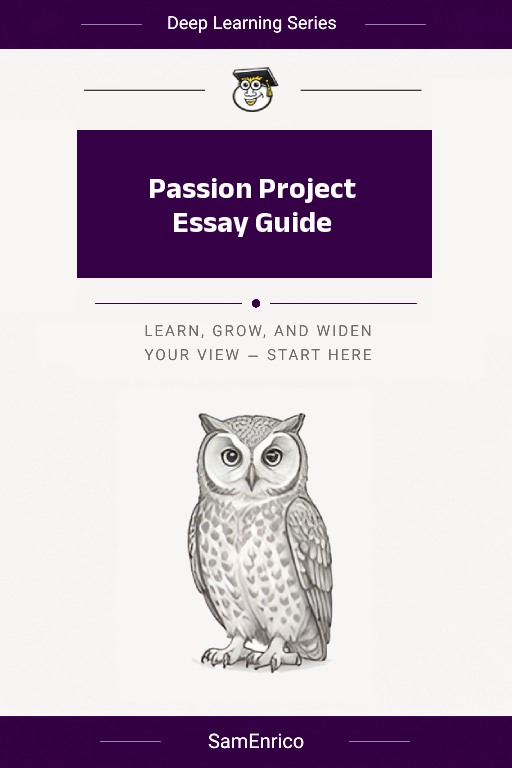
essaysStudent's ShortcutPassion
Passion Project Essay Guide eBook
Showcase deep engagement, initiative, and impact w
by Mount Tia
Showcase deep engagement, initiative, and impact without bragging or overstating results.
Formats
Free sample
Chapter 1: The Curiosity Matrix...--You have been lied to.Not by malicious people. Not by some shadowy cabal of college admissions officers who secretly want you to fail. The lie is more subtle than that, more well-intentioned, and therefore more dangerous. The lie has been whispered by well-meaning parents, by well-meaning teachers, by well-meaning guidance counselors, and by every college essay guide that has ever told you to "stand out" or "show leadership" or "demonstrate impact."The lie is this: You need to pick an impressive project.Not an interesting one. Not a weird one.
Not a small one. An impressive one. A project with scale. A project with a title. A project that sounds good on a resume.
A project that will make an admissions officer sit up and say, "Now that is a future leader."And so, every year, hundreds of thousands of students do exactly what they are told. They start nonprofits. They build apps. They organize fundraisers. They create initiatives.
They give themselves titles like "Founder" and "President" and "Executive Director." They chase awards and recognition and metrics.And then they sit down to write their college essays.And they have nothing to say.Not literally nothing. They have plenty of facts. They have numbers and accomplishments and bullet points. They have a list of everything they did. But when they try to turn that list into a story—into something that actually makes an admissions officer feel something—they hit a wall.
Because a list of accomplishments is not a story. A title is not a personality. Scale is not meaning.This chapter is going to help you avoid that trap. More importantly, this chapter is going to help you find the real engine of a great passion project essay: not awards, not titles, not scale, but curiosity. The kind of curiosity that keeps you up at night.
The kind of curiosity that makes you fall down a Wikipedia rabbit hole at 11:30 PM when you were supposed to be doing homework. The kind of curiosity that produces weird, specific, unforgettable essays because it produces weird, specific, unforgettable experiences.This is the Curiosity Matrix. And it will change everything about how you choose—and write about—your passion project.The Two Types of Passion (And Why One of Them Is a Trap)Before we go any further, let's name the enemy.Most students approach passion projects with what I call outcome-based passion. This is the voice that says: I need to win something. I need to found something.
I need to get a certain number of followers, dollars, or volunteers. I need to put a title on my resume that sounds important.Outcome-based passion is not actually passion at all. It is ambition dressed in passion's clothing. And ambition is not a bad thing—ambition gets things done. But ambition without curiosity produces hollow essays because it produces hollow experiences.Think about the last time you did something purely because you wanted the result.
Maybe you studied for a test not because you cared about the material but because you wanted an A. Maybe you joined a club not because you loved the activity but because you wanted the leadership position. Do you remember the sensory details of that experience? Do you remember what you felt? Or do you just remember the grade, the title, the checkbox?Outcome-based passion produces memory loss.
It erases the messy middle—the frustration, the confusion, the small failures, the unexpected joys—because you were never paying attention to those things. You were paying attention to the finish line. And when you sit down to write your essay, all you have is the finish line. "I won." "I founded." "I led."That is not an essay. That is a tombstone.The alternative is inquiry-based passion.
This is the voice that says: I need to understand something. I need to solve a puzzle. I need to figure out why this thing works the way it does. I have a question, and I cannot stop thinking about it.Inquiry-based passion is not about the outcome. It is about the process.
It is about the question itself. And here is the counterintuitive secret: inquiry-based passion almost always produces better outcomes than outcome-based passion, because curiosity is sustainable in a way that ambition is not.Ambition runs out of steam when you hit a setback. Curiosity gets more interested when it hits a mystery.A student with outcome-based passion starts a tutoring nonprofit because they want to be a "founder." When the first three tutoring sessions fall through because no one shows up, they feel like a failure. They might push through, but they are miserable. Their essay, if they write one, will be about how they "overcame adversity." It will be generic.A student with inquiry-based passion starts a tutoring nonprofit because they have a question: Why do students in my school fail math?
Is it the teaching? The materials? The homework load? Something else? When the first three tutoring sessions fall through, they do not feel like a failure.
They feel like a detective. They have new data. They ask: Why did no one show up? Was it the time? The location?
The way I advertised? They pivot. Their essay will be about the mystery, the investigation, the pivot. It will be unforgettable.The Curiosity Matrix is simply a tool for distinguishing between these two types of passion—and for helping you choose the second.The Curiosity Matrix: A Visual Framework Imagine a two-by-two grid.On the vertical axis, from bottom to top, is Curiosity. Low curiosity at the bottom, high curiosity at the top.On the horizontal axis, from left to right, is External Validation.
Low external validation on the left, high external validation on the right.Now let's populate the four quadrants.Quadrant 1 (Low Curiosity, Low External Validation): This is the dead zone. You don't care about the project, and no one else does either. This is homework you are doing for no grade. This is an extracurricular you joined because your parents made you. Nothing good comes from this quadrant.
Do not spend time here.Quadrant 2 (Low Curiosity, High External Validation): This is the trap. This is outcome-based passion. You don't actually care about the project itself, but you care very much about what it will get you—awards, recognition, college admission. This quadrant produces impressive-sounding resumes and hollow essays. Most students live here.
Most students get rejected from their top-choice schools.Quadrant 3 (High Curiosity, Low External Validation): This is the hidden gem. This is pure inquiry-based passion. You care deeply about the question, and you do not care who knows it. This quadrant produces weird, small, authentic projects that no one else is doing. This is the student who spends six months cataloging the moss species in their backyard.
This is the student who teaches themselves ancient Greek because they want to read the New Testament in the original language. This is the student who builds a working model of a medieval trebuchet out of popsicle sticks and dental floss. These projects rarely win awards. They rarely look good on a resume. But they produce incredible essays because they…
This is the end of the free sample. Get the eBook to keep going. Buy now
About this book
Details
- Author
- Mount Tia
- Publisher
- SamEnrico
- Language
- English
- Genre
- essays, Student's Shortcut, Passion
- Released
- 2026-05-29
- Pages (approx.)
- 132
- Available as
- eBook, Audiobook

Read better in the ZLOADR app
Your eBooks on your phone or tablet. Sign in with your SamEnrico account and start reading.
More by Mount Tia
 Reconstruction of Road Rage ShootingsMount Tia$11.99
 Ballistic Fraud Conviction GuideMount Tia$11.99
 Sun Never Set Empire OriginsMount Tia$11.99
 Widow Grief Physical SymptomsMount Tia$11.99
 Provisional Income CalculationMount Tia$11.99
 Pomodoro for HR ProfessionalsMount Tia$11.99
 Method Of Loci For Networking EventsMount Tia$11.99
 Opioid Risk GuideMount Tia$11.99
 Trafalgar: Nelson's Last Stand - The Sea That Shaped an EmpireMount Tia$11.99
 The Bangkok Bank Heist: The Robber Who VanishedMount Tia$11.99
 How to Produce Drill Bit ExtensionsMount Tia$11.99
 Mastering The ObliquesMount Tia$11.99
You may also like
 YouTube Video Essay DepthLeon Lala$11.99
 TOEFL Independent Essay GuideMintz Alex$11.99
 Music Theory Essay GuideWilkinson Maisha$11.99
 Expository Essay AI PromptsApplegate Dalia$11.99
 Exam Essay MemorizationMcgovern Johna$11.99
 Compare Contrast Essay PromptsOntiveros Marx$11.99
 College Application Essay GuideSisson Aimee$11.99College Application Essay GuideSisson Aimee$11.99
 The 100 Word Essay ChallengeAli Luciana$11.99
 Journalism Essay PromptsThatcher Williemae$11.99
 Finance Essay PromptsShrader Lamont$11.99
 Cause Effect Essay GPT GuideBland Jacelyn$11.99