
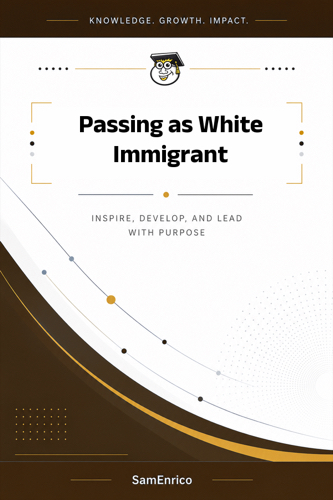
Passing as White Immigrant eBook
Bleach hair or change name to avoid detection, the
Bleach hair or change name to avoid detection, then grapple with erasing your identity.
Formats
Free sample
Chapter 1: The Two-Name Flinch...--–- The first time Samuel Rosenberg heard his new name spoken aloud in public, he did not recognize it. He was standing in the hallway of Sullivan & Cromwell’s New York offices in 1948, wearing a borrowed suit that pinched at the shoulders, and a senior partner called out “Rogers? Sam Rogers?” from the end of the corridor. For one suspended second, Samuel did not move. The name floated past him like a word in a language he had studied but never spoken.
Then the man next to him elbowed his ribs, and Samuel stepped forward, hand extended, smile fixed, and said, “That’s me.” He felt the lie leave his mouth before he had finished the sentence. That feeling—the gap between the name he answered to and the name his mother used when she tucked him in—would follow him for the next thirty-two years. He never stopped flinching.The Flinch: A Definition The flinch is the smallest possible betrayal of the passer’s secret. It is not the dramatic slip of a cousin calling out a childhood nickname at a company picnic, nor the catastrophic discovery of an old passport photo on social media. The flinch is quieter than that.
It is the micro-second hesitation before answering to a name that is not yours. It is the almost-imperceptible pause when someone asks, “Where are you from?” and you must decide whether to say “Ohio” or “Bogotá.” It is the slight tightening around the eyes when a colleague says, “You don’t look like a Maria,” and you smile and say, “It’s a family name,” even though Maria is your birth name and you have just spent three hundred dollars to make your hair look less like Maria’s hair.The flinch is the body’s refusal to fully cooperate with the performance. It is the trace of the real self that the passer cannot quite erase. And for millions of immigrants and children of immigrants across the United States, the flinch is a daily reality—a small muscle spasm of identity that happens dozens of times a day, often unnoticed by anyone except the person performing it.This book is about those flinches. It is about the people who change their names, bleach their hair, straighten their curls, flatten their accents, and curate their social lives to pass as white in a country that rewards whiteness.
It is about the economic logic that makes passing seem rational and the psychological cost that eventually makes it unbearable. This chapter, the first of twelve, focuses on the cheapest and fastest form of passing: the name change. But more than that, it focuses on the flinch—the involuntary reaction that reveals, in a fraction of a second, that the name you answer to is not the name you were given.The Two-Name Life Every immigrant who passes as white lives what I call the two-name life. One name is private, given by parents who may still pronounce it with an accent they have never lost. That name carries history: the grandmother who bore it in the old country, the saint or ancestor it invokes, the vowel sounds that belong to a language the passer may still dream in.
The other name is public, chosen for its blandness, its ease of pronunciation, its whiteness. It is a name that does not trigger the unconscious bias of hiring managers, landlords, or TSA agents. It is a name that fits on a resume without raising eyebrows.The two-name life is not a new phenomenon. In the early twentieth century, Jewish immigrants arriving at Ellis Island watched as officials anglicized their names on the spot—Abraham became Albert, Chaim became Herman, Rivka became Rebecca. Some families embraced the change; others resented it for generations.
But the most interesting cases, as historian Kirsten Fermaglich documents in A Rosenberg by Any Other Name, were the voluntary name-changers: the Jewish lawyers, doctors, and academics who changed their names in the 1940s and 1950s not because the government forced them, but because they wanted to get jobs. They changed Rosenberg to Rogers, Goldstein to Gordon, Shapiro to Shane. They did not hate their Jewishness. They hated the ceiling that their Jewishness imposed.The same logic drives name changes today, but the demographics have shifted. The largest group of voluntary name-changers in contemporary America is not Jewish but Latino, Asian, and Arab.
A 2023 study by the National Bureau of Economic Research found that job applicants with “white-sounding” names receive 50 percent more callbacks than applicants with distinctly African American names, and approximately 30 percent more than applicants with Latino or Asian names. These are not small differences. In a competitive job market, a 30 percent callback gap is the difference between a career and a series of rejections.The teenager who changes Yesenia to Jessie on her Starbucks application is not a traitor to her culture. She is a rational economic actor responding to incentives. But rationality does not protect her from the flinch.
Every time a coworker says “Jessie,” she hesitates. Every time her mother calls her Yesenia, she feels the fracture. She lives in two names, and neither one entirely fits.The Economic Logic of Erasure Let us be precise about the data, because the data matter. The most famous study on name-based discrimination is Bertrand and Mullainathan (2004), in which researchers sent nearly 5,000 resumes to employers in Boston and Chicago. The resumes were identical in qualifications, but half had “white-sounding” names (Emily Walsh, Greg Baker) and half had “African American-sounding” names (Lakisha Washington, Jamal Jones).
The result: white-sounding names received 50 percent more callbacks. A subsequent meta-analysis by Quillian and colleagues (2017) examined dozens of field experiments across multiple countries and found that name-based discrimination persists, though the gap varies by ethnic group. For Latino names, the penalty is approximately 30 percent; for Asian names, approximately 25 percent; for Arab and Muslim names, the penalty can exceed 40 percent in the wake of heightened Islamophobia.These numbers are not abstractions. They translate directly into economic outcomes. A person with a white-sounding name is more likely to be invited for an interview, more likely to receive a job offer, more likely to be promoted, and more likely to earn a higher salary over their lifetime.
One study estimated that having a “foreign-sounding” name reduces lifetime earnings by as much as $100,000. Another found that landlords are 15 percent less likely to respond to rental inquiries from applicants with Latino or Asian names.Faced with this data, what is a rational immigrant to do? The answer for millions has been to change their name. Not legally, necessarily—many passers keep their birth name on their passport and change it only on their resume, their Linked In profile, and their work email signature. This is the shadow economy of identity: a legal name that appears on tax forms and a professional name that appears everywhere else.
The two-name life is not a legal fiction; it is a carefully maintained architecture of deception.But here is the paradox that will run through this entire book: Passing as white is economically rational but psychologically costly. The name change makes economic sense. It opens doors. It reduces discrimination. It…
This is the end of the free sample. Get the eBook to keep going. Buy now
About this book
Details
- Author
- Williamson Christine
- Publisher
- SamEnrico
- Language
- English
- Genre
- Non-Fiction, Biography
- Released
- 2026-06-09
- Pages (approx.)
- 126
- Available as
- eBook, Audiobook

Read better in the ZLOADR app
Your eBooks on your phone or tablet. Sign in with your SamEnrico account and start reading.
More by Williamson Christine
 Managing Virtual MeetingsWilliamson Christine$11.99
 Brainwriting 635 TechniqueWilliamson Christine$11.99
 Working Parent Anger SpilloverWilliamson Christine$11.99
 Mirroring Rapport BuildingWilliamson Christine$11.99
 Small Talk for Digital NomadsWilliamson Christine$11.99
 Dream Portal JournalWilliamson Christine$11.99
 Male Sleep Apnea RisksWilliamson Christine$11.99
 The Admiral's Crescent Moon: Yi Sun-sin and the Turtle Ships of GoryeoWilliamson Christine$11.99
 Fire and Empire: The Volcanic Legacy of the Holy Roman EmpireWilliamson Christine$11.99
 How to Produce Off-road and All-terrain Vehicle Rims and WheelsWilliamson Christine$11.99
 Underwriting AnalystWilliamson Christine$11.99
 How to Produce Coaching Education MaterialsWilliamson Christine$11.99
You may also like
 Hong Kong Handover 1997Dunn Johnnie$11.99
 Zumba For Postnatal Recovery CourseNeal Christian$11.99
 Zumba for BeginnersLadner Nikia$11.99
 YouTube Comment Mining GuideHumes Pandora$12.99
 Worry Box MeditationCarlin Rudy$11.99
 Workplace Stress MeditationNguyen Lynn$11.99
 Workplace Stress and Sleep RepairHawley Ivory$11.99
 Workplace Perfectionism CureDelaney Jeffry$11.99
 Workplace Injustice Anger GuideWallen Isabelle$11.99
 Work Addiction and Burnout LinkGreenwood Ester$11.99
 Women in Yoga and WellnessBeattie Galina$11.99
 Women in Stand Up ComedyChun Evangeline$11.99