
Non-FictionHealth & WellnessCouples Fertility
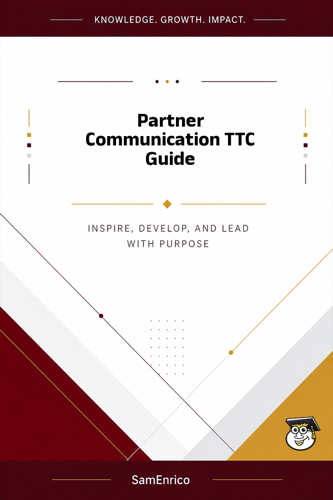
Partner Communication TTC Guide eBook
Keep intimacy alive and blame free during trying.
Keep intimacy alive and blame free during trying.
Formats
Free sample
Chapter 1: The Blame Cage...--Most couples do not realize they are fighting the wrong war.They walk into conflict armed with timelines, receipts, and a meticulously reconstructed sequence of who said what when. They believe that if they can just prove they are right—if they can just get their partner to admit fault—the fight will end and closeness will return. But the opposite happens. The more right they become, the more distant their partner feels. The more evidence they gather, the more alone they find themselves sitting at the kitchen table at eleven o'clock at night, wondering how two people who love each other could feel so utterly disconnected.This is the Blame Cage.It is not a place anyone chooses to enter.
It is not a sign of a bad relationship or a failing marriage. The Blame Cage is a psychological trap that emerges naturally when human beings feel threatened, and nothing feels more threatening than the possibility of disconnection from the person we love most. When we sense that our partner does not see us, does not hear us, or does not care about what matters to us, our nervous system interprets this as a survival threat. Not a mild inconvenience. A survival threat.
And when survival feels at stake, the brain's highest priority is not kindness or curiosity or connection. The brain's highest priority is self-protection.And so we defend. We explain. We correct. We produce evidence.
We build cases. We do all of this in the name of being understood, never realizing that each defensive move we make pushes our partner further into their own defensive posture. We become two people standing on opposite sides of a glass wall, each convinced that the other is refusing to listen, each convinced that if the other would just see the facts, everything would be fine.The facts are not the problem.The problem is that in the Blame Cage, facts become weapons. And nobody feels safe with a weapon pointed at them.The Great Misconception Before we go any further, let us name the belief that keeps most couples trapped in the Blame Cage for years. It is a belief so common, so culturally reinforced, that most people have never even thought to question it.
Here it is:A good relationship means rarely fighting. And when you do fight, the goal is to resolve the issue by determining who is correct.This is wrong. Not just slightly inaccurate. Profoundly, destructively wrong.Let us examine why. The first part of the misconception—that good relationships rarely fight—has been thoroughly debunked by decades of relationship research.
Dr. John Gottman's famous studies at the University of Washington found that healthy, happy couples fight just as often as unhappy couples. The difference is not the frequency of conflict. The difference is how they fight. Unhappy couples get stuck.
Happy couples repair.But the second part of the misconception is even more damaging: the idea that the goal of conflict is to determine who is correct. This assumption turns every disagreement into a courtroom drama. One partner becomes the prosecutor, armed with evidence. The other becomes the defense attorney, armed with counter-evidence. Both are so focused on winning the case that neither notices they have lost the relationship.Think about the last significant disagreement you had with your partner.
Not the minor stuff—not who left the milk out or who forgot to return the library book. Think about a real fight. One where voices were raised or silences stretched into hours. Now ask yourself this question: During that fight, was I trying to prove I was right, or was I trying to understand my partner's experience?If you are like most people, the answer is the former. And that is not because you are selfish or cold or incapable of love.
It is because when conflict escalates, the brain's amygdala (the alarm system) hijacks the prefrontal cortex (the reasoning center). You literally cannot access your empathy while your nervous system believes you are under attack. This is biology, not character.But biology can be overridden. Not by willpower—willpower fails when the alarm is screaming. But by understanding.
By recognizing the shape of the trap before you fall into it. By learning to see the Blame Cage for what it is: a structure built not by your partner's failures, but by your shared nervous systems trying to protect you from the thing you actually need most.The Two Kinds of Conversations Here is the single most useful distinction you will learn in this entire book. Master this, and you will cut your conflict time in half. Ignore it, and you will remain in the Blame Cage indefinitely.Every difficult conversation you will ever have with your partner falls into one of two categories: Problems to be Solved or Moments to be Engaged.A Problem to be Solved is logistical. It is concrete.
It has a clear beginning and end. Examples include: Who is picking up the kids from school tomorrow? How are we splitting the grocery budget this month? What time are we leaving for the airport? These conversations require information, coordination, and sometimes negotiation.
But they do not require emotional repair because no emotional injury has occurred. They are about the external world.A Moment to be Engaged is emotional. It is not about logistics at all. It is about a person's inner experience—their fear, their exhaustion, their loneliness, their hope, their longing. Examples include: "I feel like I never see you anymore." "I'm really worried about my mother's health." "I don't feel attractive to you lately." These are not problems to be solved.
They are experiences to be witnessed.Here is where couples get into catastrophic trouble: they treat Moments to be Engaged as if they were Problems to be Solved.When your partner says, "I feel like I never see you anymore," a Problem-to-be-Solved response sounds like this: "That's not true. We had dinner together on Tuesday and we watched a movie on Friday. I was home by seven every night this week except Thursday." Every word of that response might be factually correct. But every word is also a rejection of your partner's emotional reality. Your partner did not ask for a calendar review.
Your partner asked for connection. And you responded with a spreadsheet.When you treat an emotional bid as a logistical problem, you instinctively assign fault. Because logistical problems have causes. And causes point to someone being responsible. And responsibility, in the heat of conflict, quickly becomes blame.But here is the truth: your partner's exhaustion is not a problem to be solved.
Your partner's loneliness is not a problem to be solved. Your partner's fear about the future is not a problem to be solved. These are Moments to be Engaged. They require only one thing: your presence. Your willingness to say, "Tell me more about that." Your ability to sit in the discomfort of not knowing what to do, without rushing to fix anything.The great irony is that when you engage a Moment rather than solve a Problem, the emotion often de-escalates on its own.
Your partner feels seen. The nervous system calms. And what seemed like an urgent crisis becomes something much simpler: two…
This is the end of the free sample. Get the eBook to keep going. Buy now
About this book
Details
- Author
- Yarbrough Dorthea
- Publisher
- SamEnrico
- Language
- English
- Genre
- Non-Fiction, Health & Wellness, Couples Fertility
- Released
- 2026-06-07
- Pages (approx.)
- 136
- Available as
- eBook, Audiobook

Read better in the ZLOADR app
Your eBooks on your phone or tablet. Sign in with your SamEnrico account and start reading.
More by Yarbrough Dorthea
 The Caregiver Gratitude PracticeYarbrough Dorthea$11.99
 Bedtime Self Talk RewiringYarbrough Dorthea$11.99
 Anger at Children's MistakesYarbrough Dorthea$11.99
 Nightmare Processing for Fire SurvivorsYarbrough Dorthea$11.99
 The Fall of Granada: The Last Moorish Stronghold (1492)Yarbrough Dorthea$11.99
 Understanding Odontoonychodermal DysplasiaYarbrough Dorthea$17.99
 How to Become a Laundry-bag-punch OperatorYarbrough Dorthea$11.99
 CoastguardYarbrough Dorthea$11.99
 Chinese University Housing Deposit GuideYarbrough Dorthea$12.99
 Vertex PharmaceuticalsYarbrough Dorthea$12.99
You may also like
 Hong Kong Handover 1997Dunn Johnnie$11.99
 Zumba For Postnatal Recovery CourseNeal Christian$11.99
 Zumba for BeginnersLadner Nikia$11.99
 YouTube Comment Mining GuideHumes Pandora$12.99
 Worry Box MeditationCarlin Rudy$11.99
 Workplace Stress MeditationNguyen Lynn$11.99
 Workplace Stress and Sleep RepairHawley Ivory$11.99
 Workplace Perfectionism CureDelaney Jeffry$11.99
 Workplace Injustice Anger GuideWallen Isabelle$11.99
 Work Addiction and Burnout LinkGreenwood Ester$11.99
 Women in Yoga and WellnessBeattie Galina$11.99
 Women in Stand Up ComedyChun Evangeline$11.99