
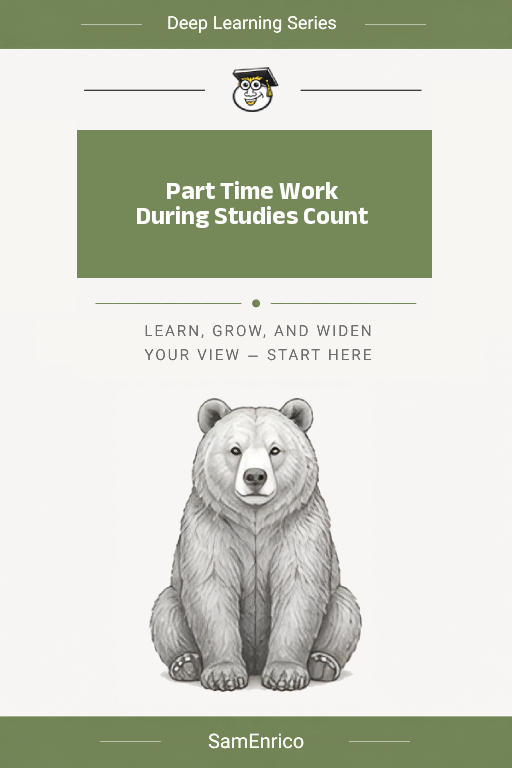
Part Time Work During Studies Count eBook
Understand that part-time work during your degree
by Fair Dede
Understand that part-time work during your degree does NOT count toward CEC, focusing on full-time post-graduation Canadian experience only.
Formats
Free sample
Chapter 1: The $10,000 Lie...--–- The email arrived on a Tuesday. Priya read it three times in her campus library, her vision blurring after the second pass. Six months of waiting. Six months of hoping. Six months of telling her parents she was almost a permanent resident.
And now this: a one-paragraph refusal letter from Immigration, Refugees and Citizenship Canada stating that her application for permanent residence under the Canadian Experience Class had been rejected.The reason? Her 2,080 hours of Canadian work experience—accumulated over three years while she completed her master's degree at the University of Toronto—did not count. Not a single hour.Priya had worked twenty hours per week as a research assistant in the economics department. She had paid Canadian taxes. She had Canadian references.
She had, by every reasonable definition, "Canadian work experience." But IRCC's letter was clear: work performed while holding a study permit is not eligible for the Canadian Experience Class. Only work completed after graduation counts.She had graduated fourteen months ago. She had worked another 1,200 hours in a full-time job after graduation. But because she had claimed the 2,080 student hours in her application, believing they would strengthen her case, IRCC had flagged her file for misrepresentation. They had not simply rejected the student hours.
They had rejected her entire application, including the legitimate post-graduation hours, because the officer could not determine which hours she was claiming under which status.Priya lost her $1,365 application fee. She lost six months of processing time. She lost the remaining twelve months on her Post-Graduation Work Permit because she had stopped working while waiting for a decision. Most painfully, she lost her place in the Express Entry pool. When she reapplied eighteen months later, the minimum CRS score had risen by forty-two points.
She never received another invitation.Priya is not a cautionary tale about laziness or ignorance. She is a cautionary tale about what no one tells you before you arrive in Canada.The Most Expensive Sentence You Have Never Read Somewhere in the Immigration and Refugee Protection Regulations—a document that runs over 400 pages and is written in the dense, impenetrable language of Canadian administrative law—there is a sentence that will determine whether you become a permanent resident or go home. Most international students will never read it. Their universities will not quote it. Their immigration consultants may not even mention it.
And yet that single sentence is the difference between a successful PR application and a $10,000 mistake.That sentence appears in section 87.1(2) of the regulations, tucked between provisions about provincial nominees and family sponsorships. It reads: "Work experience must be acquired after the foreign national completed the program of study."Let that sink in for a moment. Not "work experience is valuable." Not "work experience should be Canadian." Not "work experience helps your application." After the foreign national completed the program of study. Every hour you work before graduation—whether on campus or off, whether as a teaching assistant or a software developer, whether for minimum wage or six figures—is invisible to the Canadian Experience Class.This is not a loophole. It is not a technicality that clever lawyers can argue around.
It is the letter of the law, written explicitly to prevent precisely what Priya attempted: counting student work toward permanent residence. The logic is simple but brutal. A study permit grants you temporary status for the purpose of education. Any work you perform under that permit is incidental to your primary role as a student. The Canadian Experience Class, by contrast, is designed for workers who have already integrated into the Canadian labor market as full-time employees, not as students juggling part-time jobs between lectures.The problem is not that the law is hidden.
The problem is that everyone around you—your university, your friends, social media influencers, even some immigration consultants—is telling you a story that feels true but is legally false.The Story You Have Been Sold Picture the typical international student orientation at any Canadian university. The presenter stands at the front of a lecture hall filled with anxious, hopeful faces from India, China, the Philippines, Nigeria, Brazil, and dozens of other countries. They click to a slide titled "Work While You Study!" The bullet points are cheerful: "20 hours per week during academic sessions," "Full-time during scheduled breaks," "No work permit required—it's included with your study permit!"The students nod. They take photos of the slide. They text their parents: "See?
Canada wants us to work. We will gain Canadian experience while we study." The university has told them a truth, but not the whole truth. Yes, you can work twenty hours per week. Yes, that work is legal. Yes, it will give you spending money and a line on your resume.
What the university does not say—what no university says, because it is not their job to teach immigration law—is that those hours will never, ever count toward permanent residence.The same story plays out on You Tube and Tik Tok. Influencers with thousands of followers post videos titled "How I Got Canadian PR While Studying" or "My Secret to 2,000 Canadian Work Hours Before Graduation." They show screenshots of their paystubs and their study permits. They talk about the importance of "Canadian experience." What they do not show you is the fine print of their own PR applications. Many of them did not use their student hours for CEC at all. They used Provincial Nominee Programs, or spousal sponsorship, or they had enough post-graduation hours that the student hours were irrelevant.
But the video edit cuts around those details because "I got lucky with a PNP stream that accepts co-op hours" is less clickable than "How I hacked Canadian immigration."This is not malice. Most of these influencers genuinely believe they are helping. They are repeating what they heard from someone else, who heard it from someone else, in an endless game of telephone where the original regulatory text has been lost. But good intentions do not stop IRCC from rejecting your application.The Three Categories of Canadian Work (Only One Matters)To understand why this confusion persists, you need to understand how IRCC categorizes work experience. There are three distinct categories, and only one of them leads to CEC eligibility.
Most students and even many immigration guides blur these categories together, with disastrous results.Category One: Work Performed While Holding a Study Permit (Before Graduation)This includes every hour you work from the day your study permit is approved until the day your institution confirms that you have completed your program. It does not matter whether the work is on campus (library, food court, research assistant) or off campus (retail, restaurant, office job). It does not matter whether the work is TEER 0 (management), TEER A (professional), or TEER B (technical). It does not matter whether you worked twenty hours per week or, during breaks, forty hours per week. Every single hour in this category is excluded from CEC by section 87.1(2).The only exception—and it is a narrow one—is if you completed a co-op or internship that was formally integrated into your curriculum and for which you received academic credit.…
This is the end of the free sample. Get the eBook to keep going. Buy now
About this book
Details
- Author
- Fair Dede
- Publisher
- SamEnrico
- Language
- English
- Genre
- Non-Fiction, Student's Shortcut
- Released
- 2026-05-30
- Pages (approx.)
- 144
- Available as
- eBook, Audiobook

Read better in the ZLOADR app
Your eBooks on your phone or tablet. Sign in with your SamEnrico account and start reading.
More by Fair Dede
 Accessory Dwelling Unit for RetirementFair Dede$11.99
 Sheppard Case Final Verdict HistoryFair Dede$11.99
 Party Quirks CharadesFair Dede$11.99
 Stress Management PerimenopauseFair Dede$11.99
 Lucid Dream Problem SolvingFair Dede$11.99
 Peter Cullen Optimus PrimeFair Dede$11.99
 Sleep Meditation For AnxietyFair Dede$11.99
 Morning Routine for FirefightersFair Dede$11.99
 The Stormy Love of Barbara Hepworth and Ben Nicholson: A Marriage of Modern ArtFair Dede$11.99
 The Troll King's Last Gamble: A Nordic Wager of Stone and ShadowFair Dede$11.99
 How to Produce Vehicle Door Lock ActuatorsFair Dede$11.99
 Organic Certification ExportsFair Dede$12.99
You may also like
 LSE Online Program LengthAgee Letisha$11.99
 Harvard Extension School for Working AdultsRoush Yer$11.99
 LSE Online Reading ListAshford Ludivina$11.99
 LSE Online Language RequirementsWhitten Daphine$11.99
 LSE Online Class SizeHughey Garret$11.99
 LSE Online Alumni MentorshipWild Lyla$11.99
 London School of Economics Alumni NetworkDutton Chantal$11.99
 Harvard Extension School Student SupportCantrell Christene$11.99
 Harvard Extension School Library AccessSantana Adah$11.99
 Harvard Extension School Degree CompletionBray Wyatt$11.99
 Harvard Extension School Course AuditingAbbott Craig$11.99
 Harvard Extension School Extension DiplomaNew Joane$11.99