
Non-FictionStudent's ShortcutStudent Employment
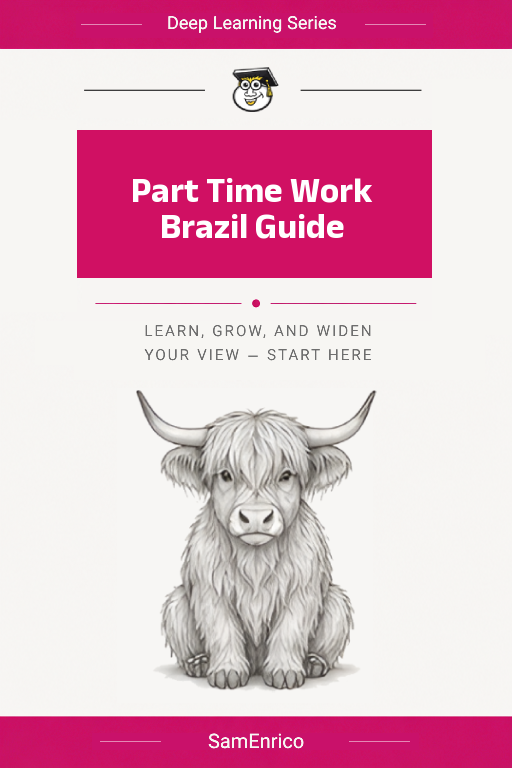
Part Time Work Brazil Guide eBook
Understand student work rights and find informal o
Understand student work rights and find informal or freelance work while studying.
Formats
Free sample
Chapter 1: The Visa Paradox--–- The consulate officer stamped your passport, smiled, and said, "Remember, no work allowed." Three weeks later, your landlord wants rent, your bank account is draining, and you see Brazilian students your age waiting tables, driving deliveries, and tutoring English. Something doesn't add up. You're about to discover that everything the consulate told you is incomplete—and what the Federal Police actually allows might surprise you enough to keep you in the country.Every year, thousands of foreign students arrive in Brazil carrying a VITEM-IV student visa and a set of instructions that are technically correct but practically useless. The consulate told you not to work. The airline didn't ask.
The immigration officer at Guarulhos Airport just stamped your passport and waved you through. Now you're here, and the math of survival is hitting hard: tuition, rent, food, transportation, and the social life that makes study abroad worthwhile. If you don't figure out how to earn money legally, you have three options: burn through savings, depend on family, or break the law and hope you don't get caught.This chapter solves the central paradox that traps nearly every foreign student in Brazil. You will learn exactly what your visa allows, what it forbids, and—most importantly—how to navigate the gap between consular warnings and federal permissions. By the end of this chapter, you will know whether you can work, how many hours, what types of jobs are legal, and how to avoid becoming one of the deportation case studies that Brazilian immigration lawyers whisper about at conferences.The Consulate Told You One Thing.
The Federal Police Say Another.The confusion starts at the source. Brazilian consulates abroad operate under a conservative interpretation of immigration law. Their default answer to any question about work is "no" because it protects them from liability. If a consulate tells you that you can work and you later violate your visa terms, you might blame them. So they take the safest path: deny everything.But the Federal Police (Polícia Federal), who actually enforce immigration law within Brazil, have a different mandate.
They are responsible for administering visas, renewing them, and deciding who gets deported. And their internal regulations explicitly allow certain types of work for student visa holders.Here is the critical distinction that will save you months of confusion: The consulate controls entry. The Federal Police control stay. The consulate's job is to screen who comes in. The Federal Police's job is to manage who stays.
And the Federal Police have decided that students who contribute to the Brazilian economy through legal, limited work are not a threat—they are an asset.The legal basis for student work comes from two sources. First, Article 14 of Law 13.445/2017 (the Migration Law) states that temporary visa holders may engage in remunerated activities if authorized by immigration authorities. Second, Normative Resolution 36/2017 of the National Immigration Council (CNIg) specifically addresses student visa holders and establishes the framework for work authorization.What does this mean in plain Portuguese? Your student visa does not say "work prohibited." It says "work requires specific authorization." That authorization exists. You just have to request it properly.Remuneração vs.
Bolsa: The Distinction That Changes Everything Before we go any further, you need to understand two Portuguese words that will determine your entire work strategy in Brazil. Mixing them up can mean the difference between legal work and deportation.Remuneração (salary) refers to payment for services rendered under an employment relationship. This means a formal contract, a signed CTPS (Carteira de Trabalho e Previdência Social), employer contributions to INSS (social security), and all the rights and obligations of Brazilian labor law. Remuneração is what most people mean when they say "a job."Bolsa (scholarship or stipend) refers to payment for educational activities. This includes research assistantships, teaching assistantships, monitoring positions, and certain internship programs.
A bolsa is not considered employment under Brazilian labor law. It is considered educational support.Why does this matter? Because bolsas generally do not require separate work authorization from the Federal Police. If your university offers you a bolsa for research or teaching assistance, your student visa and university enrollment are usually sufficient. The bolsa does not count toward your work hour limits in most cases.
And the bolsa is not subject to minimum wage laws because it is classified as educational support, not employment.However—and this is a critical however—if your bolsa requires a CTPS, then it legally becomes remuneração and all employment rules apply. Always check your contract. If it says "CTPS" anywhere, you are in employment territory, not educational territory.The 30-Hour Rule: Your Legal Maximum Let's establish the single most important number in this book: 30 hours per week. That is the legal maximum for student work in Brazil under standard authorization. Not 40.
Not 35. Thirty.But here is where nuance matters. The law says "maximum 30 hours" but most universities recommend 20-25 hours to balance work with studies. The Federal Police will not penalize you for working 28 hours. They will penalize you for working 32.
The line is clear: 30 is the ceiling. Anything above that is visa violation.The rule applies to two specific categories of work:First, estágios (internships) . These are formal arrangements between you, your university, and an employer. The employer must sign a contract called the Termo de Compromisso de Estágio. Your university must approve it.
And your work cannot exceed 30 hours per week. Estágios can be paid or unpaid, though paid is obviously preferable.Second, trabalho formal (formal employment) through a CTPS. This is rarer for students because it requires the employer to register you as an employee with all associated costs (13th salary, vacation pay, INSS contributions). Most employers prefer estágios because they are cheaper and more flexible.What about informal work—babysitting, tutoring, dog walking? The 30-hour rule technically applies if you are engaged in any remunerated activity.
But informal work is, by definition, undocumented. The Federal Police cannot track hours you don't report. This creates a gray area that we will explore in Chapter 5. For now, understand that the legal maximum is 30 hours regardless of how you earn the money.Jovem Aprendiz: The Special Case Brazil has a unique law called the Jovem Aprendiz (Young Apprentice) program. Under the Lei da Aprendizagem (Law 10.097/2000), medium and large companies are required to hire a percentage of their workforce as apprentices aged 14 to 24.
The purpose is not cheap labor—it is professional training. Apprentices work, but they also attend classes. The employer must provide both.For foreign students, the Jovem Aprendiz program is the safest legal path to formal employment. Here is why:First, it requires a formal CTPS. Your work is fully documented, which means you have all the rights of any Brazilian worker: 13th salary, vacation pay, INSS contributions, and unemployment protection.Second, the hours are capped at 20-30 per week, perfectly aligned with your visa limits.Third, the employer cannot fire you without cause.
The Jovem Aprendiz contract is designed for training, not exploitation. Termination requires documented performance issues or mutual agreement.Fourth, and most importantly for visa purposes, the Jovem Aprendiz program explicitly acknowledges your student status.…
This is the end of the free sample. Get the eBook to keep going. Buy now
About this book
Details
- Author
- Childs Sparkle
- Publisher
- SamEnrico
- Language
- English
- Genre
- Non-Fiction, Student's Shortcut, Student Employment
- Released
- 2026-06-01
- Pages (approx.)
- 155
- Available as
- eBook, Audiobook

Read better in the ZLOADR app
Your eBooks on your phone or tablet. Sign in with your SamEnrico account and start reading.
More by Childs Sparkle
 Anger in Borderline PersonalityChilds Sparkle$11.99
 Spoofing and Layering CasesChilds Sparkle$11.99
 Spin Class Pre Workout Fueling GuideChilds Sparkle$11.99
 Antwerp Diamond Heist Hidden Camera FootageChilds Sparkle$11.99
 The Adaptive Athlete GuideChilds Sparkle$11.99
 The Cult of the Black Cube: How a Modern Mystery Took Over the InternetChilds Sparkle$11.99
 Silicon Shame: The Rise and Fall of Elizabeth HolmesChilds Sparkle$11.99
 Understanding DiphalliaChilds Sparkle$17.99
 10 Ways to Use Crisps (Recipe Book)Childs Sparkle$11.99
 Danish Pay Limit SchemeChilds Sparkle$12.99
 Automotive Store ManagerChilds Sparkle$11.99
You may also like
 Hong Kong Handover 1997Dunn Johnnie$11.99
 Zumba For Postnatal Recovery CourseNeal Christian$11.99
 Zumba for BeginnersLadner Nikia$11.99
 YouTube Comment Mining GuideHumes Pandora$12.99
 Worry Box MeditationCarlin Rudy$11.99
 Workplace Stress MeditationNguyen Lynn$11.99
 Workplace Stress and Sleep RepairHawley Ivory$11.99
 Workplace Perfectionism CureDelaney Jeffry$11.99
 Workplace Injustice Anger GuideWallen Isabelle$11.99
 Work Addiction and Burnout LinkGreenwood Ester$11.99
 Women in Yoga and WellnessBeattie Galina$11.99
 Women in Stand Up ComedyChun Evangeline$11.99