
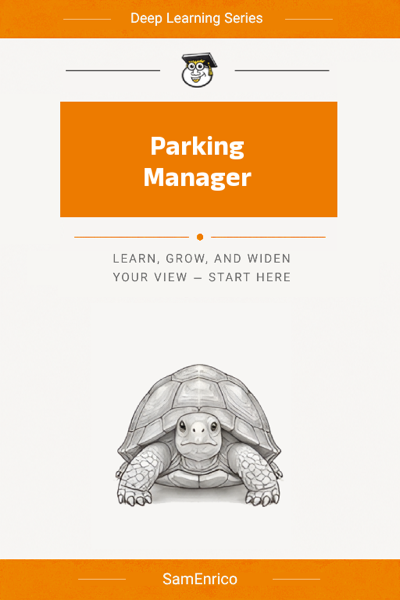
Parking Manager eBook
A Coursebook on Parking Manager
by Peck Shella
A Coursebook on Parking Manager
Formats
Free sample
Chapter 1: The Asphalt Revolution...–- Let me tell you something that sounds like a contradiction: the most valuable real estate in your city is probably the piece you hate the most. It’s where you circle for fifteen minutes while your child waits in the emergency room. It’s where you’ve gotten three tickets in two years. It’s where that crumbling garage charges you eighteen dollars for the privilege of wondering if your car will still have its catalytic converter when you return. That piece of real estate is parking.
And everything you think you know about it is wrong.Let me start with a confession. I spent the first decade of my career believing that parking management was a necessary evil—a utility, like sewage treatment or street sweeping. You did it because you had to, not because you wanted to. You hired attendants who hated their jobs, enforced regulations that made everyone angry, and watched as your parking assets operated at 40 percent occupancy while citizens screamed that there wasn’t enough parking. I was, by every measure, a competent parking manager.
I balanced budgets. I maintained facilities. I issued citations according to the municipal code. And I was completely missing the point.The point—the one that took me ten years and a near-meltdown at a city council meeting to understand—is that parking is not a utility. It is a lever.
Pull it one way, and you create traffic congestion, housing unaffordability, and downtown decay. Pull it the other way, and you unlock housing supply, reduce vehicle miles traveled, revive commercial districts, and generate revenue that can rebuild neighborhoods. The difference between those two outcomes is not technology or budget or political will. It is the difference between seeing parking as a collection of spaces and seeing it for what it actually is: the most powerful, most misunderstood, and most poorly managed asset in the modern city.This book exists because that misunderstanding is expensive. Not just in dollars—though we will talk about the millions of dollars that leak out of parking operations every year through poor processes, outdated technology, and strategic blindness.
It is expensive in wasted time (the average American driver spends seventeen hours per year circling for parking). It is expensive in environmental damage (cruising for parking accounts for approximately 30 percent of urban traffic congestion). And it is expensive in human terms: the frustration, the anger, the quiet desperation of a parent circling a hospital lot while a child waits inside.I wrote this book for the people who are tired of that reality. You might be a parking manager who inherited a dysfunctional operation and doesn’t know where to start. You might be a city planner who suspects that your downtown’s parking requirements are strangling the very businesses you’re trying to save.
You might be a real estate developer who has built two levels of underground parking that nobody uses because the city code required it. You might be a mayor or a city council member who has sat through three-hour public hearings about parking and emerged with a headache and no solutions. Or you might be none of those things—just someone who lives in a city and wonders why something so simple feels so broken.Here is the answer: it’s not broken. It’s unmanaged. And the difference between broken and unmanaged is the difference between a problem you inherit and a problem you can solve.The Moment Everything Changed I need to tell you about a Tuesday in October.
I was the parking manager for a mid-sized city of about 120,000 people—the kind of city that had a charming downtown, a regional hospital, a community college, and what residents called a “parking problem.” For three years, I had heard that phrase at every public meeting, every city council session, and every coffee shop conversation I accidentally walked into. “We have a parking problem.” It was the civic mantra, repeated so often that no one questioned it.Then I did something stupid. I looked at the data.Not the superficial data—the complaints, the wait times, the revenue totals. I looked at actual occupancy numbers. Every hour, for two weeks, my staff and I walked every block of downtown, every parking garage, every surface lot, and we counted empty spaces.
What we found was inconvenient for the narrative. At peak demand—a Tuesday at 1:00 PM, when the courthouse was in session, the restaurants were busy, and the medical offices were full—our downtown parking utilization rate was 68 percent. That meant nearly one out of every three spaces was empty. Yet when I presented this data to the city council, a council member looked at me and said, with complete sincerity, “I don’t care what your numbers say. I can’t find parking when I go to lunch.”That was the moment.
Not the data. The gap between the data and the perception. Because here’s the truth I learned that Tuesday: parking is not a physical problem. It is a psychological one. It is a distribution problem.
It is a pricing problem. It is a design problem. But it is almost never a supply problem. Cities almost never lack parking spaces. They lack the management systems to make those spaces available to the people who need them at the times they need them.Sixty-eight percent utilization.
Think about that. For every ten spaces, three were sitting empty at the busiest hour of the week. And yet the perception was scarcity. Why? Because the spaces that were empty were not the spaces people wanted.
They were three blocks from the courthouse. They were on the top floor of a garage with a broken elevator. They were unpriced—free, unlimited, and therefore always occupied by the same commuter cars that arrived at 7:00 AM and didn’t move until 5:00 PM. The scarcity was not a shortage of spaces. It was a shortage of the right spaces, priced correctly, managed intelligently.That realization changed everything.
It changed how I thought about my job. It changed how I trained my staff. And it changed the trajectory of that city’s downtown. Over the next eighteen months, we implemented a series of changes that seem obvious in retrospect but felt radical at the time. We introduced demand-based pricing—charging more for the most convenient spaces during peak hours and less for peripheral spaces.
We converted eight blocks of free, unlimited street parking to paid, time-limited parking. We used the revenue from those meters to fund a downtown shuttle that connected the peripheral lots to the main commercial corridor. We painted, re-striped, and re-lit every garage.The result? Cruising traffic dropped by 22 percent. Downtown retail sales increased by 9 percent.
The city recovered $180,000 in previously uncollected revenue. And the complaints? They spiked for three months—and then they all but disappeared. Because the people who complained were not complaining about parking. They were complaining about the experience of parking.
And we changed the experience.What This Book Is Not Before we go any further, let me tell you what this book is not. It is not a dry, academic textbook filled with…
This is the end of the free sample. Get the eBook to keep going. Buy now
About this book
Details
- Author
- Peck Shella
- Publisher
- SamEnrico
- Language
- English
- Genre
- Non-Fiction, Informative, Educational
- Released
- 2026-05-11
- Pages (approx.)
- 147
- Available as
- eBook, Audiobook

Read better in the ZLOADR app
Your eBooks on your phone or tablet. Sign in with your SamEnrico account and start reading.
More by Peck Shella
 Temperature Sleep RegulationPeck Shella$11.99
 Phone Conversation Starters CoursePeck Shella$11.99
 Einstein's Nobel Prize StoryPeck Shella$11.99
 Walking Meditation for Beginners GuidePeck Shella$11.99
 Cognitive Defusion CravingsPeck Shella$11.99
 Nefertem's Lotus: The Dawn of PerfumePeck Shella$11.99
 Frozen Frontiers: The Antarctic Physiology Breakthroughs That Changed MedicinePeck Shella$11.99
 How to Start a Space Research and Technology BusinessPeck Shella$11.99
 Grant Writer Freelance GuidePeck Shella$12.99
 One Page Influencer Strategy WorkbookPeck Shella$12.99
 Understanding GlycosuriaPeck Shella$17.99