
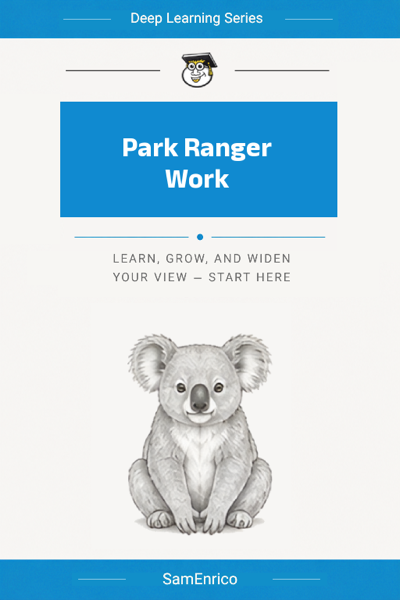
Non-FictionInformativeEducational
Park Ranger Work eBook
A Coursebook on Park Ranger Work
by Hawks Kareem
A Coursebook on Park Ranger Work
Formats
Free sample
Chapter 1: What We Inherited...--The elk had been dead for three days when I found it, though the smell suggested something closer to a week. Its body lay at the bottom of a ravine forty yards off the main trail, hidden from casual view but not from a ranger who knew where to look during the late summer rut. The antlers were gone—sawed off clean at the base, a straight cut that spoke of a battery-powered reciprocating tool, not the hack-and-tear of wildlife scavengers. The rest of the carcass had been left to rot. No meat taken.
No hide harvested. Just the antlers, destined for a wall, a buyer, or a black-market website advertising "sheds" that were never shed at all.I knelt in the dirt and pulled out my notebook. The date. The time. The GPS coordinates.
The direction of the saw marks. The tire tracks I had already photographed twenty yards up the old logging road. This was not my first poaching scene, and it would not be my last. But as I sat there, the late afternoon sun filtering through the ponderosa pines, I realized that everything I needed to know about being a park ranger had led me to this exact moment: a dead animal, a stolen piece of public trust, and the long, complicated history that made this ravine mine to protect.This chapter is about that history. Not the dry, dates-and-names version you slept through in high school, but the living history that shapes every decision a ranger makes—from why we wear flat hats instead of campaign covers, to why a National Park ranger and a Forest Service ranger standing side by side have different legal authorities, different missions, and sometimes different opinions about what "conservation" actually means.
You cannot understand the job without understanding the inheritance. And the inheritance, like that poached elk, is both beautiful and brutal.The Cavalry Years: Soldiers in the Park Before there were rangers, there were soldiers. When Yellowstone became the world's first national park in 1872, Congress allocated no funding for its management. For fourteen years, the park had no official protection beyond the occasional visit from a well-meaning citizen or a volunteer superintendent with no budget and no authority. Visitors carved their names into Old Faithful.
Poachers slaughtered bison by the hundreds. Entrepreneurs built hotels and fenced off hot springs for private baths. The experiment in public land preservation was failing.In 1886, the United States Cavalry rode in. The Army dispatched Company M of the First Cavalry to take control of Yellowstone, and for the next thirty-two years, soldiers in blue coats served as the first true park rangers. They patrolled on horseback, arrested poachers, evicted squatters, and built the first infrastructure of park management: trails, patrol cabins, and a rudimentary system of visitor regulation.
The cavalry brought military discipline to a civilian problem, and they invented many of the traditions we still recognize today—the flat hat, the campaign uniform, the expectation that a ranger is part lawman, part host, and part soldier.But the cavalry years also left a complicated legacy. The soldiers who protected Yellowstone from poachers were the same soldiers who had recently participated in the Indian Wars, clearing Indigenous peoples from lands that became parks. The contradiction was not lost on anyone at the time, and it should not be lost on us now. When we say that rangers inherited a tradition of "protection," we must also acknowledge who was being protected and who was being removed. The first park rangers stood on land that was never empty, and that truth echoes in every dispute over tribal access, sacred site protection, and co-management agreements today.The Organic Act of 1916: The Mission Statement We Still Fight Over In 1916, President Woodrow Wilson signed the Organic Act, creating the National Park Service and giving it a mission that has been debated, interpreted, and argued over for more than a century.
The language is deceptively simple: the Park Service exists "to conserve the scenery and the natural and historic objects and the wild life therein and to provide for the enjoyment of the same in such manner and by such means as will leave them unimpaired for the enjoyment of future generations."Read that sentence again. It contains a contradiction that every ranger lives with daily. Conserve. Provide for enjoyment. Leave unimpaired.
These three verbs pull against each other constantly. How do you provide access to a waterfall while leaving it unimpaired? How do you let ten million people enjoy a geyser basin without loving it to death? How do you protect a trail from erosion while keeping it open to the hikers who pay your salary?The Organic Act did not resolve these tensions. It codified them.
And that is the genius and the curse of American land management: we are not a country that resolves contradictions cleanly. We are a country that builds agencies to manage them.The Birth of Multiple Use: The Forest Service and the BLMWhile the National Park Service focused on preservation, the US Forest Service took a different path. Created in 1905 under the leadership of Gifford Pinchot, the Forest Service was built on a philosophy called "conservation through use." Pinchot believed that forests should be managed scientifically to produce timber, water, grazing land, and recreation simultaneously. This was not preservation; it was sustainable extraction. The USFS motto—"Caring for the land and serving people"—reflects a mission that balances production and protection in ways that the Park Service never attempted.The Bureau of Land Management arrived later, cobbled together in 1946 from the General Land Office and the Grazing Service.
The BLM inherited millions of acres that nobody else wanted: desert, sagebrush steppe, scrubland, and the leftover spaces between national forests and parks. For decades, the BLM was called the "Bureau of Livestock and Mining" because its primary constituents were ranchers and miners. That has changed, but the legacy remains. A BLM ranger working in the Mojave Desert faces different challenges than an NPS ranger at Yosemite—fewer visitors, more cattle, more off-road vehicles, and a legal mandate that prioritizes multiple use over preservation.The Multiple-Use Sustained-Yield Act of 1960: The Legal Bedrock of Conflict If the Organic Act is the constitution of the National Park Service, the Multiple-Use Sustained-Yield Act of 1960 is the constitution of the Forest Service and the BLM. This law declared that federal lands should be managed for five purposes: outdoor recreation, range (grazing), timber, watershed protection, and wildlife and fish.
That is five different missions pulling in five different directions. A forest that produces timber cannot always produce pristine wildlife habitat. A grazing allotment that feeds cattle cannot always protect stream banks. A watershed that supplies drinking water to a city cannot always accommodate off-road vehicles.The ranger's job is to navigate these conflicts every day. When a mountain biker complains about a logging road, when a rancher accuses a hiker of leaving gates open, when a timber company sues to block a trail closure—these are not failures of management.
They are the intended consequences of a legal system that refuses to pick a winner. The Multiple-Use Act does not say which use is…
This is the end of the free sample. Get the eBook to keep going. Buy now
About this book
Details
- Author
- Hawks Kareem
- Publisher
- SamEnrico
- Language
- English
- Genre
- Non-Fiction, Informative, Educational
- Released
- 2026-05-08
- Pages (approx.)
- 131
- Available as
- eBook, Audiobook

Read better in the ZLOADR app
Your eBooks on your phone or tablet. Sign in with your SamEnrico account and start reading.
More by Hawks Kareem
 Shopping Addiction And Gift Giving Compulsion WorkbookHawks Kareem$11.99
 The Face Mapping TechniqueHawks Kareem$11.99
 Russian Smuggling to North KoreaHawks Kareem$11.99
 BPH Symptom Recognition GuideHawks Kareem$11.99
 Snapchat Spotlight Self EsteemHawks Kareem$11.99
 The Lost Kingdoms Beneath: Exploring Africa's Forgotten Caves (15th-16th Century)Hawks Kareem$11.99
 The Grand Illusion: How the 'Mars Hoax' Fooled MillionsHawks Kareem$11.99
 How to Start a Awnings and Sunblinds (retail) Business (Beginners Guide)Hawks Kareem$11.99
 Understanding Congenital HHawks Kareem$17.99
 China Student Budget GuideHawks Kareem$12.99
 Scaling BoP Product SuccessHawks Kareem$12.99
You may also like
 Hong Kong Handover 1997Dunn Johnnie$11.99
 Zumba For Postnatal Recovery CourseNeal Christian$11.99
 Zumba for BeginnersLadner Nikia$11.99
 YouTube Comment Mining GuideHumes Pandora$12.99
 Worry Box MeditationCarlin Rudy$11.99
 Workplace Stress MeditationNguyen Lynn$11.99
 Workplace Stress and Sleep RepairHawley Ivory$11.99
 Workplace Perfectionism CureDelaney Jeffry$11.99
 Workplace Injustice Anger GuideWallen Isabelle$11.99
 Work Addiction and Burnout LinkGreenwood Ester$11.99
 Women in Yoga and WellnessBeattie Galina$11.99
 Women in Stand Up ComedyChun Evangeline$11.99