
Non-FictionHealth & WellnessOutdoor Fitness
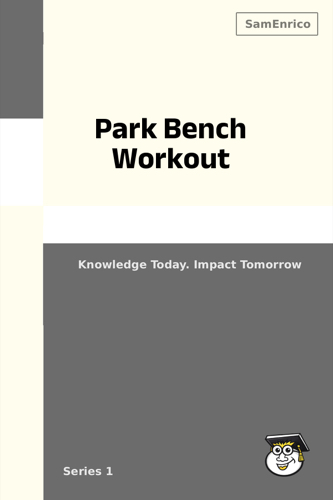
Park Bench Workout eBook
Teaches outdoor public park exercises using benche
Teaches outdoor public park exercises using benches for support and triceps dips.
Formats
Free sample
Chapter 1: The Hidden Gym--–- It started with a broken alarm clock and a canceled gym membership.The alarm didn't go off. That was the first thing. The second thing was the email from the gym—the one informing you that your monthly dues had increased again, this time by eighteen percent, and that a "facility improvement fee" would be added to your next billing cycle. You know the email. You've probably received it yourself, or something close to it.
You sat there on the edge of your bed, phone in hand, doing the mental math that no one should have to do at six-fifteen in the morning. Eighty-something dollars a month. Nearly a thousand dollars a year. For what? For the privilege of waiting fifteen minutes for the squat rack.
For the stale, recycled air that smells vaguely of rubber mats and someone else's desperation. For the fluorescent lights that make everyone look slightly ill.You scrolled past the email and opened your calendar instead. The day was already full—back-to-back meetings, a late deadline, a kid's soccer practice, a sink full of dishes you didn't wash last night. There was no time to drive twenty minutes to the gym, change clothes, wait for equipment, work out, shower, drive back. There was barely time to breathe.
And somewhere in that exhausted, pre-dawn calculation, you made a decision. Not a dramatic one. Not the kind of decision that comes with a soundtrack or a montage. Just a quiet, practical conclusion: This isn't working.That's where this book begins. Not with a hero's journey or a transformation story.
Not with a before-and-after photo that makes you feel inadequate. It begins with the simple, unglamorous recognition that the way most of us have been taught to exercise is broken. It's too expensive. It's too inconvenient. It's too dependent on machines and memberships and the perfectly controlled environment of a building that you have to drive to, pay for, and schedule your life around.But here's the thing about that broken system: it has convinced you that you need it.
That without it, you cannot get strong. That the only path to fitness runs through a front desk where someone scans your key fob and hands you a towel. That the equipment in that building—the gleaming metal stacks of weight plates, the cable machines with their pulleys and pins, the pneumatic leg presses that cost more than your car—is somehow essential to the process of building a stronger body.It's not. And the proof has been sitting outside your front door the entire time, often ignored, sometimes occupied by a person eating lunch or a teenager scrolling through their phone. The park bench.
That simple, unassuming slab of wood and metal. It doesn't have a brand name. It doesn't require an app. It has never appeared in a commercial with a shirtless influencer yelling at the camera. But it is, quite possibly, the most effective piece of functional fitness equipment ever built.This chapter is going to show you why.
Not with hype. Not with promises of six-pack abs in six minutes a day. With something better: evidence, experience, and a fundamental understanding of how the human body actually works when you take it outside and ask it to move.The Green Gym: What the Research Actually Says Let's start with the science, because the science is surprisingly clear. In 2018, researchers at the University of Edinburgh published a study that compared two groups of people performing the exact same workout. One group did it indoors, in a standard gym environment with climate control and artificial lighting.
The other group did it outdoors, in a park with trees, grass, and natural light. The workout itself was identical—thirty minutes of bodyweight circuits involving squats, lunges, push-ups, and planks. The results were not identical.The outdoor group reported significantly lower levels of perceived exertion—meaning the workout felt easier even though they were doing the same amount of work. Their cortisol levels, measured through saliva samples, dropped by an average of fifteen percent more than the indoor group's. Their self-reported mood scores improved by nearly double.
And when both groups were given cognitive tests after the workout—tests measuring attention, working memory, and processing speed—the outdoor group outperformed the indoor group by a statistically significant margin.This is not an isolated finding. The phenomenon has a name: the "Green Gym" effect, coined by researchers at the University of Essex who have been studying outdoor exercise since the early 2000s. Their work has consistently shown that exercising in the presence of nature—even just trees and grass, not dramatic landscapes—produces measurable improvements in mental health, stress recovery, and exercise adherence. People who work out outdoors are more likely to stick with their fitness routines, not because outdoor workouts are easier (they aren't) but because they are more pleasant. The experience of moving your body under open sky, with wind on your skin and sunlight on your face, changes the psychological calculus of exercise.
It stops feeling like a chore you have to endure and starts feeling like something you get to do.There's also the question of vitamin D, though that's almost too obvious to mention. Roughly forty percent of adults in the United States are deficient in vitamin D, a hormone that plays critical roles in bone health, immune function, and mood regulation. You cannot get meaningful amounts of vitamin D from food. You get it from sunlight. Specifically, from exposing your skin to direct sunlight for fifteen to twenty minutes several times per week.
A gym, by definition, has no windows that open to the sun. A park bench sits directly in it.But the benefits go deeper than mood and micronutrients. Consider the physics of indoor versus outdoor movement. When you exercise indoors, you are moving through a controlled environment with a flat floor, predictable surfaces, and stable temperatures. When you exercise outdoors, you are moving through a dynamic environment with uneven ground, changing light, shifting wind, and variable temperatures.
That unpredictability forces your body to do something that machines and flat floors never require: adapt in real time. Every step you take on grass requires micro-adjustments in your ankles, knees, and hips. Every push-up you perform with your hands on a bench requires stabilizing muscles that flat-floor push-ups ignore. Every squat you do on uneven ground recruits small stabilizer muscles that are completely dormant when you squat on a rubber gym mat.This is not a bug. It's a feature.
The outdoors is not an inferior version of the gym—it's a more complete training environment. The gym simplifies movement to make it safer and more predictable. The outdoors complicates movement to make it more functional and more transferable to real life. And a park bench, as you're about to learn, is the perfect tool for navigating that complexity.The Poverty of Equipment: Why Machines Build Fake Strength Let me tell you about a man named Tom. Tom was a client of mine several years ago, a software engineer in his early thirties who had been going to the gym four days a week for nearly two years.
He could leg press four hundred pounds on the plate-loaded machine. He could sit at the cable crossover station and…
This is the end of the free sample. Get the eBook to keep going. Buy now
About this book
Details
- Author
- Russo Germaine
- Publisher
- SamEnrico
- Language
- English
- Genre
- Non-Fiction, Health & Wellness, Outdoor Fitness
- Released
- 2026-06-09
- Pages (approx.)
- 127
- Available as
- eBook, Audiobook

Read better in the ZLOADR app
Your eBooks on your phone or tablet. Sign in with your SamEnrico account and start reading.
More by Russo Germaine
 Posture Reset Before TalksRusso Germaine$11.99
 Wedding Speech Mastery GuideRusso Germaine$11.99
 Body Language in FinanceRusso Germaine$11.99
 The Silk Road and the Stadium: How Ancient China's Football Fields United EmpiresRusso Germaine$11.99
 Live In Resident ManagerRusso Germaine$11.99
 How to Produce Card Game AccessoriesRusso Germaine$11.99
 Price War Avoidance Strategy GuideRusso Germaine$12.99
 How to Start a Oil-rig Transportation By Towing or Pushing Business (Beginners Guide)Russo Germaine$11.99
You may also like
 Hong Kong Handover 1997Dunn Johnnie$11.99
 Zumba For Postnatal Recovery CourseNeal Christian$11.99
 Zumba for BeginnersLadner Nikia$11.99
 YouTube Comment Mining GuideHumes Pandora$12.99
 Worry Box MeditationCarlin Rudy$11.99
 Workplace Stress MeditationNguyen Lynn$11.99
 Workplace Stress and Sleep RepairHawley Ivory$11.99
 Workplace Perfectionism CureDelaney Jeffry$11.99
 Workplace Injustice Anger GuideWallen Isabelle$11.99
 Work Addiction and Burnout LinkGreenwood Ester$11.99
 Women in Yoga and WellnessBeattie Galina$11.99
 Women in Stand Up ComedyChun Evangeline$11.99