
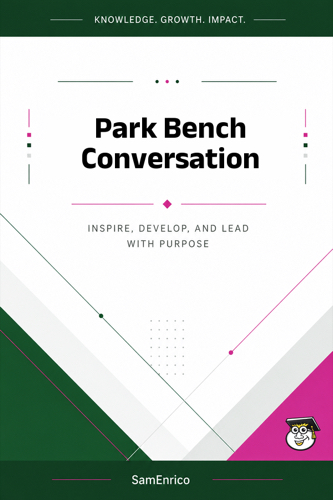
Park Bench Conversation eBook
Starts chats with strangers sitting nearby.
Starts chats with strangers sitting nearby.
Formats
Free sample
Chapter 1: The Loneliest Century...--–- The statistic arrives like an unwelcome houseguest: despite having more "connections" than any generation in human history—social media followers, Whats App groups, Linked In networks, texting chains that never end—rates of self-reported loneliness have tripled since the 1980s. The surgeon general has called loneliness an epidemic on par with smoking fifteen cigarettes a day. And yet, on any given morning, you will walk past dozens of people on your way to work without making eye contact with a single one. You will sit in a coffee shop surrounded by strangers and scroll through the curated lives of people you haven't spoken to in a decade. You will return home to a phone buzzing with notifications and a chest hollow with the quiet certainty that no one would notice if you vanished for a week.This is the paradox of the hyper-connected age.
We have never had more tools to reach each other. And we have never been more alone.The question this book poses is disarmingly simple, almost childlike in its innocence: what if the cure is sitting right next to you? What if the solution to the loneliness epidemic requires no app, no subscription, no therapy copay, no self-help seminar? What if it requires only a wooden plank, a public park, and the willingness to say the first word?This is the case for the bench.The Invention of Civil Inattention To understand why we stopped talking to strangers, we must first understand a peculiar social skill that sociologist Erving Goffman called "civil inattention." It is the polite fiction we maintain in public spaces that other people do not exist. You know the choreography: you enter an elevator, you glance at the floor numbers, you do not look at the other passengers.
You walk down a crowded sidewalk, your gaze fixed somewhere in the middle distance, your body language screaming "I am not here to interact." You sit on a park bench, and when someone sits on the other end, you pull out your phone as though it were a crucifix warding off a vampire.Civil inattention is not rudeness. It is a social contract. In a dense urban environment, if we acknowledged every person we passed, we would be overwhelmed within minutes. Civil inattention allows us to share space without sharing our attention. It is a survival mechanism for the city.But survival mechanisms have a way of metastasizing.
What began as a polite nod to the limits of human attention has become a default setting for almost all public interaction. We have trained ourselves so thoroughly to ignore strangers that we have forgotten how to recognize the ones who want to be seen.The Default to Truth: Why Your Brain Wants to Trust Strangers Here is a fact that will surprise you: evolution wired you to trust strangers.Malcolm Gladwell's "Default to Truth" theory, drawn from decades of psychological research, argues that humans are fundamentally predisposed to believe what other people tell them. This is not naivety. It is efficiency. Imagine if you had to verify every statement made by every person you encountered.
You would never leave your cave. Your ancestors survived because they assumed that the person pointing toward the berry patch was pointing toward berries, not toward a predator. Cooperation required trust. Trust required a baseline assumption of honesty.Your brain is a trust machine. It is built to say yes.So why, then, do you cross the street to avoid a bench-sitter?
Why do you pretend to be on your phone when someone sits beside you? Why does your heart rate spike when a stranger says "Hello"?Because between your evolutionary wiring and your present-day behavior, three forces have installed themselves like squatters in your nervous system. Understanding these forces is the first step toward evicting them.Force One: The Media Amplification Machine The first force is the simplest to name and the hardest to escape: modern media amplifies rare dangers until they feel like daily certainties.Consider the following. In 2019, before the pandemic rewrote every social script, the total number of child abductions by strangers in the United States was 115. Out of 73 million children.
Your odds of being struck by lightning in a given year are roughly 1 in 500,000. Your odds of being killed by a shark are 1 in 3.7 million. Your odds of being attacked by a stranger on a park bench are statistically indistinguishable from zero.But you have seen the news stories. You have heard the urban legends passed from parent to child like haunted heirlooms. You have internalized a world where every stranger is a potential threat because the media ecosystem profits from your fear.
"If it bleeds, it leads" is not a conspiracy theory. It is a business model.Your brain evolved to pay attention to threats. The media machine learned to manufacture threats. The result is a mismatch between perceived danger and actual danger that leaves you afraid of the very people most likely to help you in an emergency.Force Two: The Urban Legend Inheritance The second force is cultural rather than commercial: the stranger-danger messaging that shaped your childhood.Generation X and millennials were raised on a diet of after-school specials, public service announcements, and parental warnings that taught a simple, terrifying equation: stranger equals danger. The missing child on the milk carton became a symbol of a world where friendly men in vans offered candy and then stole your life.
The message was clear: trust no one you do not already know.This message worked. It kept children safe from a statistically negligible threat. But it also installed a neural circuit that has never been deactivated. Your adult brain still carries the child's fear. When a stranger sits beside you, you do not see a potential friend.
You see the face on the milk carton, even though you have never actually seen a face on a milk carton. The symbol has outlived the reality.Force Three: Lived Experience and Legitimate Fear The third force is the most important to name and the most difficult to discuss: for some people, the fear of strangers is not learned from media or urban legend. It is earned.Women, LGBTQ+ individuals, and people of color often have legitimate, lived-experience reasons to fear stranger interactions that straight white men do not share. This is not "stranger danger" bias. This is pattern recognition from survival.
If you have been catcalled, followed, harassed, or assaulted by strangers, your brain's threat response is not a malfunction. It is a rational adaptation to a world that has been dangerous to you in ways it has not been dangerous to others.This book does not ask you to ignore that lived experience. It does not tell you that your fear is imaginary. It does not suggest that you should sit down next to every stranger who passes. What this book offers is a low-risk training ground where you can choose when to override your fear and when to honor it.
The bench is not about pretending danger does not exist. It is about learning to distinguish between the roar of learned distrust and the whisper of legitimate…
This is the end of the free sample. Get the eBook to keep going. Buy now
About this book
Details
- Author
- Kimmel Cletus
- Publisher
- SamEnrico
- Language
- English
- Genre
- Non-Fiction, Self-Help, Outdoor
- Released
- 2026-06-06
- Pages (approx.)
- 128
- Available as
- eBook, Audiobook

Read better in the ZLOADR app
Your eBooks on your phone or tablet. Sign in with your SamEnrico account and start reading.
More by Kimmel Cletus
 Personal Branding for EngineersKimmel Cletus$11.99
 Coast Guard Rescue Swimmer StressKimmel Cletus$11.99
 Listening in Political Debate and DeliberationKimmel Cletus$11.99
 Accessory Dwelling Units for IncomeKimmel Cletus$11.99
 Paleo Slow Cooker RecipesKimmel Cletus$11.99
 Mother Loss Adult ChildKimmel Cletus$11.99
 Video Call Social AnxietyKimmel Cletus$11.99
 The Silent Coup: How a Shadow Network Toppled a GovernmentKimmel Cletus$11.99
 The Eagle and the Lion: Wellington’s Gambit at Salamanca (1812)Kimmel Cletus$11.99
 How to Produce Waste Containment AccessoriesKimmel Cletus$11.99
 How to Start a Panels Made of Fibre-cement Business (Beginners Guide)Kimmel Cletus$11.99
 How to Produce Lighters and Smoking AccessoriesKimmel Cletus$11.99
You may also like
 Hong Kong Handover 1997Dunn Johnnie$11.99
 Zumba For Postnatal Recovery CourseNeal Christian$11.99
 Zumba for BeginnersLadner Nikia$11.99
 YouTube Comment Mining GuideHumes Pandora$12.99
 Worry Box MeditationCarlin Rudy$11.99
 Workplace Stress MeditationNguyen Lynn$11.99
 Workplace Stress and Sleep RepairHawley Ivory$11.99
 Workplace Perfectionism CureDelaney Jeffry$11.99
 Workplace Injustice Anger GuideWallen Isabelle$11.99
 Work Addiction and Burnout LinkGreenwood Ester$11.99
 Women in Yoga and WellnessBeattie Galina$11.99
 Women in Stand Up ComedyChun Evangeline$11.99