
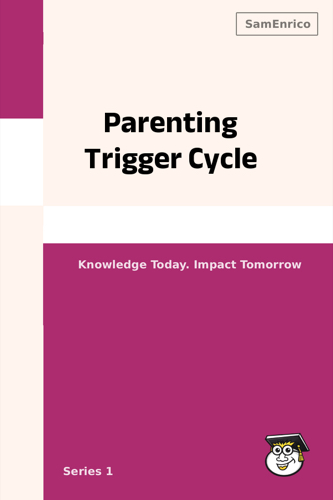
Parenting Trigger Cycle eBook
Helps parents avoid passing trauma triggers to chi
by Borden Lino
Helps parents avoid passing trauma triggers to children.
Formats
Free sample
Chapter 1: The Ghosts in the Nursery--You yelled at your four-year-old for spilling milk.Not a gentle “let’s clean this up together.” Not a patient reminder that cups go on the table. A full, chest-heaving, vein-in-the-neck yell that made your child’s face crumple before you even finished the second word. And then you saw it—the exact same expression you wore thirty years ago when your own mother lost her mind over something just as small.That moment—the split second between your explosion and your child’s tears—contains the entire thesis of this book. You were not yelling about milk. You were not even yelling at your child.
You were having a conversation with a ghost.Welcome to the nursery. It’s crowded in here.The Premise That Will Change Everything Let me say something that might sound extreme, but I need you to hear it clearly: most parents do not react to their children. They react to the memory of being parented.Every slammed door, every spilled drink, every whining voice, every “I hate you” from a teenager—these are not just events in the present. They are keys that unlock neural pathways laid down twenty, thirty, or forty years ago. Your child’s behavior is the stimulus.
Your past is the script. And your explosion is the replay.This is not a metaphor. This is neuroscience.Selma Fraiberg, a pioneering child psychologist, first named this phenomenon in her 1975 essay “Ghosts in the Nursery.” She wrote about how unresolved childhood experiences unconsciously dictate how we respond to our own children. The ghosts, she said, are “the visitors from the unremembered past” who take up residence in the parenting space. They whisper instructions.
They trigger reactions. And most of the time, we do not even know they are there.This chapter is the beginning of an exorcism.By the time you finish these pages, you will understand why you lose control over things that “shouldn’t matter.” You will learn to distinguish between a conscious, chosen response and an automatic, triggered replay. And you will begin the journey from shame—that heavy, suffocating feeling that says “something is wrong with me”—to curiosity, which asks the much more productive question: “What is my past demanding I see?”The Difference Between a Reaction and a Replay Before we go any further, we need to establish a distinction that will run through every chapter of this book. It is the difference between a conscious reaction and a triggered replay.Conscious Reaction A conscious reaction is thoughtful, proportional, and present-moment oriented. It looks like this:Your child whines about dinner.
You feel a flicker of annoyance. You take a breath. You say, “I hear that you don’t want to eat this. You don’t have to love it, but you do need to take three bites.” Your voice is firm but not loud. Your body is relaxed.
Your child might still complain, but you are not swept away.A conscious reaction is not about being perfectly calm. It is about choice. You are choosing your response, even if it is not a perfect one.Triggered Replay A triggered replay is automatic, out-of-proportion, and past-oriented. It looks like this:Your child whines about dinner. Before you know what happened, you are yelling.
Your face is hot. Your voice is loud. You say something like “You are so ungrateful! After everything I do for you!” Your child starts crying. You feel a wave of shame.
And you think, Where did that come from?That question—where did that come from?—is the doorway to healing. Because the answer is almost never “the whining.” The whining was just the trigger. The explosion came from somewhere else.Let me show you what I mean.Case Study: The Father Who Could Not Stand Tears James is a forty-two-year-old father of two. He loves his children. He works hard.
He reads parenting books. And he cannot stop yelling when his three-year-old daughter cries.“It’s not even real crying,” he told me once, shame leaking from every word. “She’ll drop a cracker and act like her world just ended. I know it’s normal. I know she’s three.
But something in me just... snaps. I see her face scrunch up and I hear myself screaming before I can stop it.”When we traced the feeling back, James discovered something he had not thought about in decades. When he was five years old, his father punished crying. Not with words—with a belt.
James learned that tears were dangerous. Tears invited pain. And so he stopped crying. By the time he was seven, he could count on one hand the number of times he had cried in front of another person.But the body remembers what the mind suppresses.When James’s daughter cried, her tears did not just activate his annoyance. They activated the five-year-old boy who learned that crying meant danger.
His amygdala—the brain’s fear center—sounded the alarm. His nervous system prepared for an attack. And the only response his childhood had taught him was fight.He was not yelling at his daughter. He was yelling at his father, who was not in the room. He was protecting a little boy who no longer needed protection.This is the ghost in the nursery.
James’s father was not physically present. But his legacy—the rule that tears are unacceptable—was running the show.Case Study: The Mother Who Panicked at Silence Maria is a thirty-eight-year-old mother of a teenage daughter. Her daughter, Sofia, is quiet by nature. She likes to retreat to her room after school. She does not share every detail of her day.
She is a normal, healthy adolescent.But Maria cannot handle the silence.“When she closes her door, I feel like I’m going to die,” Maria admitted. “Not metaphorically. My heart races. I start sweating. I have this overwhelming urge to knock on her door, to make her talk to me, to fix whatever is wrong—even when nothing is wrong.”Maria’s childhood tells the story.
Her mother was emotionally absent—present in the house but unreachable. When Maria was upset, her mother would say “You’re fine” and walk away. When Maria tried to share her feelings, her mother would change the subject. Maria learned that silence meant abandonment. If someone was quiet, they were leaving.Now, every time Sofia closes her door, Maria’s nervous system replays the terror of being a little girl whose mother was emotionally unavailable.
She is not responding to Sofia. She is responding to the ghost of her own mother.And here is the cruelest part: Maria’s panic actually pushes Sofia away. The more Maria demands connection, the more Sofia retreats. The cycle reinforces itself. The ghost grows stronger.What These Cases Have in Common James and Maria come from different backgrounds, different family structures, different generations.
But their trigger cycles share a common architecture:A present stimulus (a child’s tears, a child’s silence)A past wound (a father who punished crying, a mother who was emotionally absent)An automatic replay (yelling, panic, demand for connection)A child’s response…
This is the end of the free sample. Get the eBook to keep going. Buy now
About this book
Details
- Author
- Borden Lino
- Publisher
- SamEnrico
- Language
- English
- Genre
- Non-Fiction, Self-Help
- Released
- 2026-06-09
- Pages (approx.)
- 143
- Available as
- eBook, Audiobook

Read better in the ZLOADR app
Your eBooks on your phone or tablet. Sign in with your SamEnrico account and start reading.
More by Borden Lino
 CEO Morning Routine PlaybookBorden Lino$11.99
 The Remote Time JournalBorden Lino$11.99
 The Choking Rescue GuideBorden Lino$11.99
 Pinterest Perfection LetdownBorden Lino$11.99
 Thermal Burn PreventionBorden Lino$11.99
 EQ for HealthcareBorden Lino$11.99
 Negotiation Influence TacticsBorden Lino$11.99
 The Silk Road Conspiracy: How a Digital Underworld Built an EmpireBorden Lino$11.99
 The Great Pedestrian Race: How a 19th-Century Footrace United a Divided EuropeBorden Lino$11.99
 How to Produce Fishing GaffsBorden Lino$11.99
 Cohort Pricing Inflation ShieldBorden Lino$12.99
 ARIPO Invalidation GuideBorden Lino$12.99
You may also like
 Hong Kong Handover 1997Dunn Johnnie$11.99
 Zumba For Postnatal Recovery CourseNeal Christian$11.99
 Zumba for BeginnersLadner Nikia$11.99
 YouTube Comment Mining GuideHumes Pandora$12.99
 Worry Box MeditationCarlin Rudy$11.99
 Workplace Stress MeditationNguyen Lynn$11.99
 Workplace Stress and Sleep RepairHawley Ivory$11.99
 Workplace Perfectionism CureDelaney Jeffry$11.99
 Workplace Injustice Anger GuideWallen Isabelle$11.99
 Work Addiction and Burnout LinkGreenwood Ester$11.99
 Women in Yoga and WellnessBeattie Galina$11.99
 Women in Stand Up ComedyChun Evangeline$11.99