
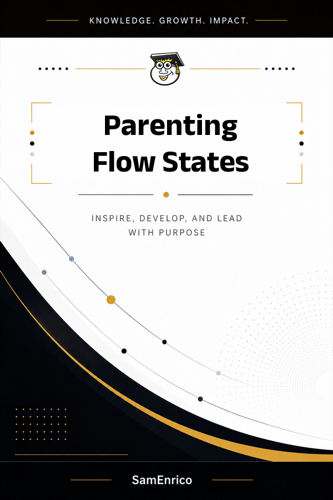
Parenting Flow States eBook
Teaches being fully present with children during p
Teaches being fully present with children during play, reading, and routine.
Formats
Free sample
Chapter 1: The Bored Parent--–- You love your child more than anything in the world. You would step in front of a moving car for them. You have spent hundreds of dollars on wooden toys that claim to spark creativity, and you have read the studies about how play builds executive function, and you have pinned thirty-seven sensory bin ideas on Pinterest that you will absolutely never make.And yet.Here you are, sitting on the floor, watching your child stack the same block on top of the same block for the ninth time in a row. The block wobbles. Your child giggles.
The block falls. Your child picks it up and stacks it again. And again. And again.And you are bored.Not just a little bored. Deeply, existentially bored.
The kind of bored where you can feel the minutes stretching like cold taffy. The kind of bored where you start calculating how many minutes until nap time. The kind of bored where your hand actually twitches toward your phone, even though you know you shouldn't, even though you just checked it four minutes ago.Then the guilt arrives.What kind of parent gets bored playing with their own child? you ask yourself. Am I broken?
Do I not love them enough? Am I already failing at this whole parenting thing?Here is the truth that no other parenting book will tell you: The boredom is not the problem. The guilt about the boredom is the problem. And both of them are far more common than anyone admits.This chapter is about why you feel bored during play, why that boredom is actually a useful signal rather than a character flaw, and how understanding that signal is the first step toward something entirely different: not the absence of boredom, but the presence of flow.The Conspiracy of Silence Around Parental Boredom Let us name what almost no one names. Parenting a young child involves an extraordinary amount of repetitive, low-stimulation, cognitively underpowered activity.
You will read the same board book hundreds of times. You will watch the same episode of the same animated show until you can recite the dialogue in your sleep. You will stack blocks, pour water back and forth, push a toy truck across the same stretch of carpet, and narrate the process of putting on socks as if it were a NASA mission.For the child, this repetition is not boring. It is essential. Repetition is how young brains build neural pathways.
Every time your child stacks that block, they are not being tedious—they are performing neurosurgery on their own developing brain. The wobble, the fall, the pick-up-again: this is the scientific method in action. They are testing hypotheses about gravity, balance, and cause-effect relationships. It is genuinely fascinating to them.To you, it is the opposite of fascinating. And that is not because you are a bad parent.
It is because you are an adult with a fully developed prefrontal cortex and a lifetime of experience with gravity. You do not need to test whether the block will fall for the tenth time. You already know. Your brain, starved of novelty, begins to disengage.Here is what the parenting industry does not tell you: Most parents feel this way. The ones who post pictures of themselves joyfully playing with blocks on Instagram?
They are either lying, or they took that picture during the first thirty seconds of play before the boredom set in, or they are the rare exception. The rest of us are on the floor wondering how something so important can feel so mind-numbingly dull.The conspiracy of silence around parental boredom serves no one. It makes you feel alone. It makes you feel guilty. And guilt, unlike boredom, is genuinely unhelpful.
Boredom is data. Guilt is just shame wearing a parenting hat.The Two Modes of Parental Presence To understand what boredom is telling you, we need to distinguish between two very different ways of being with your child. Let us call them Watching Mode and Being Mode.Watching Mode is what most parents default to during repetitive play. You are physically present. Your body is on the floor.
Your eyes are pointed in the direction of your child. But your mind is somewhere else entirely—planning dinner, replaying a conversation from work, worrying about the pediatrician appointment tomorrow, or calculating how much longer until bedtime. You are supervising, not connecting. You are waiting for the activity to end.The experience of Watching Mode is characterized by:A sense of time dragging Frequent urges to check your phone or glance at a clock Mental to-do lists running on a loop in the background A feeling of being "stuck" or "trapped"Guilt about not enjoying the moment Being Mode is something else entirely. In Being Mode, you are not just watching—you are attending.
Your senses are engaged. You notice not just that your child is stacking blocks, but the specific way their tongue sticks out slightly when they concentrate, the sound the block makes against the floor, the quality of the light coming through the window, the small shift in your child's breathing when the tower wobbles.Being Mode does not necessarily feel exciting. It does not feel like a dopamine hit. But it also does not feel like waiting. In Being Mode, time does not drag because you are not tracking it.
You are inside the activity, not standing outside it watching the clock.The difference between Watching and Being is the difference between looking at a painting and seeing it. Looking is passive. Seeing requires attention. And attention, unlike willpower, is a skill you can train.Here is the crucial insight: Boredom is not a sign that you are failing at Being Mode. Boredom is the alarm bell that tells you you have slipped into Watching Mode.
It is not the problem—it is the symptom of the problem. And that means it is useful.The Neuroscience of Co-Regulation (Why Your Calm Actually Matters)Before we go any further, we need to understand something that sounds almost magical but is actually just neurology. Your child's nervous system is literally connected to yours. Not through wires or telepathy, but through a set of brain cells called mirror neurons.Mirror neurons fire both when you perform an action and when you observe someone else performing that same action. They are the reason you wince when you see someone stub their toe.
They are the reason yawning is contagious. And they are the reason your child's emotional state is constantly, automatically, uncontrollably influenced by yours.When you are calm, your child's body receives that signal. Their heart rate slows. Their breathing deepens. Their stress-response system down-regulates.
This is called co-regulation, and it is the primary way that young children learn to manage their own emotions before their prefrontal cortex is developed enough to do it alone.When you are stressed, the same thing happens in reverse. Your child's body receives the signal that something is wrong. They may not know what, but they feel it. They become fussier, more reactive, harder to soothe.And when you are bored and checked out? Your child…
This is the end of the free sample. Get the eBook to keep going. Buy now
About this book
Details
- Author
- Stuckey Tiffiny
- Publisher
- SamEnrico
- Language
- English
- Genre
- Non-Fiction, Self-Help, Parenting
- Released
- 2026-06-05
- Pages (approx.)
- 131
- Available as
- eBook, Audiobook

Read better in the ZLOADR app
Your eBooks on your phone or tablet. Sign in with your SamEnrico account and start reading.
More by Stuckey Tiffiny
 Comparing Less Creating MoreStuckey Tiffiny$11.99
 Mindful Gardening GuideStuckey Tiffiny$11.99
 Overland Andes Mountain Passes GuideStuckey Tiffiny$11.99
 The Skyward Dreamers: How Gothic Architects Defied GravityStuckey Tiffiny$11.99
 How to Produce Camera and Optic AccessoriesStuckey Tiffiny$11.99
 Accounting Equation Practice ManualStuckey Tiffiny$12.99
 How to Start a Agents and Agencies in Motion Picture Theatrical Production Business (Beginners GuidStuckey Tiffiny$11.99
You may also like
 Hong Kong Handover 1997Dunn Johnnie$11.99
 Zumba For Postnatal Recovery CourseNeal Christian$11.99
 Zumba for BeginnersLadner Nikia$11.99
 YouTube Comment Mining GuideHumes Pandora$12.99
 Worry Box MeditationCarlin Rudy$11.99
 Workplace Stress MeditationNguyen Lynn$11.99
 Workplace Stress and Sleep RepairHawley Ivory$11.99
 Workplace Perfectionism CureDelaney Jeffry$11.99
 Workplace Injustice Anger GuideWallen Isabelle$11.99
 Work Addiction and Burnout LinkGreenwood Ester$11.99
 Women in Yoga and WellnessBeattie Galina$11.99
 Women in Stand Up ComedyChun Evangeline$11.99