
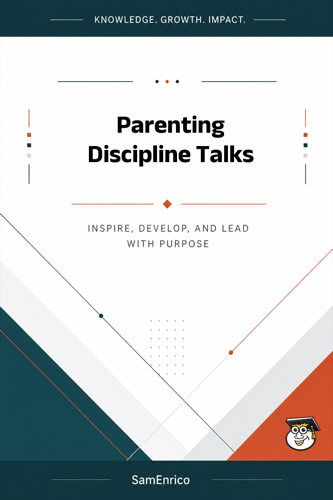
Parenting Discipline Talks eBook
Address behavioral issues with children without ye
by Vernon Paris
Address behavioral issues with children without yelling or shame.
Formats
Free sample
Chapter 1: The Shame Trap--–- Every parent knows the feeling. Your child has just done something for the tenth time today. They have ignored your polite request, spilled the juice you asked them to hold carefully, or whined through the entire grocery store aisle while strangers stared. Your chest tightens. Your jaw clenches.
Your voice rises before your brain can stop it. And then the words come out: “What is wrong with you?” “Why can’t you just listen?” “I am so disappointed in you.” The moment the words leave your mouth, you feel it—that sickening drop in your stomach. You have done it again. You have yelled. You have shamed.
And somewhere underneath the frustration, you already know: this isn’t working. It didn’t work last week, and it won’t work tomorrow. But you don’t know what else to do.This is the shame trap. Not just the shame we accidentally aim at our children, but the shame we carry as parents. The shame that whispers: Good parents don’t yell.
You are failing. Your child is going to be messed up because of you. That voice is the very thing that keeps us stuck in cycles of punishment, yelling, and disconnection. This book exists to get you out of that trap—not by making you feel worse, but by giving you something that actually works. Before we can teach you the tools of connection-based discipline, we have to name the enemy.
And the enemy is not your child. The enemy is the myth that shame and fear create lasting behavior change.The Neurobiology of a Shout Let us start with what happens inside your child’s brain when you yell. This is not abstract psychology. This is measurable, observable neuroscience. When a parent raises their voice in anger or contempt, the child’s amygdala—a small, almond-shaped cluster of neurons deep in the brain—activates as if the child were under physical attack.
The amygdala does not distinguish between emotional threat and physical threat. To the child’s survival brain, a screaming parent is as dangerous as a predator. The result is a cascade of stress hormones: cortisol and adrenaline flood the system. The child’s heart rate spikes. Their breathing becomes shallow.
And crucially, the prefrontal cortex—the “thinking brain” responsible for logic, impulse control, and learning—shuts down. Literally. Blood flow redirects away from the prefrontal cortex toward the limbs and survival centers. Your child cannot process your lesson because their brain has decided that surviving you is more important than learning from you.This is why yelling feels effective in the moment but fails in the long run. A shouted command often produces immediate compliance—not because the child has learned anything, but because they are terrified.
That terror looks like obedience. A child who freezes or says “sorry” quickly is not demonstrating character growth; they are demonstrating a trauma response. Over time, children habituate to yelling, requiring louder and more intense outbursts to achieve the same fearful compliance. Other children go the opposite direction: they learn to tune out the yelling entirely, developing emotional armor that also blocks out loving connection. Either way, the lesson you wanted to teach—about kindness, responsibility, or safety—never lands.
The child’s thinking brain was offline. No learning occurred.Dr. Sarah Ockwell-Smith, author of Gentle Discipline, summarizes this clearly: “When we shout, we trigger a fight, flight, or freeze response. The child cannot hear our message. They can only hear danger.” This is not a parenting opinion.
It is biology. You would not expect a person to learn calculus while being chased by a bear. You cannot expect a child to learn emotional regulation while being shouted at.The Shame Cycle: How Good Parents Get Stuck Shame operates differently than yelling, but it is equally destructive—and often more insidious. While yelling is an acute stressor, shame is a chronic poison that rewires a child’s self-concept. Here is the critical distinction that most parenting books get wrong: guilt says “I did something bad.” Shame says “I am bad.” Guilt can be productive because it points to a specific behavior that can be changed.
Shame attacks the child’s core identity. When a parent says, “That was a selfish thing to do,” they invite guilt. When they say, “You are so selfish,” they inflict shame. The difference is everything.Shamed children do not learn to behave better. They learn to hide better.
A child who believes they are fundamentally “bad” has no motivation to improve—because you cannot improve your fundamental nature. So instead, they develop survival strategies: lying to avoid detection, blaming others to deflect shame, or acting out even more to confirm their “bad kid” identity (if I am already bad, why try to be good?). This is the Shame Cycle:Step One: The child makes a developmental mistake (e.g., spills milk, hits a sibling, lies about homework).Step Two: The parent, exhausted and triggered, responds with shaming language (“Why are you so careless?” “You never listen!”).Step Three: The child internalizes the shame, believing “I am bad.”Step Four: The child acts out more because they have no hope of being good.Step Five: The parent sees more acting out, feels validated in their shaming, and shames again. The cycle repeats.What makes the Shame Cycle so cruel is that it convinces both parent and child that punishment is necessary. The parent thinks: “See?
I was right to be harsh. Nothing else works.” The child thinks: “See? I really am bad. Mom and Dad are right about me.” Both are trapped in a feedback loop that has nothing to do with teaching and everything to do with reactivity. Breaking this cycle is the single most important intervention in this book.
You cannot shame a child into self-discipline. You can only shame them into self-hatred.The Crazy Cycle of Power Struggles If shame is the poison, power struggles are the battleground. Every parent knows the Crazy Cycle: you ask your child to put on their shoes. They ignore you. You ask again, firmer this time.
They say “no” or dawdle. Your voice rises. They whine or yell back. Suddenly you are both locked in a fight over shoes—something that should have taken fifteen seconds has consumed fifteen minutes and drained your entire morning. The original goal (getting shoes on) is long forgotten.
The new goal is winning.The Crazy Cycle happens because both parent and child shift from cooperation to control. The parent thinks: “If I let them win this time, they will walk all over me forever.” The child thinks: “If I give in, I have no power over my own life.” Both are right about the stakes and wrong about the solution. The parent is correct that children need boundaries. The child is correct that autonomy matters. But the Crazy Cycle turns these legitimate needs into a zero-sum war.
No one wins in a zero-sum war. Even if you force the shoes onto a screaming child, you have lost—because you have sacrificed connection for compliance. And compliance gained through coercion never generalizes. That same child will not…
This is the end of the free sample. Get the eBook to keep going. Buy now
About this book
Details
- Author
- Vernon Paris
- Publisher
- SamEnrico
- Language
- English
- Genre
- Non-Fiction, Self-Help, Parenting
- Released
- 2026-06-07
- Pages (approx.)
- 145
- Available as
- eBook, Audiobook

Read better in the ZLOADR app
Your eBooks on your phone or tablet. Sign in with your SamEnrico account and start reading.
More by Vernon Paris
 Loneliness Community GardenVernon Paris$11.99
 Relationship Building for FreelancersVernon Paris$11.99
 Senior Resilience BuilderVernon Paris$11.99
 Anxiety Scripts LibraryVernon Paris$11.99
 No Interruption Zone SignsVernon Paris$11.99
 Antwerp Heist InformantVernon Paris$11.99
 Recovery from Corporate BurnoutVernon Paris$11.99
 The Lake Superior Drowning MysteryVernon Paris$11.99
 The Unseen Watchers: How AI Cameras Changed the WorldVernon Paris$11.99
 The Melody Makers: How Latin America's First Record Labels Revolutionized Music (1880s-1890s)Vernon Paris$11.99
 Neptune’s Gambit: The Billionaire’s Underwater HeistVernon Paris$11.99
 Email Newsletter Management ServicesVernon Paris$11.99
You may also like
 Hong Kong Handover 1997Dunn Johnnie$11.99
 Zumba For Postnatal Recovery CourseNeal Christian$11.99
 Zumba for BeginnersLadner Nikia$11.99
 YouTube Comment Mining GuideHumes Pandora$12.99
 Worry Box MeditationCarlin Rudy$11.99
 Workplace Stress MeditationNguyen Lynn$11.99
 Workplace Stress and Sleep RepairHawley Ivory$11.99
 Workplace Perfectionism CureDelaney Jeffry$11.99
 Workplace Injustice Anger GuideWallen Isabelle$11.99
 Work Addiction and Burnout LinkGreenwood Ester$11.99
 Women in Yoga and WellnessBeattie Galina$11.99
 Women in Stand Up ComedyChun Evangeline$11.99