
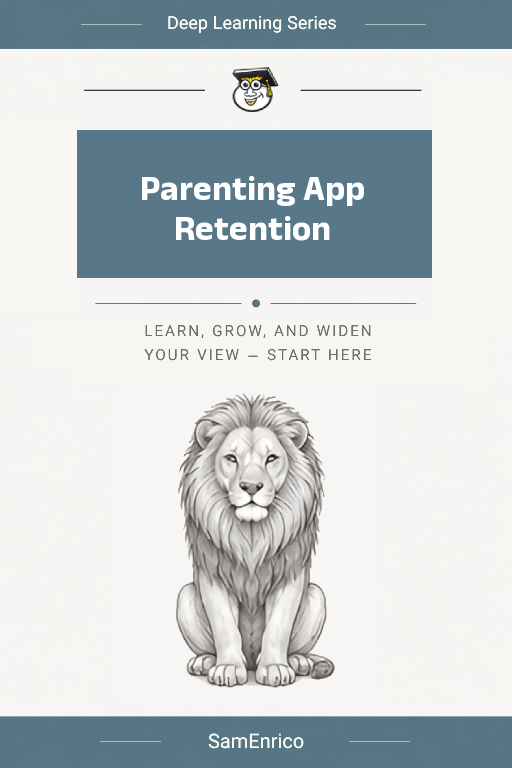
Non-FictionStrategic AtlasParenting Retention
Parenting App Retention eBook
Study how BabyCenter, What to Expect, and Peanut r
Study how BabyCenter, What to Expect, and Peanut retain parents through week-by-week updates and community.
Formats
Free sample
Chapter 1: The Two Cliffs--–- The first time you open a parenting app, you are not a user. You are a person who just saw two pink lines on a plastic stick, and your brain is doing something it has never done before: calculating risk for a human who does not yet exist. Your thumbs tremble slightly as you type your due date into Baby Center. You are not thinking about retention cohorts or daily active users. You are thinking, “Is this normal?” And that question—simple, urgent, terrifying—is the entire engine of the parenting app economy.This book is about what happens after you type that due date.
Why do some parents open the same app three times a day for eighteen months, while others delete it before the first trimester ends? Why does Baby Center keep 40% of its users past day 30, while 80% of parenting apps die within six months? The answer is not better features, more notifications, or a prettier interface. The answer is timing. Specifically, the two moments when parents are most likely to abandon your product forever—and the one moment when they become loyal for life.Welcome to the Two Cliffs.The Parenting App Paradox Let’s start with a number that should terrify every product manager in this industry: 80% of all parenting app downloads happen during the first trimester of pregnancy.
Think about what that means. A woman pees on a stick, sees two lines, and within hours—sometimes minutes—she has downloaded your app. Not because your marketing is brilliant. Not because your onboarding flow is optimized. But because she is desperate for information.
She wants to know if the sushi she ate yesterday will hurt the baby. She wants to know why she is already exhausted at week five. She wants to know if the dull ache in her lower back is normal or a warning sign.That is not retention. That is panic. And panic is not a sustainable business model.Here is the paradox that kills most parenting apps: the same urgency that drives downloads also guarantees churn.
Because after the panic fades—after the first ultrasound, after the genetic test results come back normal, after the morning sickness subsides—the parent has less reason to open your app. She is no longer asking “Is this normal?” She is asking “When do I need to pack my hospital bag?” That is a different question, with a different urgency level. And if your app only answers the first type of question, you lose her.But the real killer—the reason 70% of parenting apps fail to reach their second birthday—is that most founders build for the pregnancy, not for the parent. They assume that the nine months of gestation are the product’s golden era. And they are right, for a while.
But then the baby arrives, and everything changes.The First Cliff: Four Months Postpartum The first major retention collapse happens at four months. It is so predictable, so consistent across every parenting app ever studied, that industry insiders call it the “4-month sleep regression graveyard.” Here is what happens:The baby, who has been sleeping in two-to-three-hour chunks since birth, suddenly starts waking every forty-five minutes. The parents, who have been surviving on fragmented sleep, now enter a state of chronic exhaustion that borders on clinical sleep deprivation. Their cognitive function drops by 30-40%. Their patience evaporates.
Their ability to make decisions—including the decision to open your app—plummets.In this state, the parent performs a brutal triage on every tool in their life. The diaper subscription? Essential. The grocery delivery service? Essential.
Your app? Not essential. Because at four months postpartum, the parent is no longer asking “What is the ideal feeding schedule?” She is asking “How do I get this baby to stop crying so I can sleep for twenty minutes?” Your beautifully designed week-by-week content feels like a luxury she cannot afford.This is the First Cliff. And it claims 50-60% of your users, regardless of how good your product is.But here is what separates the apps that survive from the apps that die: the survivors saw the First Cliff coming. They did not build for the pregnancy.
They built for the parent who would emerge from the fog at month five, blinking and confused, wondering what happened to the last four months. They built for the parent who finally sleeps through the night and thinks, “I should figure out what my baby is supposed to be doing now.”That parent is not the same person who downloaded your app in the first trimester. She is harder to impress, more skeptical of claims, and less tolerant of friction. But she is also more loyal—because if you help her at month five, she will remember you at month fifteen.The Second Cliff: The Toddler Drop Most books about parenting apps stop at the First Cliff. They assume that if you can survive the 4-month sleep regression, you have won.
That is wrong. The Second Cliff is larger, more deceptive, and has killed more apps than the first.The Second Cliff happens between months twelve and eighteen. And it happens for reasons that sound positive: the baby sleeps through the night. The mother returns to work. The acute survival mode of the first year ends.
These are good things for the family. They are terrible things for your retention numbers.Here is why. During the first year, the parent’s primary question is “Is my baby alive and healthy?” That question creates an intense, visceral need for information. Is the baby gaining weight? Is the baby meeting milestones?
Is that cough normal or should we go to the ER? Your app answers these questions, and the parent loves you for it.But around month twelve, the question changes. It shifts from “Is my baby alive?” to “How do I get my toddler to stop throwing food on the floor?” That is a different category of question. It is less urgent, less medical, less terrifying. And crucially, it is easier to answer with a quick Google search than with your app.
Why would a parent open your beautifully designed week-by-week content when she can type “toddler throwing food” into Google and get ten blog posts in two seconds?This is the Second Cliff. And it claims 40-50% of the users who survived the First Cliff. If you started with 100,000 downloads in the first trimester, you lost 50,000 at month four, and then another 20,000 at month twelve. You are now down to 30,000 users—a 70% drop from your peak. Most apps never recover.But some do.
And the ones that do have discovered a secret that this book will teach you: the Second Cliff is survivable if you pivot your value proposition from Health & Safety to Development & Activities. You stop answering “Is my baby breathing?” and start answering “How do I teach my toddler to use a spoon?” You stop sending notifications about vaccines and start sending notifications about potty training. You become a different product for a different parent.The Three Pillars of Retention Before we go any further, we need a framework. Throughout this book…
This is the end of the free sample. Get the eBook to keep going. Buy now
About this book
Details
- Author
- Gainey Earlean
- Publisher
- SamEnrico
- Language
- English
- Genre
- Non-Fiction, Strategic Atlas, Parenting Retention
- Released
- 2026-06-01
- Pages (approx.)
- 157
- Available as
- eBook, Audiobook

Read better in the ZLOADR app
Your eBooks on your phone or tablet. Sign in with your SamEnrico account and start reading.
More by Gainey Earlean
 Delegation for TherapistsGainey Earlean$11.99
 Downsizing Family Mediation CourseGainey Earlean$11.99
 Informant Testimony False ConvictionsGainey Earlean$11.99
 Men's Cardiac Rehab Exercise GuideGainey Earlean$11.99
 Business Plan Complete GuideGainey Earlean$11.99
 Brewing the Revolution: How a Belgian Monk Toppled the Beer WorldGainey Earlean$11.99
 Fangs of the Forbidden: The Great London Zoo Panic of 1857Gainey Earlean$11.99
 Technical Systems AnalystGainey Earlean$11.99
 How to Become a Calendering-machine OperatorGainey Earlean$11.99
 Vendor Innovation Sourcing GuideGainey Earlean$12.99
 Understanding Chromosome 13q DeletionGainey Earlean$17.99
You may also like
 Hong Kong Handover 1997Dunn Johnnie$11.99
 Zumba For Postnatal Recovery CourseNeal Christian$11.99
 Zumba for BeginnersLadner Nikia$11.99
 YouTube Comment Mining GuideHumes Pandora$12.99
 Worry Box MeditationCarlin Rudy$11.99
 Workplace Stress MeditationNguyen Lynn$11.99
 Workplace Stress and Sleep RepairHawley Ivory$11.99
 Workplace Perfectionism CureDelaney Jeffry$11.99
 Workplace Injustice Anger GuideWallen Isabelle$11.99
 Work Addiction and Burnout LinkGreenwood Ester$11.99
 Women in Yoga and WellnessBeattie Galina$11.99
 Women in Stand Up ComedyChun Evangeline$11.99