
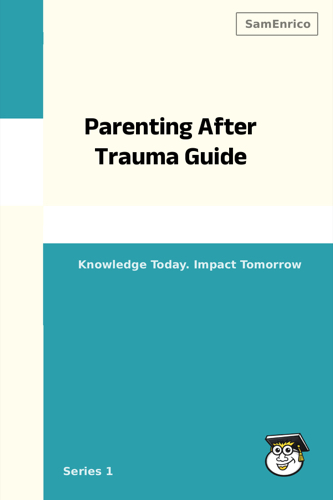
Parenting After Trauma Guide eBook
Heal your own past while raising children without
by Bray Tandy
Heal your own past while raising children without passing down unresolved pain.
Formats
Free sample
Chapter 1: The Ghost in the Room--–- The first time I lost my temper with my son, I didn't recognize the person screaming. She had my voice, my hands, my exhausted face in the bathroom mirror afterward. But she was not the mother I had promised myself I would be. I had spent years in therapy, read dozens of parenting books, and sworn on everything sacred that I would never, ever say the things my mother said to me. And yet, there I was, kneeling on the kitchen floor, my three-year-old sobbing because he had spilled his milk—milk, for God's sake—and I had just told him, in a voice that did not sound like mine, that he was being dramatic, that he needed to grow up, that this was nothing to cry about.The exact words my mother used with me.I froze.
Not because I was scared of my son, but because I was terrified of myself. If I could become her in a single moment of spilled milk, what hope did I have? What hope did any of us have, the ones who swore we would be different, only to find ourselves standing in the wreckage of our own good intentions, wondering where the ghost came from?This book is for you. Not the perfect parent you wish you were. Not the parent who never yells, never shuts down, never feels the hot rush of rage over something small.
This book is for the parent who yelled yesterday and still feels the shame crawling under their skin. For the parent who went numb during their child's tantrum and walked away, not because they didn't care, but because caring hurt too much. For the parent who caught themselves saying "I'll give you something to cry about" and then wanted to cut out their own tongue.You are not broken. You are not your mother, your father, or whoever hurt you. You are a person with an unhealed past living in a body that remembers danger even when there is none.
And this chapter—this entire book—is about updating that alarm system so you can parent from presence rather than pain.The concept of "ghosts in the nursery" comes from the psychoanalyst Selma Fraiberg, who in 1975 published a paper that changed how we understand intergenerational trauma. Fraiberg noticed something extraordinary: parents who had experienced severe trauma in their own childhoods were not consciously repeating their parents' mistakes. They were not bad people, neglectful people, or cruel people. They were haunted people. Their unresolved trauma would emerge precisely during moments of their child's emotional vulnerability—a baby crying at 2 AM, a toddler's tantrum in the grocery store, a preschooler's defiance over shoes—and the parent would suddenly, inexplicably, react as if they were back in their own childhood danger.The ghost is not the child's behavior.
The ghost is the unprocessed memory of what happened to you. It lives in your nervous system, not in your conscious mind. You do not choose to be triggered. Your body chooses for you, faster than thought, faster than intention, faster than love.Let me give you an example that might feel familiar. A father I worked with, let's call him Marcus, grew up in a house where crying was punished.
If he wept after a scraped knee or a friend's betrayal, his father would grab him by the arm and say, "Stop that noise before I give you something real to cry about." Marcus learned, as children do, to swallow his tears. To freeze his face. To become small and silent.Decades later, Marcus had a daughter. He adored her. He would have died for her.
But when she cried—not screamed, not manipulated, just cried, the way all small humans do—Marcus felt a rage so sudden and so hot that it scared him. He never hit her. He never even yelled. But he would leave the room. He would say, "You're fine." He would hand her to his wife and walk away.
And later, in the quiet, he would hate himself.The ghost in Marcus's nursery was not his daughter's tears. The ghost was the memory of his father's grip, the shame of being told his feelings were a problem, the desperate belief that crying leads to punishment. His daughter was not in danger. But Marcus's body thought she was—or rather, thought he was, back in 1985, a small boy who learned that tears attract threats.The goal of this book is to turn ghosts into angels.Angels in the nursery are the opposite of ghosts. They are the healed, integrated memories that allow a parent to respond with compassion rather than reactivity.
Where a ghost makes you say "Stop crying," an angel makes you say "I see you're sad. Come here." Where a ghost makes you freeze or flee, an angel makes you stay. Angels are not magic. They are the result of doing the work: identifying your ghosts, feeling the feelings you were never allowed to feel, practicing new responses, and repairing when you fail.This chapter is where that work begins. Not with a complicated exercise or a deep dive into your childhood.
We will get there. First, we have to learn how to pause.The single most important skill in trauma-informed parenting—the skill that makes every other skill possible—is learning to distinguish between a child's emergency and a historical emergency.A child's emergency is real. It involves blood, fire, running into traffic, imminent physical danger, or a situation where someone is being actively hurt. In a child's emergency, you do not pause. You act.
You grab the child, you call for help, you remove the danger. Your reactivity is appropriate. Your adrenaline is useful. Your ghost is not the problem; physics is.A historical emergency is different. In a historical emergency, your child is safe.
They may be having a feeling—loud, inconvenient, exhausting—but they are not in danger. Your racing heart, your clenched jaw, your flood of catastrophic thoughts ("This is never going to end," "He's manipulating me," "I'm a terrible parent") are not coming from the present. They are coming from the past. Your child spilled milk. Your body thinks you are back in the room where you were hit, yelled at, or ignored.The problem is that historical emergencies feel exactly like real emergencies.
Your nervous system does not know the difference between a tantrum and a tiger. To your amygdala—the brain's alarm system—both are threats. Both require a response. Both trigger the same cascade of cortisol, adrenaline, and norepinephrine.But you can learn to tell the difference. Not through willpower, not through self-criticism, but through a simple, physiological tool that you can use anywhere, anytime, even in the middle of a meltdown.I call it the 2-Second Pause.
Here is how it works.The moment you feel the first flash of anger, fear, or overwhelm—the moment you feel yourself about to scream, shame, or shut down—you stop. Not forever. Just for two seconds. Place your hand on your chest. Feel your heartbeat if you can.
Breathe once, slowly, exhaling longer than you inhale.That's it. That is the entire tool.Two seconds. One breath. A hand on…
This is the end of the free sample. Get the eBook to keep going. Buy now
About this book
Details
- Author
- Bray Tandy
- Publisher
- SamEnrico
- Language
- English
- Genre
- Non-Fiction, Self-Help, Trauma
- Released
- 2026-06-12
- Pages (approx.)
- 116
- Available as
- eBook, Audiobook

Read better in the ZLOADR app
Your eBooks on your phone or tablet. Sign in with your SamEnrico account and start reading.
More by Bray Tandy
 Nonverbal Cues For Teachers CourseBray Tandy$11.99
 The Financial Ruin Prevention GuideBray Tandy$11.99
 Contamination OCD Recovery PlanBray Tandy$11.99
 Survey Segmentation with AI ClusteringBray Tandy$11.99
 The Great Firewall: How China's Digital Inferno Reshaped the WorldBray Tandy$11.99The Great Firewall: How China's Digital Inferno Reshaped the WorldBray Tandy$11.99
 The Secret Serum: How a Little-Known Doctor Fueled Cycling’s Darkest EraBray Tandy$11.99
 PhD Application Without Any PapersBray Tandy$12.99
 Schedule A Background DeclarationBray Tandy$12.99
 Understanding Café AU Lait Spots SyndromeBray Tandy$17.99
 How to Become a Card PlayerBray Tandy$11.99
 VentriloquistBray Tandy$11.99
You may also like
 TM For PTSD RecoveryBagwell Jenae$11.99
 Self Hypnosis For PTSD ReliefDangelo Trent$11.99
 Anticipatory Grief And TraumaJones Muriel$11.99
 Breath for Mass ShootingsFernandez Kevin$11.99
 The Pain and Trauma LinkDelacruz Thi$11.99
 Dream Journal For Trauma ProcessingLefebvre Rosamaria$11.99
 Trauma Related Emotional NumbingHanna Dina$11.99
 Trauma Informed SleepUtley Denny$11.99
 The Trauma Disclosure TalkChurchill Coralee$11.99
 The Emotional Aftermath GuidePartin Carlee$11.99
 The Addiction Trauma LinkGuidry Samatha$11.99
 Imposter PTSD HypervigilanceMartindale Drucilla$11.99