
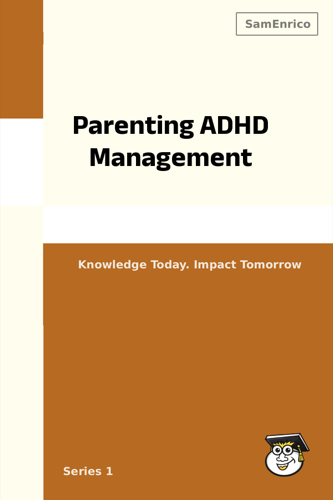
Parenting ADHD Management eBook
Stay organized and consistent despite executive fu
by Brito Denae
Stay organized and consistent despite executive function challenges.
Formats
Free sample
Chapter 1: The Willpower Myth--For years, you have been told a lie. Not a small, harmless fib, but a corrosive, exhausting lie that has seeped into every parenting book, every well-meaning relative’s advice, and every quiet moment of self-recrimination at 2:00 AM when you replay the day’s meltdowns. The lie is this: If you just tried harder—if you were more consistent, more patient, more organized, more loving—your child would behave better, and you would finally feel like a competent parent.You have tried harder. You have made charts, set timers, read articles, attended therapy sessions, and vowed to “do better tomorrow.” And yet, the morning routine still explodes, homework still ends in tears, and you still find yourself shouting words you swore you would never say. The gap between knowing what to do and doing it feels like a chasm you cannot cross.
You are not alone, and more importantly, you are not broken. The problem is not a lack of effort. The problem is that standard parenting advice was designed for a neurotypical brain, and you and your child are navigating a world built for a different operating system.This chapter dismantles the most damaging myth in all of ADHD parenting: the myth of willpower. You will learn why “trying harder” actually makes things worse, what executive function mismatch means for your daily struggles, and why the solution is not superhuman self-discipline but rather scaffolding—external tools and routines that do the mental heavy lifting for you. By the end of this chapter, you will trade the exhausting question “Why can’t I get this right?” for a far more productive one: “What can I put in place to make this easier?”The Exhaustion That No One Talks About Let us name the enemy.
It is not your child, though there are moments when it feels that way. It is not your partner, your in-laws, or the judgmental parent at the playground. The enemy is executive function depletion—the slow, grinding drain of your mental energy as you try to manage not only your own impulses, memory, and emotions but also your child’s.Every day, you perform a hidden labor that no one sees. You remember that the permission slip is due tomorrow. You hold in your mind the three things your child needs for school while also tracking that the pediatrician’s appointment is at 3:00 and the chicken needs to thaw for dinner.
You suppress the urge to snap when your child interrupts you for the twelfth time. You shift from planning mode to crisis mode to soothing mode and back again, sometimes within the span of sixty seconds. This is executive function in action: working memory (holding information in mind), inhibition (stopping yourself from reacting), task shifting (moving from one mental set to another), and emotional regulation (calming your own nervous system).Now imagine that your child has ADHD. Their executive functions are delayed by roughly 30 percent compared to their peers. A ten-year-old with ADHD has the self-regulation skills of a seven-year-old.
They forget instructions. They cannot stop themselves from blurting out. They melt down during transitions because shifting attention is neurologically costly for them. And because you love them, you step in. You remind them again.
You coach them through the tantrum. You hold the mental checklist for both of you.This is the invisible math of ADHD parenting: you are running two executive function systems on one brain’s worth of fuel. And by 7:00 PM, you are running on fumes.The Neuroscience of “Frontal Lobe Lag”To understand why willpower fails, you need a brief tour of the brain. The prefrontal cortex—located right behind your forehead—is the CEO of your brain. It handles planning, impulse control, working memory, and emotional regulation.
In people with ADHD, this region develops more slowly and functions less reliably. Think of it as a Wi-Fi signal that keeps dropping. Sometimes the connection is strong. Sometimes it vanishes entirely, especially under stress, fatigue, or boredom.Here is what most people do not understand: the prefrontal cortex is also the first brain region to shut down under exhaustion. When you are tired, hungry, overwhelmed, or emotionally triggered, your brain’s CEO essentially clocks out.
You are left with the more primitive parts of your brain—the amygdala (fear and anger) and the basal ganglia (habit and impulse). This is why you yell. This is why you forget the one thing you swore you would remember. This is why you eat the stale cookie instead of making a healthy dinner. You are not weak.
You are running on a neurological deficit.Now add a child whose prefrontal cortex is even less reliable. Their CEO is frequently out of the office. They are not defying you to be difficult; they are struggling to access the very functions that would allow them to comply. When you say, “Go brush your teeth,” their brain does not say, “Yes, I will do that.” It says, “I hear sounds, but I cannot hold the instruction in working memory while also finishing this Lego tower.” The gap between knowing and doing is not a character flaw. It is a neurological fact.Why Standard Parenting Advice Backfires Most parenting books are written for children with typical executive function.
They assume that if you set a clear expectation, deliver a consistent consequence, and remain calm, the child will eventually learn. This works for neurotypical children because they have the internal infrastructure to connect action to outcome, delay gratification, and hold instructions in memory.For a child with ADHD, standard consequences often feel random and punitive. They do not think, “I left my shoes out, so I lost screen time.” They think, “You are mean, and this is unfair,” because the neural pathway linking the lost shoes (an hour ago) to the lost screen time (now) is too weak to support logical cause-and-effect. Punishment does not teach skills. It teaches shame.
And shame triggers the amygdala, which floods the body with stress hormones, which makes executive function even worse. You have seen this happen: you punish, your child explodes, and now you are both dysregulated, and nothing is solved.The other failure of standard advice is the assumption that parents have infinite emotional and cognitive reserves. The books say “stay calm” as if calm were a switch you can flip. But staying calm requires impulse control and emotional regulation—exactly the functions that deplete fastest under stress. When you have not slept well, when work is demanding, when your own ADHD (diagnosed or not) makes it hard to organize your thoughts, “stay calm” is not actionable advice.
It is a judgment.The Myth of Self-Discipline Let us be direct: self-discipline is a finite resource, not a moral virtue. The psychologist Roy Baumeister demonstrated this decades ago through the concept of ego depletion. In study after study, people who exerted self-control on one task performed worse on a subsequent task that also required self-control. Willpower is like a gas tank. You can refill it with rest, glucose, and low-stress environments.
But if you are constantly drawing from it—resisting the urge to yell, forcing yourself to remember appointments, pushing through exhaustion…
This is the end of the free sample. Get the eBook to keep going. Buy now
About this book
Details
- Author
- Brito Denae
- Publisher
- SamEnrico
- Language
- English
- Genre
- Non-Fiction, Self-Help, ADHD
- Released
- 2026-06-09
- Pages (approx.)
- 132
- Available as
- eBook, Audiobook

Read better in the ZLOADR app
Your eBooks on your phone or tablet. Sign in with your SamEnrico account and start reading.
More by Brito Denae
 Body Language For Conflict Resolution HandbookBrito Denae$11.99
 The Sponsors Anonymous StepBrito Denae$11.99
 Pediatric OCD Treatment GuideBrito Denae$11.99
 Survey MaxDiff Analysis AutomationBrito Denae$11.99
 Echoes from the Deep: The Unsolved Mystery of the SS Ourang MedanBrito Denae$11.99
 The Lost Codex: How a 1,000-Year-Old Viking Manuscript Vanished from the National ArchivesBrito Denae$11.99
 Animal ScientistBrito Denae$11.99
 Understanding Callus DiseaseBrito Denae$17.99
 How to Become a Carbon-paper-coating-machine SetterBrito Denae$11.99
 Gap Year Research Without PublicationsBrito Denae$12.99
 Canadian Health Card After PRBrito Denae$12.99
You may also like
 Hong Kong Handover 1997Dunn Johnnie$11.99
 Zumba For Postnatal Recovery CourseNeal Christian$11.99
 Zumba for BeginnersLadner Nikia$11.99
 YouTube Comment Mining GuideHumes Pandora$12.99
 Worry Box MeditationCarlin Rudy$11.99
 Workplace Stress MeditationNguyen Lynn$11.99
 Workplace Stress and Sleep RepairHawley Ivory$11.99
 Workplace Perfectionism CureDelaney Jeffry$11.99
 Workplace Injustice Anger GuideWallen Isabelle$11.99
 Work Addiction and Burnout LinkGreenwood Ester$11.99
 Women in Yoga and WellnessBeattie Galina$11.99
 Women in Stand Up ComedyChun Evangeline$11.99