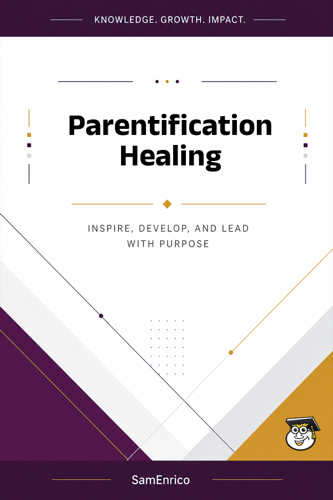
Parentification Healing eBook
Recover from being forced to parent your own paren
by Magana Kiana
Recover from being forced to parent your own parent.
Formats
Free sample
Chapter 1: The Role Reversal...--–- The first time I realized I had been parenting my mother, I was not in a therapist’s office. I was standing in a grocery store aisle, staring at a box of cereal, and trying to remember what kind she liked. Not what I liked. What she liked. I was twenty-seven years old.
I had not lived in her house for nearly a decade. And still, the first question that ran through my mind before any purchase, any decision, any move was always the same: What does she need?The woman next to me reached up without thinking and grabbed the brightly colored box her child was pointing at. She tossed it in the cart like it was nothing. Like feeding her child a requested cereal was the most natural thing in the world. I stood frozen, my hand hovering between two brands, and felt something crack open inside my chest.
Not loudly. Not dramatically. Just a small, quiet fracture in the wall I had spent twenty-seven years building. The wall that said: You are fine. You are strong.
You do not need anyone.But I did need someone. I needed someone to tell me what cereal I liked.That moment in the grocery store is what forced me to stop running. It is also why I wrote this book.If you are reading these words, there is a high probability that you know exactly what I am talking about. You might not have had your moment in a cereal aisle. Maybe yours came in a therapist’s office when they asked, “And what do you want?” and you realized you had no answer.
Maybe yours came when a partner said, “You never ask for anything,” and you felt a flash of anger because asking for things felt dangerous, selfish, wrong. Maybe yours came when your parent called you for the fifth time that week to cry about their job, their marriage, their loneliness, and you hung up the phone and realized you could not remember the last time someone asked how you were doing.This chapter is for you. It is an invitation to stop. To look back. To name what happened to you.
And to begin the process of understanding that you were never supposed to be the parent. You were supposed to be the child.The Moment Everything Switched Parentification is not a word most people know. It is not a diagnosis in the DSM. It is not something your pediatrician screens for. And yet, it is one of the most quietly destructive family dynamics that exists because it wears a mask.
The mask is labeled “maturity.” The mask is labeled “responsibility.” The mask is labeled “what a good child does.”Here is what parentification actually means: it is a form of role reversal in which a child is systematically expected to meet the emotional or practical needs of a parent, rather than the other way around. The child becomes the caretaker. The parent becomes the dependent. And everyone outside the family looks at that child and says, “What a good kid. So helpful.
So mature.”No one says, “That child is drowning.”Let me be precise. Parentification comes in two forms, and understanding the difference is the first step toward naming your specific wound.Instrumental parentification is the physical, task-based version. This is the child who cooks dinner at age eight because no one else will. The child who manages the household finances at twelve because a parent is too depressed or too addicted or too checked out. The child who bathes younger siblings, wakes them up for school, helps them with homework, puts them to bed.
The child who becomes the second parent in the house not because they volunteered but because someone had to.Emotional parentification is the invisible version. This is the child who becomes the parent’s therapist, confidant, or emotional regulator. The child who listens to a parent cry about their marriage, their money problems, their loneliness. The child who learns to scan a parent’s face for signs of anger or despair and adjusts their own behavior accordingly. The child who suppresses their own needs because the parent’s needs are always, always bigger.Most parentified children experience both forms.
The oldest daughter who cooks dinner (instrumental) and also listens to her mother complain about her father (emotional). The only son who manages his mother’s finances (instrumental) and also talks her down from panic attacks (emotional). The child of an immigrant parent who translates legal documents (instrumental) and also carries the weight of the family’s hopes and fears (emotional).But often, one form dominates. And that dominance shapes how the wound shows up in adulthood.The Spouse-Child and the Little Adult I want you to imagine two children. Not real children—archetypes.
Patterns. See if you recognize yourself in either of them.The Spouse-Child is the child who functions as the parent’s emotional partner. This child knows too much. They know about the parent’s affair before the other parent does. They know about the family’s financial ruin because the parent cried about it to them.
They know about the parent’s childhood trauma, their suicidal thoughts, their fear of being alone. The Spouse-Child learns early that their job is to listen, to comfort, to never add more weight to an already overloaded parent. They become experts at reading moods, at defusing tension, at saying the right thing to keep the peace. But somewhere along the way, they lose the ability to know what they themselves feel. Their own emotional world becomes a foreign country they were never allowed to visit.The Little Adult is the child who functions as the parent’s practical manager.
This child does too much. They wake up earlier than their classmates to make breakfast. They pack their own lunch and their siblings’ lunches. They remember appointment dates, school deadlines, bill due dates. They are praised as “responsible” and “reliable,” and they wear those labels like medals until they realize the medals are chains.
The Little Adult grows into an adult who cannot stop working, cannot stop producing, cannot stop doing because their sense of worth is entirely output-driven. Rest feels like laziness. Play feels like theft. Being still feels like death.You might be both. Many of us are.
But one pattern usually runs deeper. And the exercises later in this chapter will help you identify which one shaped you most.The Broken Circle: What Should Have Happened To understand what parentification took from you, you first have to understand what should have happened. There is a model in attachment theory called the Circle of Security. It is simple and devastating. It goes like this:A healthy child moves through the world in a loop.
They start at the parent’s side. Then they venture out to explore—to play, to learn, to make mistakes, to fall down. When they need comfort, they return to the parent. The parent provides safety, soothing, and support. Then the child ventures out again.
The loop continues, over and over, thousands of times, building a foundation of security. The child learns: I can go…
This is the end of the free sample. Get the eBook to keep going. Buy now
About this book
Details
- Author
- Magana Kiana
- Publisher
- SamEnrico
- Language
- English
- Genre
- Non-Fiction, Self-Help, Parentification
- Released
- 2026-06-06
- Pages (approx.)
- 131
- Available as
- eBook, Audiobook

Read better in the ZLOADR app
Your eBooks on your phone or tablet. Sign in with your SamEnrico account and start reading.
More by Magana Kiana
 Accent Reduction Classes as ChildMagana Kiana$11.99
 Lithium Withdrawal GuideMagana Kiana$11.99
 Green Beret HALO JumpMagana Kiana$11.99
 The Navigator of the Seas: Prince Henry the Navigator and the Birth of the Portuguese EmpireMagana Kiana$11.99
 How to Produce Climate Control AppliancesMagana Kiana$11.99
 How to Become a Back TenderMagana Kiana$11.99
 Team Building Across Three CountriesMagana Kiana$12.99
 SwingMagana Kiana$11.99