
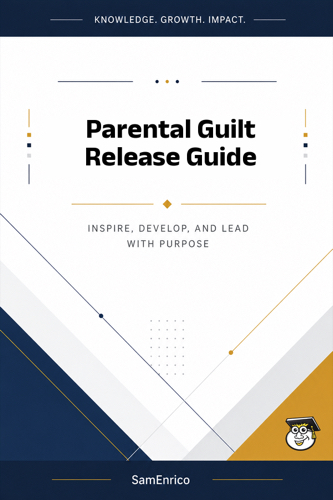
Non-FictionSelf-HelpParental Guilt
Parental Guilt Release Guide eBook
Let go of the constant feeling that you're not doi
Let go of the constant feeling that you're not doing enough.
Formats
Free sample
Chapter 1: The Rigged Setup--–- You are reading this because somewhere, probably in the last 48 hours, a voice inside your head told you that you are failing. Not that you made a mistake—that you are a mistake as a parent. The voice might have come while you were scrolling your phone instead of playing with your child. Or while you were folding laundry instead of reading one more bedtime story. Or while you were lying awake at 2:00 AM, mentally replaying the moment you lost your patience and yelled.
That voice is not yours. It never was. And this chapter is going to prove it.The Whisper That Runs Your Life Let’s name the thing before we do anything else. There is a specific, grinding, low-grade feeling that haunts modern parents. It is not the sharp pain of a crisis.
It is the dull ache of not enough. Not patient enough. Not organized enough. Not present enough. Not fun enough.
Not calm enough. Not successful enough at work to justify the time away, but not present enough at home to feel like you earned your child’s love. You are failing on all fronts, the voice says, and the worst part is that everyone else seems to be handling it just fine.This feeling has a name, though you rarely hear it spoken aloud in polite company. It is called parental guilt. And unlike the useful guilt that tells you when you have genuinely hurt someone, this version is not attached to a specific action.
It is not “I feel bad because I did X.” It is “I feel bad because I exist as a parent, and my existence is never quite enough.” That is not guilt. That is something closer to a chronic condition. And if you have it, you are not broken. You are not weak. You are not uniquely flawed.
You are standing in a system that was designed to make you feel exactly this way.Consider what the average parent is expected to manage in a single week. You are supposed to prepare nutritious, home-cooked meals that accommodate everyone’s dietary preferences and allergies. You are supposed to monitor screen time, but also ensure your child has enough technological literacy to succeed in a digital world. You are supposed to foster emotional intelligence by validating every feeling, but also teach boundaries and self-discipline. You are supposed to advance in your career without missing school events.
You are supposed to maintain a romantic partnership that feels connected and spontaneous. You are supposed to exercise, meditate, and practice self-care so you do not burn out—but not in a way that takes time away from your family. You are supposed to do all of this while appearing calm, grateful, and slightly amused by the chaos, because if you complain, you are a martyr, and if you ask for help, you are weak.No one can do this. Not one person. And yet the voice says: Everyone else is managing.
Why can’t you?The Myth of the Superparent The “Superparent” is the most destructive fiction of modern family life. You know the Superparent. She bakes birthday cakes from scratch at midnight and makes them look like unicorns. He coaches the soccer team, volunteers at the school auction, and still makes it home for family dinner every night. They never raise their voices.
They never scroll their phones during bath time. They have family mission statements printed on reclaimed wood hanging in their kitchen. Their Instagram feeds are a soft, beige panorama of handmade crafts, organic snacks, and children who smile at the camera instead of running away from it.The Superparent is a lie. But here is what makes the lie so effective: it is not told to you by a single villain. It is whispered by a thousand small messengers.
Your mother-in-law mentions that she never used daycare. Your neighbor posts a photo of her child’s elaborate science fair project. Your child’s teacher sends home a note about “family engagement” that makes you feel like a ghost. A parenting book suggests that if you just wake up at 5:00 AM, you can have two hours of quiet time before the kids wake up—as if you are not already exhausted. The messages are not malicious.
They are just relentless. And after a while, they weave together into a single, unspoken standard: You should be doing more.The most insidious part is that the Superparent changes shape depending on who you are. For a working parent, the Superparent is the stay-at-home parent who seems to have endless patience. For a stay-at-home parent, the Superparent is the working parent who has a career and a clean house. For a single parent, the Superparent is any two-parent household where someone can trade off.
For a two-parent household, the Superparent is the family where the parents still like each other. The Superparent is always the person you are not.Where Did This Script Come From?If the voice that says “you are not enough” is not yours, whose is it? This is not a rhetorical question. It has an actual answer. The voice is a collage.
It is assembled from fragments of your own childhood, from cultural messages you absorbed before you could talk, from social media algorithms optimized to make you feel inadequate, and from the quiet desperation of a society that has privatized the work of raising children and then pretended that work does not exist.Let’s start with your own parents. Every child internalizes a model of what a parent should be. If your parents were warm and attentive, you may feel guilty for not matching their patience. If your parents were distant or critical, you may feel guilty for not being the perfect opposite—as if you have to single-handedly break a multigenerational cycle without any instruction manual. Either way, the standard you are chasing was written before you were born, by people who were doing their best with the tools they had, which were different from your tools.
You are trying to win a game whose rules you did not choose.Now add culture. In the United States and many other countries, parenting has become what sociologists call an “intensive” endeavor. The expectation is no longer that you will feed, clothe, and educate your child. The expectation is that you will optimize every aspect of their development—emotionally, cognitively, physically, socially—through constant, deliberate, expert-guided intervention. This shift happened over the last forty years.
In 1975, a “good mother” kept her child safe and fed. In 2025, a “good mother” curates her child’s gut microbiome, monitors their screen time across four devices, tracks their reading level against national averages, manages their social calendar, and still finds time for “connection.” The job description has expanded exponentially, but the number of hours in the day has not.Glennon Doyle, in her book Untamed, calls these inherited expectations “the scripts.” We are handed scripts for how to be a woman, a man, a parent, a partner—and we are told that following the script is the same thing as being good. But the scripts were written by people…
This is the end of the free sample. Get the eBook to keep going. Buy now
About this book
Details
- Author
- Durden Danica
- Publisher
- SamEnrico
- Language
- English
- Genre
- Non-Fiction, Self-Help, Parental Guilt
- Released
- 2026-06-07
- Pages (approx.)
- 118
- Available as
- eBook, Audiobook

Read better in the ZLOADR app
Your eBooks on your phone or tablet. Sign in with your SamEnrico account and start reading.
More by Durden Danica
 The ED and Prostate MedsDurden Danica$11.99
 Progressive Muscle Relaxation TranceDurden Danica$11.99
 Password Palace MethodDurden Danica$11.99
 The Empathy Role Play GuideDurden Danica$11.99
 ED and Parkinson's DiseaseDurden Danica$11.99
 Skin Picking InterruptDurden Danica$11.99
 Industrial REIT LogisticsDurden Danica$11.99
 The Alamo: Last Stand of the Texian Rebels (1836)Durden Danica$11.99
 The Butcher of Bassett Road: Australia's Forgotten Cannibal KillerDurden Danica$11.99
 How to Start a Filter Cloth (made-up) Business (Beginners Guide)Durden Danica$11.99
 Derivatives & Futures Law: Swaps, Options & RegulationDurden Danica$11.99
 Pinterest VA Retainer Model GuideDurden Danica$12.99
You may also like
 Hong Kong Handover 1997Dunn Johnnie$11.99
 Zumba For Postnatal Recovery CourseNeal Christian$11.99
 Zumba for BeginnersLadner Nikia$11.99
 YouTube Comment Mining GuideHumes Pandora$12.99
 Worry Box MeditationCarlin Rudy$11.99
 Workplace Stress MeditationNguyen Lynn$11.99
 Workplace Stress and Sleep RepairHawley Ivory$11.99
 Workplace Perfectionism CureDelaney Jeffry$11.99
 Workplace Injustice Anger GuideWallen Isabelle$11.99
 Work Addiction and Burnout LinkGreenwood Ester$11.99
 Women in Yoga and WellnessBeattie Galina$11.99
 Women in Stand Up ComedyChun Evangeline$11.99