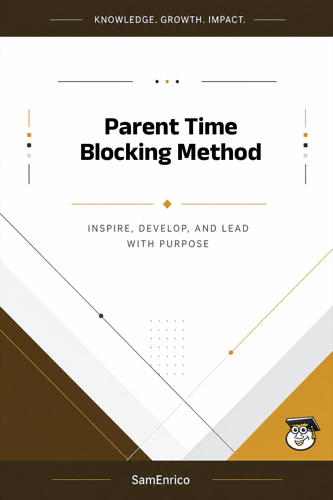
Parent Time Blocking Method eBook
Uses scheduled blocks for family and personal task
Uses scheduled blocks for family and personal tasks.
Formats
Free sample
Chapter 1: The Open-Door Trap--–- The moment it happened, I was holding a grilled cheese sandwich in one hand and a ringing work phone in the other. My three-year-old was tugging my pants leg, asking me to find a stuffed octopus named Professor Pickles. My six-year-old was crying because her Lego tower collapsed. The sandwich was burning. The phone would not stop ringing.
And somewhere in the background, my partner was asking, “Did you remember to sign the permission slip?”I did not remember. I had not remembered anything except the sound of my own heartbeat accelerating toward panic. In that single moment, I was failing as a parent, a partner, an employee, and a cook. The grilled cheese turned black. The phone call went to voicemail.
Professor Pickles remained lost. And I stood in the middle of my own kitchen, completely still, realizing something terrible: I had not had a single uninterrupted thought in three years.That night, after the kids were finally asleep, I sat on the couch and stared at the wall. I was too exhausted to watch television, too numb to read, too empty to cry. My partner asked if I was okay. I said yes, because I did not have the energy to explain that I was not okay, had not been okay for a long time, and could not remember what “okay” even felt like anymore.
I was a parent who loved her children fiercely and also a parent who had yelled at them that afternoon for no good reason except that I had been interrupted seventeen times in ninety minutes. I was a professional who met every deadline but who secretly hated the sound of an incoming email. I was a person who could not remember the last time she had finished a cup of coffee while it was still hot.This book is for every parent who has stood in that kitchen, holding that burning sandwich, feeling that rising panic. This book is for every mother, father, and caregiver who has been told that good parents are always available and who has internalized that lie so deeply that they feel guilty for closing the bathroom door. This book is for everyone who has ever whispered to themselves at 10 PM, “I have nothing left,” and then woken up at 6 AM to do it all over again.The lie we have been sold is simple and seductive: that love means availability.
That good parents drop everything every time a child calls. That saying “not right now” is a betrayal of our role. That rest is earned, not taken. That exhaustion is a badge of honor. That if you are not exhausted, you are not trying hard enough.Every one of those statements is false.
And believing them is destroying us.The Myth of the Always-On Parent Let me name the villain of this story. I call it the Open-Door Parent – the belief that your time belongs to anyone who asks for it, that your attention should be perpetually available, and that closing the door (literally or figuratively) makes you selfish. The Open-Door Parent never says “not now.” The Open-Door Parent responds to every ping, every tug, every request, every whine, every “Mommy watch this,” every “Daddy I need juice,” every single interruption as if it were an emergency. And then the Open-Door Parent collapses at the end of the day, wondering why they feel so resentful of the people they love most.This is not a parenting problem. This is a time problem.
And time problems have structural solutions, not moral ones.Here is what the research tells us. Cognitive psychologists have studied something called task-switching cost – the mental penalty we pay when we move from one activity to another. When you are focused on a work email and your child asks for a snack, and you answer them, and then you try to return to the email, your brain does not simply resume where it left off. It has to reorient, reload the context, and suppress the interruption. That process takes time and energy.
Multiple studies have shown that task-switching can temporarily reduce effective IQ by up to ten points. Ten points. That is the difference between feeling sharp and feeling foggy.Now multiply that by the average number of interruptions in a parenting day. Researchers have estimated that parents of young children are interrupted an average of once every four to six minutes during waking hours. That is hundreds of micro-transitions per day.
Each one costs a small piece of your cognitive reserve. Each one raises your cortisol levels a little higher. Each one makes you a little more irritable, a little less patient, a little closer to the edge.The Open-Door Parent is not a bad parent. The Open-Door Parent is an exhausted parent running a brain that was never designed for this level of fragmentation.The Guilt That Keeps the Door Open Why do we keep doing this to ourselves? Why do we answer the tenth “watch this” when we know it will drain us?
Why do we say yes to every request even when we are already drowning?The answer is guilt. Specifically, a specific flavor of guilt that I call the Guilt Gremlin – that internal voice that whispers, “Good parents say yes. Good parents are available. If you say ‘not right now,’ you are failing your child. They will remember this.
They will grow up and tell their therapist that you were never there for them.”The Guilt Gremlin is a liar. But it is a very persuasive liar because it dresses itself in the clothes of love. It points to our deepest fear – that our children will not feel loved – and uses that fear to keep us tethered to an impossible standard.Here is the truth that the Guilt Gremlin does not want you to know: Availability is not love. Predictability is safety.A child who has a parent who is always available but always frazzled learns something dangerous. They learn that love is anxious.
They learn that attention is unpredictable – sometimes it comes with warmth, sometimes with snapping, sometimes with tears. They learn that the parent’s emotional state is a roulette wheel. That is not safety. That is chaos.A child who has a parent who is sometimes unavailable but predictably available at certain times learns something entirely different. They learn that waiting is safe.
They learn that the parent will come back. They learn that “not now” does not mean “not ever.” They learn that rest is normal and boundaries are healthy. That is safety. That is love.The Guilt Gremlin wants you to believe that saying “not right now” is a wound. In reality, it is a gift.
It teaches your child that the world does not revolve around their every whim. It teaches them patience. It teaches them that you are a person, not a vending machine. And it preserves enough of your energy so that when you do say “now,” you are truly present – not just physically present but mentally and emotionally available.The Three Pillars of Freedom How do we escape the Open-Door Trap? How do we silence the Guilt…
This is the end of the free sample. Get the eBook to keep going. Buy now
About this book
Details
- Author
- Kendall Shante
- Publisher
- SamEnrico
- Language
- English
- Genre
- Non-Fiction, Self-Help, Time Blocking
- Released
- 2026-06-07
- Pages (approx.)
- 139
- Available as
- eBook, Audiobook

Read better in the ZLOADR app
Your eBooks on your phone or tablet. Sign in with your SamEnrico account and start reading.
More by Kendall Shante
 Senior Age Pride MovementKendall Shante$11.99
 NVC for Environmental ActionKendall Shante$11.99
 Design Thinking for Quality AssuranceKendall Shante$11.99
 Truck Driver Shift SleepKendall Shante$11.99
 Hackathon Planning GuideKendall Shante$11.99
 Francis First Christmas MassKendall Shante$11.99
 Catherine Serfdom ManagementKendall Shante$11.99
 The Last Witness of Pompeii: A Trial Through TimeKendall Shante$11.99
 The Maestro of the Americas: Juan de Dios Ramírez and the Birth of Latin Music RecordingKendall Shante$11.99
 Service Providers Guide to In-home ServicesKendall Shante$11.99
 How to Produce Toy AccessoriesKendall Shante$11.99
 Health Insurance for Portfolio CareersKendall Shante$12.99