
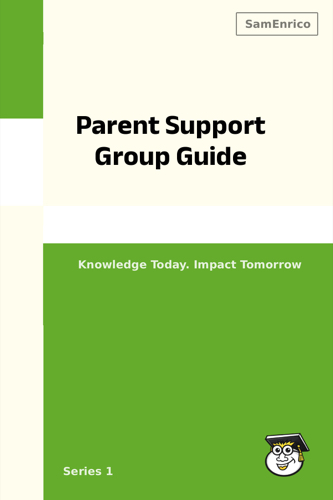
Parent Support Group Guide eBook
Find and participate in communities of other strug
Find and participate in communities of other struggling parents.
Formats
Free sample
The Parent Support Group Guide: Finding Your People, Sharing the Load, and Rising Together Revised and Expanded Chapter Summaries (All Inconsistencies & Repetitions Fixed)Part I: The Vulnerability Audit (Acknowledging the Need)Chapter 1: The Myth of the Nuclear Family In-Depth Summary (318 words):This opening chapter dismantles the deeply held belief that parenting is—and should be—a private, two-person endeavor. The author begins by tracing the historical shift from multigenerational, communal child-rearing—the "village" model that existed across virtually every human culture for millennia—to the isolated, suburban nuclear family that became the idealized norm in the 20th century. Readers are shown how this shift was accelerated by several converging forces: economic mobility that scattered extended families across states and countries, urban planning that replaced front porches and shared courtyards with fenced backyards, the erosion of third spaces like church basements and community centers, and finally the rise of social media, which presents a facade of effortless perfection while silently deepening isolation. The chapter introduces the concept of "Silent Overload" —those specific, heavy pains that no parenting hack, discipline strategy, or "self-care" ritual can fix. Examples include: the grief of a developmental diagnosis, the shame of financial insecurity, the exhaustion of parenting a child with mental illness, the loneliness of single parenthood, or the slow erosion of a marriage under the weight of special needs.
These are not situations to be managed but wounds that need witnessing. The author argues that modern parents have been sold a dangerous lie: that struggling alone is virtuous, that asking for help is a confession of weakness. Through personal anecdotes and anonymized stories from real support groups, the chapter reframes "I need help" from a shameful admission into an act of courage and a prerequisite for good parenting. For the first time in the book, the author defines the term that will be used consistently throughout: "In these pages, we will call anyone who participates in a mutual support community a 'co-villager.' Because that is what you become for each other—not just members of a group, but builders of a village." The chapter closes with a powerful reframing: isolation—not lack of parenting skill or effort—is the true enemy of healthy families.Reader Takeaway: A permission slip to admit you cannot do this alone, a consistent identity as a "co-villager," and a reframing of help-seeking as strength rather than failure.Chapter 2: Name It to Tame It: Identifying Your Parenting Struggle In-Depth Summary (342 words):Before any co-villager can find their community, they must know what they are actually looking for. This chapter introduces the "Specificity Principle" : a support group for "stressed parents" is functionally useless; a support group for "parents of children with pathological demand avoidance" or "mothers navigating post-partum rage" or "fathers grieving a medically complex diagnosis" can be life-changing.
The author provides a structured self-audit with diagnostic questions that help readers categorize their primary struggle into one of three domains. Domain One: Practical/Behavioral includes daily meltdowns that leave you hiding in the bathroom, sleep refusal that has lasted three years, picky eating that has become a medical concern, or aggressive behaviors that make you afraid in your own home. Domain Two: Emotional/Relational includes post-partum rage that scares even you, marital strain that feels irreparable, grief over a diagnosis that has no cure, or the quiet despair of loving a child who cannot love you back. Domain Three: Advocacy/Systemic includes fighting an IEP that the school keeps ignoring, navigating the foster care system, facing housing instability because your child's needs cost too much, or advocating for a disabled child in an ableist world. Using a simple flowchart and checklist (expanded in Appendix A), readers learn whether they need a therapeutic group (led by a licensed professional), a social group (peer-led venting and friendship), or an advocacy group (action-oriented with shared political or systemic goals).
This chapter is the exclusive home of the "mismatch trap" warning—the phenomenon of joining a playgroup when you need grief support, or a political action group when you need a shoulder to cry on. Later chapters will cross-reference this concept rather than repeat it. This chapter also introduces a new comparison table titled "Online vs. In-Person: Which Is Right for You Right Now?" with specific criteria including: childcare access (irrelevant for online, critical for in-person), social anxiety levels, geographic isolation, need for physical touch or hugs, screen fatigue, and the ability to read body language.Reader Takeaway: A personalized "community profile" that tells you exactly what kind of group to search for first, a clear warning against the mismatch trap, and a practical framework for choosing between online and in-person formats.Part II: The Search (Navigating the Ecosystem)Chapter 3: Digital Villages: Online Communities That Actually Work In-Depth Summary (355 words):The internet is flooded with parenting groups, but most are either ghost towns (a post from 2019 with no replies) or toxic dumpster fires (competitions over who has the sickest child). This chapter teaches the skill of "digital triage" —how to evaluate an online community before joining, before sharing your story, before getting hurt again.
The author provides four specific criteria for a healthy online group. Criterion One: Active Moderation means rules are enforced, not just posted and forgotten—look for pinned posts, evidence of removed comments, and moderators who intervene in conflicts. Criterion Two: Privacy Hygiene means groups are closed or secret for sensitive topics, with clear policies about screenshots and sharing content outside the group. Criterion Three: Signal-to-Noise Ratio means more solution-sharing than trauma-dumping—importantly, as will be fully explained in Chapter 6, "solution-sharing" here refers to collaborative problem-solving offered with permission, not unsolicited advice. Criterion Four: Entry Barriers means screening questions that show intentionality—groups that ask "What brings you here?" or "What are you hoping to get from this group?" tend to have more committed, respectful members.
Readers are taken on a tour of different platforms: Reddit for niche, anonymous support (e.g., r/daddit, r/specialneedsparenting, r/postpartum_depression) where the upvote/downvote system acts as a form of community moderation; Facebook Groups for local, real-name community building where you can actually meet people in your zip code; Discord for real-time, chat-based crisis support where you can get a response in minutes rather than days. The chapter includes a "Toxicity Checklist" —warning signs like chronic venting without any action or follow-up, active shaming of different parenting choices (formula vs. breast, sleep training vs. co-sleeping), absence of moderators, and a culture of "who has it worse" competitions. A detailed case study contrasts a healthy group (members share resources, ask "would you like suggestions or just listening?" before venting) with a toxic one (every post is a one-upping contest about medical trauma).
Throughout, the chapter plants the seed for Chapter 6's "Permission Question" framework by noting that the healthiest groups are those where members ask before offering solutions.Reader Takeaway: The ability to find, vet, and join an online community in under 30 minutes, using a four-criteria framework, while confidently avoiding the groups that will make you feel worse.Chapter 4: Breaking the Ice: Attending Your First Meeting In-Depth Summary (368 words):Knowing about a support group and walking through its door—whether a physical door or a…
This is the end of the free sample. Get the eBook to keep going. Buy now
About this book
Details
- Author
- Asher Corinne
- Publisher
- SamEnrico
- Language
- English
- Genre
- Non-Fiction, Self-Help, Peer Support
- Released
- 2026-06-06
- Pages (approx.)
- 147
- Available as
- eBook, Audiobook

Read better in the ZLOADR app
Your eBooks on your phone or tablet. Sign in with your SamEnrico account and start reading.
More by Asher Corinne
 School Building PalaceAsher Corinne$11.99
 TMJ Relaxation AnchorAsher Corinne$11.99
 Pet Loss Birthday GuideAsher Corinne$11.99
 Retirement Depression MenAsher Corinne$11.99
 Leverage In REITsAsher Corinne$11.99
 ED and Cardiovascular ExerciseAsher Corinne$11.99
 The First Public Spectacle: How the 18th Century Laid the Groundwork for Sports BroadcastingAsher Corinne$11.99
 Guernica: The Sky That Blew ApartAsher Corinne$11.99
 How to Produce Feminine Hygiene ProductsAsher Corinne$11.99
 Financial Services Regulation: Banking, Securities & ComplianceAsher Corinne$11.99
 German Student Childcare BenefitsAsher Corinne$12.99
 LLC Registered Agent Address GuideAsher Corinne$12.99
You may also like
 Binge Eating Support Group GuideRoney Evelynn$11.99
 Burnout Recovery Support Group GuideFountain Morgan$11.99
 Binge Eating Support GroupsVogt Shirleen$11.99
 Work Addiction Support Group GuideWill Jarrett$11.99
 Support Group Integration GuideAshcraft Johnie$11.99
 Drug Dependency Support Group DirectoryRobins Loise$11.99
 Gambling Addiction Support Group DirectoryBlocker Tosha$11.99
 Widow Support Group FinderLocke Cleo$11.99
 Twelve Step Phone List UsageArtis Elodia$11.99
 The Twelve Step Phone List GuideLockhart Dot$11.99
 Peer Support for Student StressCovey Brittny$11.99
 Peer Support for Self DoubtWheaton Corie$11.99