
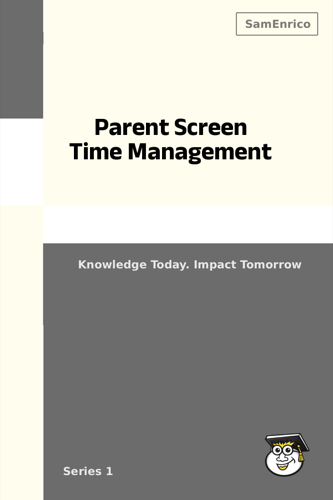
Non-FictionSelf-HelpScreen Time
Parent Screen Time Management eBook
Limits tech distractions to reclaim family time.
Limits tech distractions to reclaim family time.
Formats
Free sample
Chapter 1: The Shame Trap--–- I yelled at my six-year-old for watching too much Paw Patrol while simultaneously checking Instagram on my own phone. That sentence is not a confession designed to make you like me. It is a provocation designed to make you recognize yourself. Because if you are reading this book, you have done something similar. You have told your child to "get off that screen" while your own thumb hovered over a notification.
You have felt the hot flush of hypocrisy. You have gone to bed promising tomorrow will be different, only to wake up and repeat the exact same cycle.This chapter is called The Shame Trap for a reason. Shame is not your ally. Shame is not a motivator. Shame is the quicksand that pulls you deeper into the very behaviors you are trying to escape.
And until we name it, until we drag it into the light and examine it like a标本, you will continue to parent from a place of fear rather than from a place of strategy.Let me be clear about what this book is not. It is not a 30-day digital detox that will fail by day four. It is not a screed against technology from a Luddite who types on a manual typewriter. It is not a collection of guilt-inducing statistics designed to make you feel like you have already ruined your children. And it is certainly not a set of rigid rules that work for a fictional "perfect family" living in a Pinterest board.What this book is, instead, is a recalibration.
It is an invitation to move from shame to intentionality, from reaction to design, from exhaustion to clarity. The top-selling books on this topic—The Anxious Generation, Smartphone Nation, The Screentime Solution, Power On—all point to the same conclusion: parents are not failing because they are lazy or uncaring. Parents are failing because they are fighting a $200 billion attention economy with nothing but guilt and willpower. And guilt, as we are about to discover, is the worst possible fuel for change.The Anatomy of Parental Shame Let us dissect the specific shape of the shame you are carrying. For most parents, it arrives in three distinct flavors.The first is comparison shame.
You see another family at a restaurant where the children are coloring quietly on placemats while yours is watching an i Pad with the volume turned down to a passive-aggressive whisper. You see a social media post from a mom influencer whose "morning basket" contains wooden toys and handmade felt animals while your child’s breakfast was eaten in front of Cocomelon. You conclude that you are failing, that other parents have solved this problem, and that you are somehow constitutionally weak.The second is hypocrisy shame. This is the specific agony of telling your teenager to put down their phone while you check yours 94 times per day (the actual average for American adults, by the way). You know they see you.
You know they are mentally filing away every instance of your double standard. And yet you cannot seem to stop. This shame is particularly potent because it attacks your credibility as a parent. If you cannot manage your own screen time, who are you to manage theirs?The third is fear-based shame. This is the shame that whispers: you are harming your child permanently.
Every article about rising teen depression, every news segment about social media addiction, every study about attention spans—you absorb them all as personal indictments. You lie awake at night wondering if the hours your child spent on Roblox have somehow rewired their brain beyond repair. You carry this weight like a stone in your chest.Here is what the research actually says, and I want you to pay close attention because this is the foundation of everything that follows. Screen time itself is not a poison. There is no study showing that a child who watches 90 minutes of educational content is worse off than a child who watches 30 minutes of mindless content.
The variable that matters is not the clock. The variable that matters is the context, the content, and the child.Dr. Emily Cherkin, author of The Screentime Solution, puts it this way: "We have moralized a metric that was never designed to carry moral weight." Imagine if we treated food the way we treat screens. You would never say "eating is bad" or "eating is good." You would ask: What are you eating? Why are you eating it?
How does it make you feel? The same logic applies to screens. But shame has blinded us to this nuance. Shame demands a simple villain, and we have chosen the hour count.The Shame Audit: A Radical Exercise Before we go any further, I am going to ask you to do something that will feel uncomfortable. I am going to ask you to stop feeling guilty about your screen time.
Not reduce it. Stop feeling guilty about it entirely. For three days.Here is the Shame Audit. For the next 72 hours, you are going to log your screen time and your children's screen time without any judgment. You are not trying to reduce it.
You are not trying to optimize it. You are simply observing. Use a notebook, a notes app, or the built-in Screen Time feature on your phone. Every time you pick up your device, write down three things:What time is it?What app or activity are you opening?How do you feel right before you open it? (Bored?
Anxious? Lonely? Tired? Habit?)For your children, you will do the same observation. When they ask for a tablet, when they melt down at transition time, when they sneak an extra episode—just watch.
Do not intervene. Do not lecture. Do not feel bad. You are a scientist collecting data, not a judge rendering a verdict.I can already hear your objections. This feels like giving up.
This feels like permission to be lazy. If I don't feel guilty, I will never change.These objections are precisely why the shame trap is so effective. We have been taught that guilt is the engine of improvement. We believe that if we stop feeling bad, we will stop trying. But the opposite is true.
Guilt depletes your cognitive resources. It floods your brain with cortisol, the stress hormone, which impairs executive function. When you feel ashamed, you are actually less capable of making good decisions. This is why so many parents find themselves in a shame-spiral: they feel guilty about screen time, which makes them tired and reactive, which leads to more screen time, which leads to more guilt.The only way out is through self-compassion. Dr.
Kristin Neff, the leading researcher on self-compassion, has shown that people who forgive themselves for past failures are more likely to change their behavior, not less. Self-compassion provides the emotional stability required to make strategic choices.Why "Low Screen Time" Is Not the Goal Let me say something that might shock you. I do not care how many hours your child spends on screens. Neither should you.I care about which hours. I care about why those hours are happening.…
This is the end of the free sample. Get the eBook to keep going. Buy now
About this book
Details
- Author
- Kirchner Lyla
- Publisher
- SamEnrico
- Language
- English
- Genre
- Non-Fiction, Self-Help, Screen Time
- Released
- 2026-06-06
- Pages (approx.)
- 142
- Available as
- eBook, Audiobook

Read better in the ZLOADR app
Your eBooks on your phone or tablet. Sign in with your SamEnrico account and start reading.
More by Kirchner Lyla
 Weight Loss Resistance GuideKirchner Lyla$11.99
 Design Thinking for Student ServicesKirchner Lyla$11.99
 Young Adult Purpose GuideKirchner Lyla$11.99
 Lessons Learned DatabaseKirchner Lyla$11.99
 Teresas Concept of Spiritual FriendshipKirchner Lyla$11.99
 Oil Rig Shift Sleep GuideKirchner Lyla$11.99
 Catherine Black Sea ConquestKirchner Lyla$11.99
 The Dragon’s Last Breath: A Tale of the Azure Serpent’s CurseKirchner Lyla$11.99
 Gold & Ghosts: The Medici Bank's Phantom LedgersKirchner Lyla$11.99
 A Collector's Handbook to the Hrg 1500 (1939-56)Kirchner Lyla$11.99
 Service Providers Guide to Infectious DiseasesKirchner Lyla$11.99
 How to Produce an In-movie ExperienceKirchner Lyla$11.99
You may also like
 Hong Kong Handover 1997Dunn Johnnie$11.99
 Zumba For Postnatal Recovery CourseNeal Christian$11.99
 Zumba for BeginnersLadner Nikia$11.99
 YouTube Comment Mining GuideHumes Pandora$12.99
 Worry Box MeditationCarlin Rudy$11.99
 Workplace Stress MeditationNguyen Lynn$11.99
 Workplace Stress and Sleep RepairHawley Ivory$11.99
 Workplace Perfectionism CureDelaney Jeffry$11.99
 Workplace Injustice Anger GuideWallen Isabelle$11.99
 Work Addiction and Burnout LinkGreenwood Ester$11.99
 Women in Yoga and WellnessBeattie Galina$11.99
 Women in Stand Up ComedyChun Evangeline$11.99