
Non-FictionSelf-HelpSupport Groups
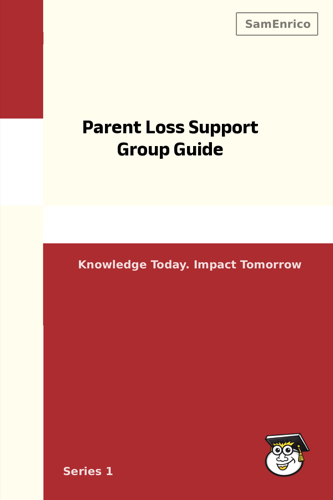
Parent Loss Support Group Guide eBook
How to find peer support for bereaved adult childr
How to find peer support for bereaved adult children.
Formats
Free sample
Chapter 1: The Invisible Orphan–- The term hits you somewhere between your throat and your chest, doesn’t it? “Adult orphan.” You might have flinched the first time you heard it, or perhaps you whispered it to yourself in a dark moment and felt the weight of those two words press down on your shoulders. You are old enough to vote, to sign a mortgage, to raise children of your own. You pay taxes, you show up to meetings, you laugh at your colleague’s jokes about their parents’ annoying texts. And yet, somewhere inside you—in a place you don’t talk about at dinner parties—you feel like a small, frightened child who has lost the only two people in the world who were supposed to keep you safe.Welcome to the club no one wanted to join.
The dues are high, the meetings are unscheduled, and the benefits are invisible to everyone except the other members. This chapter exists for one reason: to tell you that your particular flavor of grief is real, it is valid, and it is far more common than you have been led to believe. More importantly, this chapter will give you permission—explicit, written, hard-won permission—to grieve the way you need to grieve, not the way the world expects you to.The Double-Bind of Adult Grief Let’s start with the fundamental contradiction that defines your experience. When a child loses a parent, the world responds with immediate, overwhelming compassion. Neighbors bring casseroles.
Teachers offer extensions on homework. Relatives fly in from across the country. The child is wrapped in a cocoon of understanding because everyone agrees: a child should not have to bury their parent.When an adult loses a parent, the response is different. Often, it is silence. Or worse, it is a variation of: “Well, she lived a long life.” “He was in pain, so it’s a blessing.” “At least you got to say goodbye.” “You’re a grown adult—you’ll handle it.”These statements are not malicious.
Most people who say them genuinely believe they are helping. But what they communicate, whether intended or not, is that your grief should be manageable, contained, and brief. You are an adult, after all. Adults handle things. Adults don’t fall apart because their mother died, not when there are spreadsheets to complete and soccer practices to drive to and performance reviews to prepare for.This is the double-bind: You are simultaneously expected to function at full capacity while grieving one of the most significant losses a human being can experience.
Your boss expects the report. Your children need breakfast. Your spouse wants to know about your day. And somewhere in the background, your nervous system is screaming because the person who brought you into this world is no longer in it.The psychological term for this is “disenfranchised grief”—a concept first introduced by grief researcher Kenneth Doka in the 1980s. Disenfranchised grief occurs when a person’s loss is not socially recognized, validated, or supported.
Adult parental loss is often disenfranchised not because people are cruel, but because our society lacks rituals and language for it. We have funerals, we have sympathy cards, we have three days of bereavement leave if we are lucky. And then we are expected to return to normal.But here is the truth: Grief does not care about your mortgage. It does not clock out at 5 PM. It does not take weekends off.
And the particular grief of losing a parent as an adult has unique features that make it distinct from any other loss you will experience in your lifetime.What This Book Means When It Says “Adult Orphan”Before we go any further, we need to clarify a term that will appear throughout this book: “adult orphan.” Traditionally, the word “orphan” refers to a child whose parents have both died. By strict definition, an adult whose parents have died is simply an adult with deceased parents, not an orphan at all.But language evolves because human experience demands it. Over the past two decades, grief researchers, support communities, and adult children themselves have increasingly adopted the term “adult orphan” to describe a specific psychological reality. When your last surviving parent dies—or when both parents are gone, regardless of order—you experience a shift in identity that is qualitatively different from any other life transition. You are no longer anyone’s child, at least not in the living, breathing, phone-call-at-2-AM sense.
You have moved to the front of the line. There is no one standing between you and the end of your own life.Here is the clarification that will apply throughout this entire book: We use “adult orphan” inclusively to refer to anyone who has lost one parent, both parents, or the last surviving parent. Why? Because the peer support needs of these groups overlap so significantly that drawing a hard line would be artificial and unhelpful.If you have lost one parent but the other is still living, you may feel that the term “orphan” does not apply to you. And technically, you are correct.
But consider this: many of the challenges you face—the shift in family dynamics, the confrontation with mortality, the need to reorganize holidays and traditions, the exhaustion of supporting a grieving surviving parent—are identical to those faced by someone who has lost both parents. The only difference is that you have one living parent who may need care, which adds its own layer of complexity (a subject we will explore in depth in Chapter 7).If you have lost both parents, you may feel that those who have lost only one cannot possibly understand the complete severing of your childhood anchor. And you are also correct. Losing both parents creates a unique form of existential homelessness. However, the grief support community has learned that excluding people based on the “one versus two” distinction does more harm than good.
The adult who lost their father at twenty-two and still has their mother is grieving. The adult who lost their mother at forty-five and still has their father is grieving. And the adult who has buried both parents is grieving in a way that shares features with both of those experiences while also having its own distinct texture.Throughout this book, when we say “adult orphan,” we mean: any adult who has experienced the death of one or more parents and who is seeking peer support for that loss. If the term does not resonate with you, feel free to replace it in your mind with “adult child grieving a parent” or “bereaved adult child.” The label matters less than the understanding that you are not alone.The Statistics That Should Silence Your Shame If you have been telling yourself that you “should be over it by now” or that “other people have real problems,” I want you to look at the following numbers. These are not opinions.
These are data.In the United States alone, approximately 1.5 million adults lose a parent every year, according to the Social Security Administration. By age fifty, more than half of Americans have lost at least one…
This is the end of the free sample. Get the eBook to keep going. Buy now
About this book
Details
- Author
- Morey Wilhelmina
- Publisher
- SamEnrico
- Language
- English
- Genre
- Non-Fiction, Self-Help, Support Groups
- Released
- 2026-06-07
- Pages (approx.)
- 144
- Available as
- eBook, Audiobook

Read better in the ZLOADR app
Your eBooks on your phone or tablet. Sign in with your SamEnrico account and start reading.
More by Morey Wilhelmina
 Interruption Proof Personal BoundariesMorey Wilhelmina$11.99
 Total Compensation Package GuideMorey Wilhelmina$11.99
 HGH and FOXO Transcription FactorsMorey Wilhelmina$11.99
 Spiritual Goal PlanningMorey Wilhelmina$11.99
 Procrastination For Remote WorkersMorey Wilhelmina$11.99
 Nonprofit Executive Director TransitionMorey Wilhelmina$11.99
 Mu Opioid Receptor HealingMorey Wilhelmina$11.99
 The Silent Witnesses: Canada's First Forensic Pathology Breakthroughs (1960s-1980s)Morey Wilhelmina$11.99
 The Siege of Vukovar: Europe's Forgotten Hell (1991)Morey Wilhelmina$11.99
 Growing AiphanesMorey Wilhelmina$11.99
 How to Produce Medical TestsMorey Wilhelmina$11.99
 How to Produce Colored Wood FillerMorey Wilhelmina$11.99
You may also like
 Hong Kong Handover 1997Dunn Johnnie$11.99
 Zumba For Postnatal Recovery CourseNeal Christian$11.99
 Zumba for BeginnersLadner Nikia$11.99
 YouTube Comment Mining GuideHumes Pandora$12.99
 Worry Box MeditationCarlin Rudy$11.99
 Workplace Stress MeditationNguyen Lynn$11.99
 Workplace Stress and Sleep RepairHawley Ivory$11.99
 Workplace Perfectionism CureDelaney Jeffry$11.99
 Workplace Injustice Anger GuideWallen Isabelle$11.99
 Work Addiction and Burnout LinkGreenwood Ester$11.99
 Women in Yoga and WellnessBeattie Galina$11.99
 Women in Stand Up ComedyChun Evangeline$11.99