
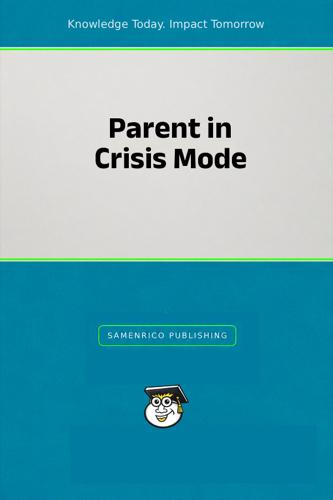
Parent in Crisis Mode Audiobook
Emergency time management for sudden illness or ac
by Powers Karl
Emergency time management for sudden illness or accident.
Formats
Free sample
Here is an in-depth, chapter-by-chapter summary for Parent in Crisis Mode: The First 72 Hours of Sudden Illness or Accident.Part I: The First 60 Seconds (The Shock Phase)Chapter 1: Red Light Thinking (Overriding the Freeze Response)In-depth summary: This chapter begins by explaining the neuroscience of panic. When a child suddenly falls ill or is injured, the parent’s amygdala (the brain’s fear center) activates faster than the prefrontal cortex (logic center). This causes “amygdala hijack”—freezing, tunnel vision, or frantic action. The chapter teaches a simple override technique called “Red Light Thinking.” Just as a red traffic light forces a driver to stop before proceeding, parents are trained to take three intentional seconds: Stop (physically halt all movement), Look (assess the child’s color, breathing, and consciousness from a distance), Breathe (one deep exhale to lower heart rate). The chapter then provides a decisive action guide: a clear flowchart differentiating urgent (manageable at home or via pediatrician, e.g., moderate fever, suspected sprain) from emergent (life or limb-threatening, e.g., anaphylaxis, seizure, severe head injury).
The goal is to prevent unnecessary ER trips that waste critical time and emotional energy while ensuring true emergencies get immediate 911 calls.Chapter 2: The 30-Second Bag (The Only Packing List That Matters)In-depth summary: This chapter tackles the common crisis-time mistake of over-packing. When an ambulance is en route or you’re rushing out the door, parents often waste 5–10 minutes grabbing toys, extra clothes, or snacks—time that could be used for comfort or first aid. The chapter introduces the “ID, Cord, Card” rule: (1) Insurance ID cards (and a photo ID for the parent), (2) a fully charged phone charger with a long cord (hospital outlets are often far from beds), and (3) one credit card (not a stack of cash or multiple cards). Everything else—blankets, books, pajamas—is declared a distraction. The chapter provides step-by-step instructions for pre-staging a “Crash Bag” by the front door or in the car.
This bag is not a diaper bag; it’s a small zippered pouch with only those three categories plus a single N-95 mask and a pen. The chapter ends with a weekend project: assembling the bag and practicing the 30-second grab with a timer.Part II: The Hospital Vortex (Managing Chaos)Chapter 3: Triage Time vs. Clock Time (Navigating the Wait)In-depth summary: Emergency rooms operate on triage time (severity of condition), not clock time (first come, first served).…
This is the end of the free sample. Get the Audiobook to keep going. Buy now
About this book
Details
- Author
- Powers Karl
- Publisher
- SamEnrico
- Language
- English
- Genre
- Non-Fiction, Self-Help, Crisis
- Released
- 2026-06-11
- Pages (approx.)
- 144
- Available as
- eBook, Audiobook

Listen in the VoxFlicks app
Audiobooks and audio dramas wherever you go. Sign in with your SamEnrico account and press play.
More by Powers Karl
 IBS Mindful Eating GuidePowers Karl$11.99
 Managing Difficult PersonalitiesPowers Karl$11.99
 The Urge Surfing for EmotionsPowers Karl$11.99
 MATADOR Study GuidePowers Karl$11.99
 Elizabeth Cultural DiplomacyPowers Karl$11.99
 Marijuana Anonymous ExplainedPowers Karl$11.99
 Road Rage WorkbookPowers Karl$11.99
 The Bone Collector of the Black Forest: Germany's Carnivorous ShadowPowers Karl$11.99
 The Last Empress: The Fall of China’s Forbidden QueenPowers Karl$11.99
 How to Produce Interior LaTeX PaintPowers Karl$11.99
 Service Providers Guide to Patient AdvocatesPowers Karl$11.99
 How to Start a Hobby in Ball and JacksPowers Karl$11.99
You may also like
 Hong Kong Handover 1997Dunn Johnnie$11.99
 Zumba For Postnatal Recovery CourseNeal Christian$11.99
 Zumba for BeginnersLadner Nikia$11.99
 YouTube Comment Mining GuideHumes Pandora$12.99
 Worry Box MeditationCarlin Rudy$11.99
 Workplace Stress MeditationNguyen Lynn$11.99
 Workplace Stress and Sleep RepairHawley Ivory$11.99
 Workplace Perfectionism CureDelaney Jeffry$11.99
 Workplace Injustice Anger GuideWallen Isabelle$11.99
 Work Addiction and Burnout LinkGreenwood Ester$11.99
 Women in Yoga and WellnessBeattie Galina$11.99
 Women in Stand Up ComedyChun Evangeline$11.99