
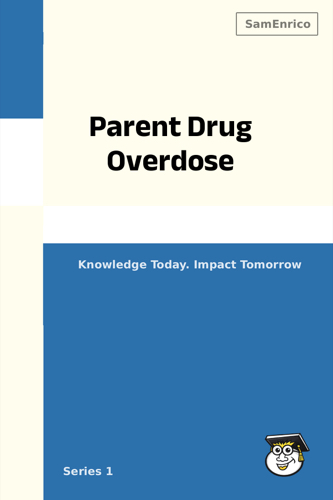
Non-FictionSelf-HelpOverdose Loss
Parent Drug Overdose eBook
Grieve mother or father lost to addiction.
by Rector Tiny
Grieve mother or father lost to addiction.
Formats
Free sample
Chapter 1: The Split-Screen Image...--The first time you close your eyes after the overdose, you see two things at once. You see the body—the one the paramedics found or the one you found yourself. Maybe it was slumped on a bathroom floor, needle still dangling from a blueish arm. Maybe it was curled on a stained couch, mouth open, skin the color of old parchment. Maybe it was in a hospital bed, tubes everywhere, but the eyes already empty.
And then, superimposed over that image like a ghost in a double exposure, you see the parent you remember from before. The one who pushed you on a swing. The one who read you bedtime stories in a voice that made you feel safe. The one who smiled with all their teeth before the drugs took the teeth, then the smile, then the person.You are not crazy. You are not weak.
You are experiencing what this book will call, throughout these pages, the split-screen image. It is the defining visual torment of losing a mother or father to addiction. And until you learn to hold both images in the same frame—without one destroying the other—you will be trapped in a loop of grief that has nowhere to go.This chapter is about that collision. About the body they left behind and the parent you remember. About why the "good death" you were taught to expect does not exist in the world of overdose.
About how to cope with the specific, visceral horror of seeing your first home—your parent’s body—turned into a crime scene, a medical emergency, or simply a sad, quiet ending that no one witnessed. And most importantly, this chapter will give you the first tools you need to stop the split-screen from playing on a loop in your head.The Body You Saw Let us name what you saw. Because the first step toward integrating the split-screen is to stop looking away from the half that frightens you most.For many children of addicts, the body of the parent at the time of death is not the body they grew up loving. Addiction is a physically destructive disease. It does not kill gently.
If your parent used opioids, you may have seen needle tracks—collapsed veins, abscesses, scarring that looked more like a battlefield than a human arm. If your parent used stimulants like methamphetamine or cocaine, you may have seen severe dental decay (often called "meth mouth"), skin sores from picking, and extreme weight loss that turned a once-robust body into a skeleton draped in loose flesh. If your parent used alcohol as their primary substance, you may have seen the yellowing of jaundice from liver failure, a distended abdomen from ascites, and the unmistakable red spider veins that bloom across the nose and cheeks of a person whose liver has given up.None of this is easy to read. None of this is meant to shock you for shock’s sake. It is here because you have already seen it, and pretending you did not see it is what keeps the split-screen playing in the dark.
You cannot heal an image by refusing to look at it. You can only learn to look at it differently.The Scene of Death: Different Scenarios, Different Wounds Not every child of an addicted parent experiences the same scene of death. Where you were—and who found them—will shape your trauma in specific ways.If You Found the Body You are carrying a weight that most people cannot imagine. Finding a parent’s body—whether you expected it or not—imprints an image that your brain will try to replay at the worst moments: in the middle of a work meeting, during sex, right as you are about to fall asleep. This is not a moral failing.
This is your amygdala (the brain’s threat detection center) trying to process an event it was never designed to handle. The chapter on the biology of grief will explain this more deeply, but for now, know this: the intrusive images are not punishment. They are your brain’s clumsy attempt at protection—a frantic effort to review the event so it never happens again. The tragedy is that it already has.If you found the body, you also likely had to make the call. The 911 call.
The call to your siblings. The call that says, “Mom is gone” or “Dad overdosed.” That call is its own trauma. You may replay the sound of your own voice saying those words. You may feel guilt about the tone—were you too cold? Too hysterical?
Did you sound relieved? That guilt is a liar. There is no correct tone for announcing your parent’s death by overdose.If the Police Found Them Perhaps you were not the first on the scene. Perhaps you got a call from a detective or a patrol officer. “We have a situation.
Can you come identify the body?” This scenario comes with its own specific horror: the unknown. You did not see the body in its raw state, but you imagine it. You imagine worse than what was there. Your brain fills in the gaps with the most frightening possibilities because that is what brains do with missing information. You may also have to navigate the legal system immediately—police reports, toxicology screens, the question of whether to press charges against whoever sold or gave your parent the fatal dose.
That last question is a torture of its own. Do you want revenge? Do you want justice? Do you even know the difference anymore?If They Died in a Hospital Alone This scenario carries a different kind of pain: the pain of absence. You were not there.
You may have been thousands of miles away, or you may have been in the waiting room when the code blue was called. You may have arrived ten minutes too late. The specific guilt of the hospital death is the guilt of not being there. You may tell yourself, “If I had just stayed five minutes longer,” or “If I had visited more often.” But hospitals are not redemption machines. Being present at the moment of death does not undo the years of addiction.
And conversely, not being present does not mean you loved them less. It means you are a human being who cannot be in two places at once, and no one—not even the most devoted child—can sit vigil forever.Dealing with the “Last Image”The last image is the one that haunts. It is the snapshot your brain took at the worst possible moment, and it refuses to delete. In trauma therapy, this is sometimes called a “hot spot”—a sensory memory that is too intense to process normally. The hot spot might be the color of your parent’s lips (blue, gray, purple).
It might be the smell of the room (stale cigarettes, vomit, the chemical sweetness of fentanyl). It might be the sound—the silence of a chest that no longer rises, or the mechanical beeping of a hospital monitor flatlining.Here is a technique you can use right now, in…
This is the end of the free sample. Get the eBook to keep going. Buy now
About this book
Details
- Author
- Rector Tiny
- Publisher
- SamEnrico
- Language
- English
- Genre
- Non-Fiction, Self-Help, Overdose Loss
- Released
- 2026-06-11
- Pages (approx.)
- 123
- Available as
- eBook, Audiobook

Read better in the ZLOADR app
Your eBooks on your phone or tablet. Sign in with your SamEnrico account and start reading.
More by Rector Tiny
 Special Education Teacher BurnoutRector Tiny$11.99
 Foster Care Birthday MemoriesRector Tiny$11.99
 Housing Downsizing for CouplesRector Tiny$11.99
 Car Rental Small TalkRector Tiny$11.99
 Personal Branding for ArtistsRector Tiny$11.99
 Keto Desserts Without Sugar AlcoholsRector Tiny$11.99
 Battlecruiser Clash at JutlandRector Tiny$11.99
 The Raven’s Lament: How the Trickster Brought Light to the WorldRector Tiny$11.99
 The Last Lap: The Untold Story of the 1984 Olympic Marathon HeistRector Tiny$11.99
 Service Providers Guide to Long Distance TelecommunicationsRector Tiny$11.99
 How to Produce Lights and LightingRector Tiny$11.99
 How to Start a Copyrights Preparation Business (Beginners Guide)Rector Tiny$11.99
You may also like
 Hong Kong Handover 1997Dunn Johnnie$11.99
 Zumba For Postnatal Recovery CourseNeal Christian$11.99
 Zumba for BeginnersLadner Nikia$11.99
 YouTube Comment Mining GuideHumes Pandora$12.99
 Worry Box MeditationCarlin Rudy$11.99
 Workplace Stress MeditationNguyen Lynn$11.99
 Workplace Stress and Sleep RepairHawley Ivory$11.99
 Workplace Perfectionism CureDelaney Jeffry$11.99
 Workplace Injustice Anger GuideWallen Isabelle$11.99
 Work Addiction and Burnout LinkGreenwood Ester$11.99
 Women in Yoga and WellnessBeattie Galina$11.99
 Women in Stand Up ComedyChun Evangeline$11.99