
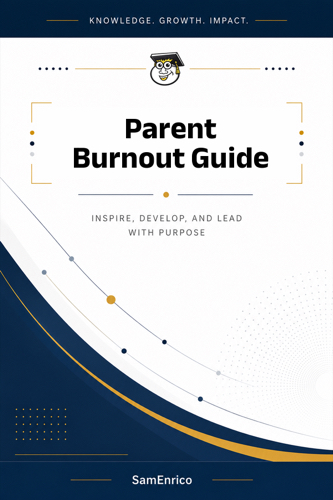
Parent Burnout Guide eBook
Balances childcare with personal energy.
Balances childcare with personal energy.
Formats
Free sample
Chapter 1: The Emptied Cup–- You wake up before the alarm. Not because you are well-rested, but because your body has forgotten how to sleep past 5:00 AM. The baby will cry in approximately eleven minutes. The preschooler will need to be pried out of bed in twenty-three. Somewhere between those two events, you will need to pee, brush your teeth, pack two lunches, find matching socks, and remember that today is “library day” which requires the book that your child lost somewhere under the couch.
Your brain feels like a browser with forty-seven tabs open, and three of them are playing music you cannot identify. This is not the start of an unusual day. This is the start of every day. And you are already exhausted before your feet have touched the floor.This is the feeling that the best-selling parenting books do not prepare you for. They teach you about sleep training and developmental milestones and how to puree vegetables into shapes that children will tolerate.
They do not teach you what to do when you look at your child—the child you would die for, the child you chose to bring into this world—and feel nothing but a hollow, buzzing emptiness. They do not prepare you for the moment you realize you are going through the motions of parenthood like an actor who has performed the same play eight hundred times and cannot remember why the lines ever mattered.Welcome to parental burnout. And welcome to the first chapter of a book that will not tell you to take more bubble baths.The Difference Between Tired and Burned Out Let us begin with a distinction that sounds simple but is, in practice, the difference between a bad week and a breakdown. Every parent is tired. Tired is the baseline condition of raising small humans who do not yet understand that nighttime is for sleeping.
Tired is having dark circles under your eyes and drinking an extra cup of coffee and feeling a little foggy during the afternoon meeting. Tired is recoverable. Tired responds to a single good night’s sleep, or a weekend with a grandparent who takes the kids, or simply the natural ebb and flow of life’s demands.Burnout is different. Burnout is tired’s evil twin. Burnout is exhaustion that does not lift.
You can sleep for nine hours—a miraculous, impossible nine hours—and wake up feeling as though you have run a marathon in your dreams. Burnout is emotional depletion so profound that you no longer feel sad or angry or frustrated. You feel nothing. Or rather, you feel a low-grade static, like a television tuned to a dead channel. Burnout is the slow erosion of joy, the creeping suspicion that you are failing at the one job that was supposed to define you.The medical and psychological literature defines burnout as a state of emotional, physical, and mental exhaustion caused by excessive and prolonged stress.
It has three core dimensions, which we will explore in depth throughout this chapter: overwhelming exhaustion, feelings of cynicism and detachment from the job (in this case, the job of parenting), and a sense of ineffectiveness or lack of accomplishment. Notice that last piece. Burnout is not just about being tired. Burnout is about feeling like you are bad at the thing that is exhausting you.This is the cruel paradox. You pour everything into parenting.
You sacrifice sleep, hobbies, friendships, career ambitions, and the last shred of your pre-children identity. And the reward for this total devotion is the creeping feeling that you are doing it wrong. That everyone else is managing. That you are the imposter behind the curtain.The Symptom Checklist: A Diagnostic Tool Before we go any further, let us get specific. The following checklist is adapted from clinical burnout assessments and tailored specifically to parents.
Read each statement and ask yourself how often it has been true in the past month. Do not overthink. Your first instinct is usually the right one.Physical and Emotional Exhaustion:I wake up feeling tired, even after what should have been enough sleep.My body feels heavy, as though I am moving through water.I have been getting sick more often—colds, headaches, stomach issues—and recovery takes longer than it used to.I feel emotionally drained at the end of most days, not in a satisfying “I worked hard” way but in a hollow “I have nothing left” way.Small tasks that used to be automatic—folding laundry, brushing teeth, answering a text—now feel monumental.Detachment and Cynicism:I find myself going through the motions of parenting without really feeling present.I have said “I love you” to my child while feeling disconnected from the words.I feel irritated or impatient with my child more often than I feel warm or joyful.I secretly look forward to my child’s bedtime not because I need a break but because I want them to be quiet and leave me alone.I have stopped caring about things that used to matter to me as a parent, like reading bedtime stories or making special breakfasts.Reduced Accomplishment and Self-Doubt:I feel like I am failing as a parent, even though I cannot point to a specific failure.I compare myself to other parents and always come up short.I believe that other parents are handling the same challenges with more grace, patience, and competence.I feel guilty about my parenting choices multiple times a day.I have thought, at least once in the past week, that my children would be better off with a different parent.If you checked five or more of these statements, you are likely experiencing more than ordinary tiredness. If you checked eight or more, you are in the zone of clinical parental burnout, and the tools in this book are designed specifically for you.The Four Horsemen of Parental Exhaustion The checklist above is a screening tool. What follows is a deeper map of the territory.
Through years of research and clinical work with burned-out parents, four signature patterns have emerged. Think of these as the Four Horsemen of parental exhaustion—not metaphorical demons but predictable, measurable shifts in how you think, feel, and behave.The First Horseman: Depletion That Rest Does Not Cure The first and most obvious sign is physical and emotional depletion, but with a specific quality: it does not respond to rest. This is the hallmark that separates burnout from simple fatigue. When you are merely tired, a good night’s sleep or a lazy Sunday resets the dial. When you are burned out, you can take a vacation—a real vacation, without the children—and return feeling exactly as empty as when you left.This happens because the exhaustion of burnout is not primarily about sleep debt.
It is about the chronic activation of your stress response system. Your body was designed to handle short bursts of high stress—the tiger appears, you run, the tiger leaves, you rest. Modern parenting, especially in households without adequate support, looks nothing like that. The tiger never leaves. The toddler wakes at 2:00 AM.
The school calls at 10:00 AM to say your child has a fever. The after-school activity runs late. The dinner…
This is the end of the free sample. Get the eBook to keep going. Buy now
About this book
Details
- Author
- Hoffman Tricia
- Publisher
- SamEnrico
- Language
- English
- Genre
- Non-Fiction, Self-Help, Parenting
- Released
- 2026-06-06
- Pages (approx.)
- 124
- Available as
- eBook, Audiobook

Read better in the ZLOADR app
Your eBooks on your phone or tablet. Sign in with your SamEnrico account and start reading.
More by Hoffman Tricia
 The Waco InfiltratorsHoffman Tricia$11.99
 ESG and Private Equity MultiplesHoffman Tricia$11.99
 Gilliam Monty Python AnarchistHoffman Tricia$11.99
 The Workaholic's Digital DetoxHoffman Tricia$11.99
 Nurse Night Shift Sleep GuideHoffman Tricia$11.99
 Active Shooter Preparedness PlanHoffman Tricia$11.99
 Imaginary Locus CreationHoffman Tricia$11.99
 Female Rulers Patronage Network HandbookHoffman Tricia$11.99
 The Tsar's Golden Notes: How Russia Gifted the World TchaikovskyHoffman Tricia$11.99
 The Last Empress: The Rise and Fall of Empress Dowager CixiHoffman Tricia$11.99
 The Silk Road of Science: How a Soviet Chemist Revolutionized Central Asia's IndustryHoffman Tricia$11.99
 Connecting dApps with Wallets and ProvidersHoffman Tricia$11.99
You may also like
 Hong Kong Handover 1997Dunn Johnnie$11.99
 Zumba For Postnatal Recovery CourseNeal Christian$11.99
 Zumba for BeginnersLadner Nikia$11.99
 YouTube Comment Mining GuideHumes Pandora$12.99
 Worry Box MeditationCarlin Rudy$11.99
 Workplace Stress MeditationNguyen Lynn$11.99
 Workplace Stress and Sleep RepairHawley Ivory$11.99
 Workplace Perfectionism CureDelaney Jeffry$11.99
 Workplace Injustice Anger GuideWallen Isabelle$11.99
 Work Addiction and Burnout LinkGreenwood Ester$11.99
 Women in Yoga and WellnessBeattie Galina$11.99
 Women in Stand Up ComedyChun Evangeline$11.99