
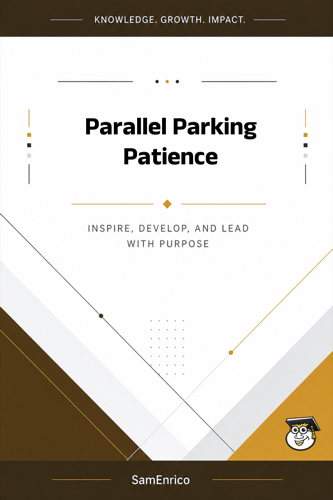
Non-FictionSelf-HelpParking Skills
Parallel Parking Patience eBook
Reduces frustration when struggling to park in tig
by Berlin Dolly
Reduces frustration when struggling to park in tight spots.
Formats
Free sample
Chapter 1: The Audience Trap--–- The first time I watched someone abandon a perfect parking spot, I was sitting in a coffee shop two blocks from downtown Portland. A middle-aged woman in a Honda CRV had found a spot wide enough for a pickup truck. She pulled forward, stopped, then sat there for seventeen seconds. Her reverse lights flickered on and off twice. Then she pulled away and kept driving.
The car behind her—a rusted sedan that had been waiting patiently—slid into the spot in one smooth motion. The woman in the Honda drove around the block and disappeared.I saw this happen three more times that same afternoon. Each driver found a usable spot. Each driver had the mechanical capability to park in it. And each driver chose to leave rather than attempt the maneuver with an audience.That was the moment I realized parallel parking is not a driving problem.
It is a performance anxiety problem that happens to involve a car.This book is not about where to put your wheels, though we will spend plenty of time on that. This book is about why otherwise competent adults suddenly lose the ability to perform a simple geometric task when other people are watching. And more importantly, this book is about how to get that ability back—not by practicing until you are perfect, but by understanding the biological trap that turns a twelve-second maneuver into a thirty-second spiral of shame.Welcome to the Audience Trap.The Phenomenon No One Talks About Let me ask you something. Have you ever parallel parked perfectly when no one was watching? Of course you have.
Late at night on a quiet street, you slide into a spot like a seasoned chauffeur. Your reference points align. Your steering is smooth. You finish in two moves and think, "That was easy."Now let me ask you something else. Have you ever failed at parallel parking when three cars were waiting behind you?
Of course you have. Everyone has. Your palms got clammy. Your heart rate climbed. You turned the wheel too early, then too late, then you were six inches from the curb but angled out at forty-five degrees, and the person in the sedan behind you sighed so loudly you could hear it through closed windows.Here is the terrifying truth: you are not a worse driver when people are watching.
You are the same driver. But your brain is not the same brain. It has been hijacked by an ancient biological program that cannot tell the difference between a parking audience and a predator.The Audience Effect: Why Being Watched Changes Everything In 1965, psychologists Robert Zajonc and Robert Kraus ran a simple experiment. They asked participants to perform a task they already knew well—typing their own name—while being observed by a small audience. The participants typed faster than usual.
Their accuracy remained high. Zajonc called this "social facilitation": the tendency for an audience to improve performance on well-learned tasks.Then they asked the same participants to perform a task they had just learned—a complex button-pressing sequence—while being watched. Performance plummeted. Mistakes doubled. The audience that had helped the simple task destroyed the difficult one.This is called the Audience Effect, and it explains everything about parallel parking.
For an experienced driver, the basic mechanics of operating a car are well-learned. You do not think about which pedal is the brake. You do not consciously calculate steering wheel rotation. But parallel parking is not a well-learned task for most drivers. It is a complex, multi-step maneuver that you perform infrequently and under variable conditions.
When an audience appears, your performance on that complex task collapses exactly as Zajonc predicted.But here is what Zajonc did not fully appreciate in 1965. The audience does not just distract you. It triggers a full physiological cascade that actively impairs your fine motor control.The Cortisol Connection: Your Body Against Itself When you see headlights in your rearview mirror and realize there are cars waiting, your brain does something remarkable. It interprets that visual information as a potential social threat. And your brain's threat detection system has not been significantly updated since you were a primate living in small troops.The amygdala, two almond-shaped clusters deep in your brain, activates the sympathetic nervous system.
Your adrenal glands release two hormones: epinephrine (adrenaline) and cortisol. Adrenaline increases your heart rate and redirects blood flow to large muscle groups. Cortisol suppresses non-essential functions and sharpens threat detection.This is an excellent response if you need to outrun a predator. It is a catastrophic response if you need to modulate brake pressure within a quarter-inch of precision.Cortisol has three specific effects that destroy parallel parking ability. First, it narrows your peripheral vision.
Under stress, your visual field literally shrinks, which means you lose awareness of the cars around you precisely when you need that awareness most. Second, cortisol increases muscle tension. Your shoulders rise. Your grip on the steering wheel tightens. Fine motor control—the ability to make small, precise adjustments—degrades significantly.
Third, cortisol impairs working memory. You forget the reference points you just learned. You lose track of how many steering adjustments you have made. You cannot hold the mental map of your vehicle's position relative to the curb.Each failed attempt releases another wave of cortisol. Each wave narrows your vision further, tightens your muscles more, and degrades your memory worse.
This is the spiral of shame: a self-reinforcing biochemical loop that turns a minor challenge into an impossible one.Here is the most important sentence in this chapter: frustration is not a character flaw. It is a physiological response. You cannot willpower your way out of a cortisol spike any more than you can willpower your way out of a fever.Recognizing the Spiral: A Self-Diagnostic Before we can interrupt the spiral, we must learn to recognize it. The spiral has three distinct phases. Learn to identify them in yourself.Phase One: The Warning Signs These appear before you even shift into reverse.
You approach a potential spot. You see cars behind you. Your body responds:A slight increase in heart rate (you notice your pulse in your ears)Shallow breathing (your chest rises instead of your diaphragm)Clammy palms (the steering wheel feels slick)A sense of time pressure (you feel you must act quickly)In Phase One, you still have full cognitive function. You can still choose to drive away or to reset your physiology. Phase One is the window of opportunity.Phase Two: The First Failure You attempt the maneuver.
Your steering is slightly off. You are six inches from the curb but angled poorly. You try to correct. Your correction is too large because your muscle tension has increased. Now you are twelve inches from the curb and still angled.In Phase Two, your peripheral vision has narrowed.
You are no longer seeing the full spatial relationships. You are focused on a small area—the curb, the mirror, the car behind—and losing awareness of everything else.Phase Three: The Freeze or Flight Response After two or three failed corrections, your cortisol levels peak. Your working memory degrades.…
This is the end of the free sample. Get the eBook to keep going. Buy now
About this book
Details
- Author
- Berlin Dolly
- Publisher
- SamEnrico
- Language
- English
- Genre
- Non-Fiction, Self-Help, Parking Skills
- Released
- 2026-06-07
- Pages (approx.)
- 138
- Available as
- eBook, Audiobook

Read better in the ZLOADR app
Your eBooks on your phone or tablet. Sign in with your SamEnrico account and start reading.
More by Berlin Dolly
 Falling Dream Meaning ExplainedBerlin Dolly$11.99
 Covid Recovery Breath PracticeBerlin Dolly$11.99
 Cloud Infrastructure Investment OutlookBerlin Dolly$11.99
 The Retirement Identity GuideBerlin Dolly$11.99
 Zumba Cumbia and ReggaetonBerlin Dolly$11.99
 Wholesaling Seller Financing GuideBerlin Dolly$11.99
 Wholesaling Bookkeeping GuideBerlin Dolly$11.99
 Ursula Burns XeroxBerlin Dolly$11.99
 The Great Train Heist: A 19th-Century Robbery That Shocked the WorldBerlin Dolly$11.99
 The Last Oracle of Delphi: A Prophecy That Split an EmpireBerlin Dolly$11.99
 The Hollow Echo: The Unsolved Mystery of the Dyatlov Pass IncidentBerlin Dolly$11.99
 The Mineral Guide to ShigaiteBerlin Dolly$11.99
You may also like
 Hong Kong Handover 1997Dunn Johnnie$11.99
 Zumba For Postnatal Recovery CourseNeal Christian$11.99
 Zumba for BeginnersLadner Nikia$11.99
 YouTube Comment Mining GuideHumes Pandora$12.99
 Worry Box MeditationCarlin Rudy$11.99
 Workplace Stress MeditationNguyen Lynn$11.99
 Workplace Stress and Sleep RepairHawley Ivory$11.99
 Workplace Perfectionism CureDelaney Jeffry$11.99
 Workplace Injustice Anger GuideWallen Isabelle$11.99
 Work Addiction and Burnout LinkGreenwood Ester$11.99
 Women in Yoga and WellnessBeattie Galina$11.99
 Women in Stand Up ComedyChun Evangeline$11.99