
Non-FictionInformativeEducational
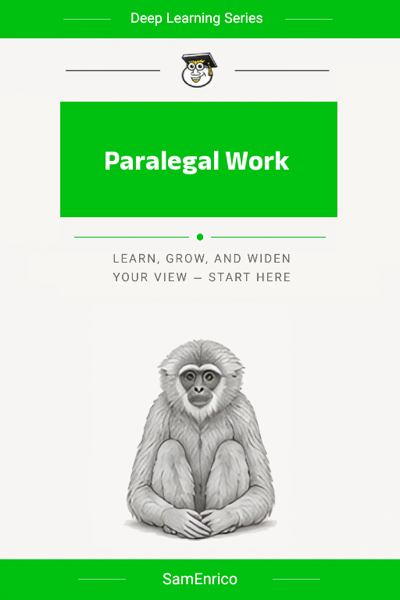
Paralegal Work eBook
A Coursebook on Paralegal Work
A Coursebook on Paralegal Work
Formats
Free sample
Chapter 1: The Profit Center...--–- You are not a “helper.” You are not a glorified secretary. You are not waiting to become a lawyer someday. If you walk into a law firm thinking of yourself as anyone’s assistant, you will be underpaid, overworked, and first in line for layoffs. The paralegals who thrive—the ones who command respect, decent salaries, and genuine partnership with attorneys—understand one counterintuitive truth: they are profit centers, not cost centers. This chapter dismantles the outdated notion that paralegals merely support lawyers.
Instead, it builds a new framework: the paralegal as an independent professional who performs substantive legal work under supervision, generates measurable value for the firm, and navigates the razor-thin boundary between legitimate practice and the Unauthorized Practice of Law (UPL). By the end of this chapter, you will understand where the profession came from, exactly what you can and cannot do, which career path fits your personality, and why law firms literally cannot function without you.The Historical Lie: From “Girl Friday” to Strategic Professional The paralegal profession did not emerge from benevolence or a sudden recognition that non-lawyers had skills to offer. It emerged from economics. In the 1960s, legal aid programs faced a flood of poverty-law cases and almost no money to hire attorneys. Meanwhile, private firms watched hourly rates climb while associate salaries exploded.
Both sectors needed a cheaper way to deliver legal services without sacrificing quality. The solution was delegation. In 1967, the American Bar Association (ABA) formally recognized the role of the “legal assistant,” later rebranded to “paralegal.” The original model was simple: attorneys would handle tasks that required bar admission (advising clients, setting fees, appearing in court), and paralegals would handle everything else.But old habits die hard. For decades, many firms treated paralegals as permanent interns—bright people who took notes, filed papers, and made coffee while waiting for law school. That model is dying.
Today, the ABA defines a paralegal as someone “qualified by education, training, or work experience who is employed or retained by a lawyer, law office, corporation, governmental agency, or other entity and who performs specifically delegated substantive legal work for which a lawyer is responsible.” Read that definition carefully. It does not say “assists.” It says performs substantive legal work. The distinction is everything.Clerical vs. Substantive: The Line You Must Internalize Before you ever draft a pleading or interview a witness, you need an instinctive ability to sort tasks into three categories. This continuum will save your career.The Clerical Zone.
These tasks require no legal judgment. Filing documents in chronological order, answering phones, scheduling depositions (the date and time, not the content), scanning mail, and updating contact lists. Anyone with basic training can do these. If more than 30 percent of your day is clerical, you are being underutilized, and you should document your substantive work for your next performance review.The Substantive Zone (Permitted Under Supervision). This is where paralegals earn their keep.
Drafting pleadings from templates—complaints, answers, motions. Interviewing clients and witnesses to gather facts. Conducting legal research using Westlaw, Lexis, or free sources. Summarizing medical records, deposition transcripts, and contracts. Calculating deadlines and managing discovery calendars.
Drafting correspondence to opposing counsel (but not signing it). Organizing exhibits for trial. Preparing privilege logs. Each of these tasks requires independent judgment: you must decide what information is relevant, which search terms to use, how to summarize a complex record. You are not a robot following instructions.
You are a professional exercising delegated authority under an attorney’s supervision. The attorney must review your work, but you are expected to produce a near-final product.The UPL Zone (Forbidden). Giving legal advice. If a client asks, “Should I settle?” you do not answer. You say, “That’s a question for the attorney.” Setting fees.
Representing a client in court (with rare statutory exceptions). Signing pleadings or filing them without attorney approval. Holding yourself out as an attorney. Choosing which legal claims to include in a complaint without attorney direction. These actions constitute the Unauthorized Practice of Law, and they carry severe consequences.Why does this distinction matter so much?
Because UPL statutes exist in every state. Violations can lead to fines, termination, decertification (where applicable), and even criminal charges in extreme cases. The attorney who supervises you also faces bar discipline. Chapter 2 will dive deep into ethics, but for now, memorize this rule: if an action requires you to interpret law for a client and tell them what to do, that is UPL. If it requires you to gather, organize, or draft based on specific instructions, that is substantive delegated work.The Continuum Diagram (Visual Aid)Picture a horizontal line.
On the far left: Clerical (filing, phones, scanning). In the middle: Substantive Delegated Work (drafting from templates, interviewing, research, summarizing). On the far right: UPL (advice, fees, representation in court, signing pleadings without review). Your job lives in the middle zone. Every day you will make judgment calls about where a task falls.
When in doubt, ask the supervising attorney. If you cannot ask, do not do it.But here is the nuance that textbooks rarely admit: the boundary is fuzzy. Drafting a complaint requires you to know which allegations fit the legal elements of a claim. That looks like legal advice, doesn’t it? The ethical distinction lies in process.
You draft based on the attorney’s instructions and template forms. You do not decide, “We should add a fraud claim because the facts support it.” You ask, “Should we add a fraud claim?” The attorney decides. Then you draft. That is the difference between substantive delegated work and UPL: who makes the final judgment call.Career Pathways: Which Flavor of Paralegal Fits You?Not all paralegal jobs look the same. The skills that make you successful in litigation will leave you lost in corporate compliance.
The temperament that thrives in family law will burn out in high-volume insurance defense. Here is a practical tour of the major pathways.Litigation Paralegal. This is the classic image. You work in a law firm representing plaintiffs or defendants in lawsuits. Your days are ruled by deadlines: answer due in 21 days, discovery cutoff in 180 days, dispositive motions due 30 days before trial.
You draft pleadings, manage document production (thousands of pages, often electronic), coordinate depositions, prepare trial exhibits, and track every filing with a docketing system. Litigation paralegals earn between $55,000 and $85,000 on average, with senior roles exceeding $100,000 in major markets. The stress is high—miss a filing deadline and you can lose the case—but the pace suits people who thrive on chaos and closure.Corporate Paralegal. You work inside a company’s legal department or a law firm’s corporate practice. Instead of lawsuits, you handle contracts, compliance filings, corporate governance, and transactional due diligence.
You might draft nondisclosure agreements, prepare board meeting minutes, file annual reports with state secretaries of state, or review contracts for missing exhibits. Corporate paralegals enjoy more predictable hours (fewer emergency filings) but less courtroom drama. Salaries range from $60,000 to $95,000, with in-house roles often adding stock options or bonuses. This path favors detail-obsessed organizers who can read the same contract template fifty times and…
This is the end of the free sample. Get the eBook to keep going. Buy now
About this book
Details
- Author
- Cochran Odell
- Publisher
- SamEnrico
- Language
- English
- Genre
- Non-Fiction, Informative, Educational
- Released
- 2026-06-02
- Pages (approx.)
- 149
- Available as
- eBook, Audiobook

Read better in the ZLOADR app
Your eBooks on your phone or tablet. Sign in with your SamEnrico account and start reading.
More by Cochran Odell
 Dual Diagnosis Gaming DisorderCochran Odell$11.99
 Blue Zone Sleep HygieneCochran Odell$11.99
 Sports Nutrition FAQCochran Odell$11.99
 Anger Management for DentistsCochran Odell$11.99
 The Pencil Only Art GuideCochran Odell$11.99
 The Pompeii Graffiti Wars: Art, Rebellion, and the Eruption That Saved ItCochran Odell$11.99
 Understanding Sakati SyndromeCochran Odell$17.99
 South Africa Business Credit GuideCochran Odell$12.99
 How to Start a Circles Made of Copper Business (Beginners Guide)Cochran Odell$11.99
You may also like
 Hong Kong Handover 1997Dunn Johnnie$11.99
 Zumba For Postnatal Recovery CourseNeal Christian$11.99
 Zumba for BeginnersLadner Nikia$11.99
 YouTube Comment Mining GuideHumes Pandora$12.99
 Worry Box MeditationCarlin Rudy$11.99
 Workplace Stress MeditationNguyen Lynn$11.99
 Workplace Stress and Sleep RepairHawley Ivory$11.99
 Workplace Perfectionism CureDelaney Jeffry$11.99
 Workplace Injustice Anger GuideWallen Isabelle$11.99
 Work Addiction and Burnout LinkGreenwood Ester$11.99
 Women in Yoga and WellnessBeattie Galina$11.99
 Women in Stand Up ComedyChun Evangeline$11.99