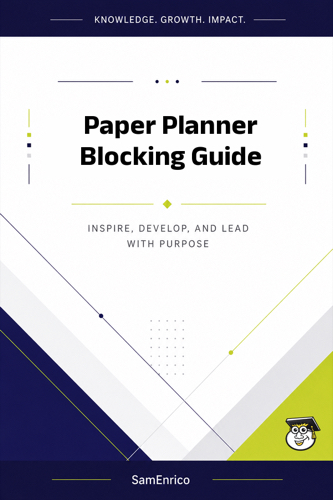
Paper Planner Blocking Guide eBook
Use a physical daily planner for distraction free
by Cox Sidney
Use a physical daily planner for distraction free time blocking.
Formats
Free sample
Chapter 1: The Drawer Method--–- The phone buzzes. You glance at the screen. Just a weather alert. You put it down. Three minutes later, it buzzes again.
A email about a sale. You swipe it away. Then a news notification. Then a calendar reminder. Then a text from a friend.
Then a work message. Then a like on a post you forgot you made. By the time you finally sit down to plan your day, your brain has been interrupted nine times in twelve minutes. You haven't even started, and you are already exhausted.This is not a failure of willpower. This is a failure of environment.The most common reason people abandon paper planners is not that paper planners are ineffective.
It is that people try to use a paper planner while keeping their smartphone on the desk, in their pocket, or face-up on the table next to their coffee. They are attempting to fight a digital wildfire with an analog cup of water. And when they fail—when they spend forty-five minutes "planning" but actually checking Instagram six times—they blame the planner. They say things like "I'm just not organized" or "Paper doesn't work for me" or "I always fall back to my phone calendar."The truth is simpler and more uncomfortable. The paper planner works perfectly.
You are just trying to use it in a war zone.The Myth of Digital Superiority We have been told for fifteen years that digital calendars are the pinnacle of productivity. They sync across devices. They send reminders. They can be shared with colleagues. They never run out of pages.
They are searchable. On paper, the argument for digital seems unassailable. And yet, the more people adopt digital planning, the more overwhelmed, distracted, and exhausted they become. Something is wrong with the math.The problem is not what digital calendars do. The problem is what they are attached to.Every digital calendar lives inside a device that is also a games console, a social media feed, a news ticker, a dating app, a shopping mall, a slot machine, a television, and a panic button.
You cannot open your calendar without also opening the door to everything else. The calendar app is not a standalone tool. It is a feature inside a distraction machine. And the people who built that machine spent billions of dollars engineering it to be as interruptive, addictive, and attention-grabbing as possible. Your phone is not a neutral tool.
It is a casino that fits in your pocket. And you are trying to do your most important thinking at the blackjack table.This chapter dismantles the myth that digital calendars are inherently superior. It argues that smartphones and apps create two specific harms that no amount of discipline can overcome: choice overload and notification drag. Understanding these two harms is the first step toward freedom. Because once you see the mechanism, you cannot unsee it.
And once you cannot unsee it, you will willingly put your phone in a drawer.Choice Overload: The Paradox of Infinite Options Choice overload is a well-documented cognitive phenomenon. When presented with too many options, the human brain does not become more empowered. It becomes paralyzed. Psychologists call this "decision fatigue." Every choice you make depletes a finite reserve of mental energy. By the time you have made ten decisions, the eleventh decision is harder than the first.
By the time you have made fifty decisions, you are mentally exhausted and will either make impulsive choices or no choices at all.Your digital calendar is a choice overload machine.Open any mainstream calendar app. Look at the interface. How many options are available to you at this very moment? You can choose between day view, week view, month view, year view, schedule view, and custom view. You can choose between color coding by calendar, by event type, by priority, by project, or by person.
You can choose between alerts that ring, vibrate, pop up, email, or text. You can choose between syncing to i Cloud, Google, Outlook, Exchange, or a custom server. You can choose between sharing your calendar with specific people, everyone in your organization, or no one. You can choose between setting events as busy, free, tentative, or out of office. You can choose between repeating events daily, weekly, monthly, yearly, or on a custom schedule that requires a Ph D to configure.Each of these choices is a decision.
Each decision costs mental energy. And you have not even written down a single task yet.A paper planner offers none of these choices. You open it. You see a spread of seven days. You have a pen.
That is the entire interface. The absence of choice is not a limitation. It is a liberation. When you have only one way to plan, you stop wasting energy on deciding how to plan and start spending energy on actually planning. This is the dirty secret of every successful productivity system: constraints create focus.
The paper planner is the ultimate constraint machine. It does not ask you what color scheme you prefer. It does not ask you which calendar you want to sync. It asks you one question: what are you going to do with your time? That is the only question that matters.
Everything else is procrastination disguised as optimization.Notification Drag: The Cognitive Cost of Resistance If choice overload is the visible problem, notification drag is the invisible one. Notification drag is the cognitive cost of resisting or reacting to notifications. It is not just the time you spend checking your phone. It is the mental residue left behind every time you decide not to check it.Here is what researchers have discovered about notifications. When your phone buzzes, your brain releases a small burst of dopamine.
This happens whether you check the phone or not. The mere expectation of a reward triggers the reward system. Your brain does not distinguish between "I am about to check a message" and "I heard a sound that might be a message." The anticipation alone is enough to hijack your attention.Now consider what happens when you are trying to plan your week. Your phone is on the desk. It buzzes.
You ignore it and keep writing. Congratulations on your willpower. But here is the problem: the notification is still in your brain. For the next several minutes, your subconscious will wonder what that buzz was. Was it important?
Was it a client? Was it an emergency? Was it just a like on a photo? You do not know. And that uncertainty sits in the back of your mind like an unresolved chord in a song.
You are still planning. But your working memory is now partially occupied by the ghost of that notification.That is notification drag. It is the tax you pay for keeping your phone within reach. Even when you successfully resist the urge to check it, you have still paid a cognitive price. And if you get multiple notifications per minute—which is normal for most smartphone users—you are paying that price constantly.
Your brain never gets a clean start. It is always carrying the residue of the last buzz, the last ping…
This is the end of the free sample. Get the eBook to keep going. Buy now
About this book
Details
- Author
- Cox Sidney
- Publisher
- SamEnrico
- Language
- English
- Genre
- Non-Fiction, Self-Help, Analog Planning
- Released
- 2026-06-07
- Pages (approx.)
- 121
- Available as
- eBook, Audiobook

Read better in the ZLOADR app
Your eBooks on your phone or tablet. Sign in with your SamEnrico account and start reading.
More by Cox Sidney
 Young Widow Anticipatory GriefCox Sidney$11.99
 Crime Scene Reconstruction CasesCox Sidney$11.99
 The Postpartum Identity GuideCox Sidney$11.99
 Shopping Addiction Cost CalculatorCox Sidney$11.99
 SMART Goal Apps GuideCox Sidney$11.99
 Self Hypnosis for Interrupting HabitsCox Sidney$11.99
 Body Language for Funeral DirectorsCox Sidney$11.99
 The Fire That Shaped an Empire: Nero’s Great Fire of Rome (64 AD)Cox Sidney$11.99
 A Collector's Handbook to the Vauxhall Viva GtCox Sidney$11.99
 Ultimate Handbook Guide to Yulin : (China) Travel GuideCox Sidney$11.99
 Newfoundlands: Gentle GiantCox Sidney$11.99
 How to Produce CupcakesCox Sidney$11.99