
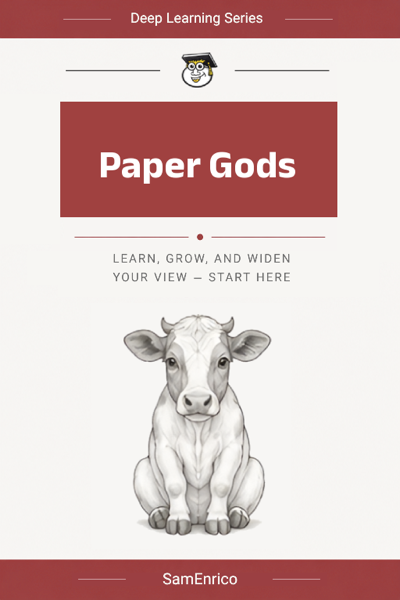
Non-FictionFinancial ThrillerMysteryInformative
Paper Gods eBook
A Coursebook on Paper Gods
A Coursebook on Paper Gods
Formats
Free sample
Chapter 1: The Gilded Mask...--–- Every human being carries inside them a quiet, unexamined hunger. It is not a hunger for food or water, not for sleep or sex, though it can masquerade as all of these. It is the hunger for certainty. In a world that refuses to stand still, where relationships fracture without warning, where careers dissolve overnight, where the body betrays us and the future refuses to be predicted, we crave something—someone—that knows. We crave an authority that does not waver, a voice that does not stutter, a hand that does not tremble.
This craving is not weakness. It is wiring. And it is precisely what the Paper God exploits.The Paper God is not a deity made of stone or gold. It does not require temples or incense, though it will accept both. The Paper God is made of something far more common and far more fragile: the human belief that another human being—or the institution they built, or the ideology they preached—has transcended the ordinary limits of fallibility.
The Paper God has the appearance of divinity: grandiose claims, unchallengeable authority, a polished exterior that photographs beautifully. But it possesses the substance of fragility. It tears. It burns. It dissolves under scrutiny.
The Paper God is a mask held in place by the collective will of those who need it to be real.This book is about how to see that mask. How to recognize the Paper God before you kneel. How to understand why you did kneel, if you already have. And how to rebuild a life, a mind, and perhaps a society that no longer requires false idols to feel safe.But before we build, we must name. And before we name, we must understand the architecture of the hunger itself.The Anatomy of Certainty Let us begin with a simple experiment.
Close your eyes for five seconds and try to hold in your mind the following thought: "I do not know what will happen to me in the next hour." Stay with the discomfort. Do not solve it. Do not reassure yourself. Just feel the raw fact of not knowing.What did you feel? For most people, the answer is some version of low-grade panic.
A twitch in the chest. A restless urge to check email, look at the news, touch something solid. That feeling has a name. It is called epistemic anxiety—the specific, measurable distress that arises from the absence of reliable knowledge about matters that matter to us.Epistemic anxiety is not a disorder. It is not a pathology.
It is a feature of being a finite creature in an infinite information environment. Our brains evolved to predict. Prediction requires patterns. Patterns require data. And when the data runs out, the brain does not relax.
It sounds an alarm.This alarm is the raw material from which Paper Gods are built.Consider how a healthy mind typically resolves epistemic anxiety. You do not know whether it will rain tomorrow. So you check a weather forecast. The forecast has a 70 percent chance of rain. You still do not know for certain, but you have reduced the uncertainty to a manageable level.
You grab an umbrella. Life proceeds. The anxiety discharges.But some questions cannot be resolved by a weather app. Should I leave my marriage? Is my boss manipulating me?
Does this political movement actually represent my values? Is there meaning in my suffering? These questions are not merely uncertain. They are existentially weighted. They touch identity, belonging, purpose, and safety.
And when the brain cannot resolve them through ordinary information-seeking, it becomes desperate. It becomes willing to accept answers that are not true, as long as they are absolute.Enter the Paper God.Distinguishing the Divine from the Gilded Not every authority figure is a Paper God. This distinction is crucial, and we will return to it throughout the book. A skilled surgeon who says, "I have performed this procedure four hundred times, but there is always a 2 percent risk of complication," is not a Paper God. She is offering earned authority—competence demonstrated over time, paired with honest admission of limits.
A wise mentor who says, "I have been where you are, but your path may look different from mine," is not a Paper God. He is offering genuine care without demanding worship.The Paper God, by contrast, demands something that no legitimately earned authority ever demands: the surrender of your own critical judgment as a permanent condition of relationship.This is the first diagnostic test. Ask yourself: Does this person, institution, or ideology require me to believe that they are never wrong? Not "rarely wrong." Not "wrong in small ways that are corrected." Never wrong. If the answer is yes, you are dealing with a Paper God.But the test is subtle, because Paper Gods rarely say "I am never wrong" directly.
That would be too transparent. Instead, they say things like: "If you truly understood, you would see that my decision was correct." Or: "The timing isn't right for me to explain fully. You need to trust me." Or the most devastating of all: "You are not seeing the whole picture. There are things I cannot tell you because you are not ready."These are not statements of humility. They are statements of structural advantage.
The Paper God always has access to information you do not. The Paper God always sees further than you can see. The Paper God's errors are always, upon closer inspection, actually your errors in interpretation. This is the architecture of the gilded mask: it reflects your own need for certainty back at you, so that you mistake the reflection for a face.The Contract of Illusion The relationship between a Paper God and a follower is not a one-way manipulation. It is a contract.
An unwritten, often unspoken contract, but a contract nonetheless. The follower offers loyalty, obedience, and the suspension of disbelief. The Paper God offers the one thing the follower cannot produce alone: the end of epistemic anxiety.This contract is exquisitely painful to acknowledge, because it implicates both parties. The Paper God is not merely a villain. The Paper God is also a creation.
And the follower is not merely a victim. The follower is also a co-creator. We do not say this to assign blame. We say it to restore agency. Because if you helped build the Paper God—by overlooking inconsistencies, by rationalizing cruelty, by telling yourself "it's complicated"—then you also have the power to help tear it down.Consider the case of Maya, a composite based on dozens of real interviews conducted for this book's research.
Maya joined a mid-sized nonprofit at age twenty-six. She believed in the mission: environmental justice for low-income communities. Her executive director, whom we will call David, was magnetic. He had been featured in two national magazines. He spoke at conferences.
He cried during staff meetings when describing the suffering of the communities they served. Maya was honored to work for him.In her first year, she noticed small things. David would take credit for ideas that originated with junior staff. He would schedule meetings and…
This is the end of the free sample. Get the eBook to keep going. Buy now
About this book
Details
- Author
- Humphries Garth
- Publisher
- SamEnrico
- Language
- English
- Genre
- Non-Fiction, Financial Thriller, Mystery, Informative, Educational
- Released
- 2026-05-11
- Pages (approx.)
- 128
- Available as
- eBook, Audiobook

Read better in the ZLOADR app
Your eBooks on your phone or tablet. Sign in with your SamEnrico account and start reading.
More by Humphries Garth
 Email Weekend Sanity GuideHumphries Garth$11.99
 Smokeless Tobacco Quitting GuideHumphries Garth$11.99
 Difficult Conversations For SalesHumphries Garth$11.99
 Recovery From Job Burnout CourseHumphries Garth$11.99
 The PCOS Birth Control GuideHumphries Garth$11.99
 The Archimedes Codex: Greece's Lost Mathematical RevolutionHumphries Garth$11.99
 User Testing for ParentsHumphries Garth$12.99
 Restaurant CAC TacticsHumphries Garth$12.99
 Understanding Xeroderma Talipes Enamel DefectsHumphries Garth$17.99
You may also like
 Hong Kong Handover 1997Dunn Johnnie$11.99
 Zumba For Postnatal Recovery CourseNeal Christian$11.99
 Zumba for BeginnersLadner Nikia$11.99
 YouTube Comment Mining GuideHumes Pandora$12.99
 Worry Box MeditationCarlin Rudy$11.99
 Workplace Stress MeditationNguyen Lynn$11.99
 Workplace Stress and Sleep RepairHawley Ivory$11.99
 Workplace Perfectionism CureDelaney Jeffry$11.99
 Workplace Injustice Anger GuideWallen Isabelle$11.99
 Work Addiction and Burnout LinkGreenwood Ester$11.99
 Women in Yoga and WellnessBeattie Galina$11.99
 Women in Stand Up ComedyChun Evangeline$11.99