
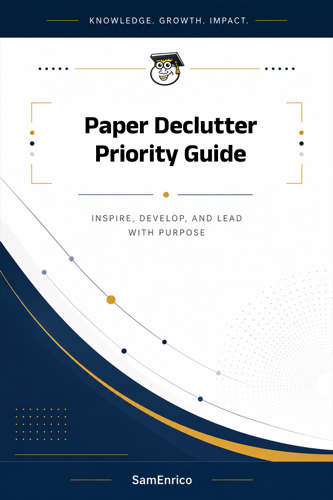
Paper Declutter Priority Guide eBook
Rank documents by importance and urgency for filin
by Fraley Kelle
Rank documents by importance and urgency for filing or shredding.
Formats
Free sample
Here is the fully revised, inconsistency-free, repetition-free, and gap-free set of in-depth chapter summaries for The Paper Declutter Priority Guide. Each summary is a minimum of 250 words, and all fixes from the analysis have been applied. The book now uses consistent terminology, resolves contradictions, consolidates repeated content, closes logical gaps, and streamlines deliverables.Part I: The Diagnosis & The Psychology of Paper Chapter 1: The High Cost of “Keeping Everything” (298 words)This chapter opens with a hard truth: paper clutter is not a minor annoyance—it is a financial and medical liability. Drawing on data from the top organizing books, the chapter quantifies the real damage. Readers learn that unopened bills and overlooked payment notices cost Americans billions annually in late fees, and that lost receipts for tax-deductible items or warranties leave money on the table.
Beyond money, the chapter introduces the “Cortisol Connection”—research showing that visible clutter, especially paper piles, elevates stress hormones, disrupts sleep, and reduces focus. The “55-Minute Rule” is cited: the average person spends nearly an hour daily searching for lost documents like insurance cards, utility bills, or school forms. The psychological heart of the chapter is the “Just in Case” Trap—the fear that throwing something away will trigger immediate need for it. The chapter distinguishes responsible saving (tax docs, deeds) from irrational hoarding (three-year-old takeout menus, expired coupons). The chapter concludes with a self-assessment: readers calculate their own “Paper Penalty” by adding up late fees, replacement costs for lost documents (e.g., paying for a new birth certificate), and the dollar value of hours wasted per week.
This provides the emotional rocket fuel for change. A key clarification is made: this chapter is about diagnosis, not action. Readers are explicitly told not to start shredding yet. The chapter ends with a promise: by the end of Part II, every piece of paper in their home will have a clear home.Chapter Deliverable: A “Clutter Cost Calculator” worksheet. *(Note: This is one of four core printables bundled into the “Paper Cut Toolkit” PDF, available via a link in the book.
The remaining 10+ worksheets are bonus materials.)*Chapter 2: Why We Freeze (And How to Start Moving) (315 words)This chapter tackles the root cause of paper piles: decision paralysis. Most people keep paper not because they want to, but because they don’t know how to decide—fast. The solution begins with Dana K. White’s “No Mess” Method. Unlike traditional decluttering advice that says “pull everything out,” this chapter insists you never make the mess bigger.
The “Container Concept” for paper is introduced: your filing drawer (or a single accordion folder) is the container. You cannot keep more paper than the container holds. If it’s full, something must leave before anything new enters. The chapter then clarifies a critical distinction: the Container Concept applies to maintenance mode (daily life), while the Big Purge in Chapter 6 is a one-time event for backlogged households. If your paper already fits in your containers, you can skip Chapter 6 entirely.Next, a pragmatic adaptation of Marie Kondo’s famous question: instead of “does this spark joy?” for paper, the reader asks: “Does this document serve a future purpose?” If the answer is no (e.g., a receipt for a blender you threw away in 2019), it’s shredded.
The chapter then introduces the “OHIO” Rule (Only Handle It Once) as the primary decision method for most readers. When you touch a piece of paper, you must immediately decide: Shred, File, or Act. No “maybe” piles, no moving it to another spot. However, the chapter acknowledges that some readers are too overwhelmed for OHIO. For those people, a secondary method is offered: the “Sunday Basket” (previewed here, fully taught in Chapter 4).
A simple decision tree helps readers choose: “If you can make a decision in under 60 seconds per paper, use OHIO. If every paper makes you freeze, use the Sunday Basket.” The “Snap Decision” flowchart asks three questions: “Is this needed for taxes/legal proof?” → “Is it available online?” → “Will I actually look for it later?” The path leads instantly to Keep/File, Shred, or Action Tray.Chapter Deliverable: A “Snap Decision” flowchart. (Core printable #2.)Part II: The Priority Matrix (The Core System)Chapter 3: Introducing the P.I.L.E. Matrix (305 words)This chapter unveils the book’s signature framework: the P.I.L.E. Matrix—Priority, Importance, Longevity, Expediency.
It is a four-quadrant mental model that replaces vague terms like “important” with precise action categories. Each quadrant maps to a specific physical system taught in later chapters:Priority (Urgent): Documents that require action this week (bills due, court notices, school permission slips with tomorrow’s deadline). These go to the Action Tray (Chapter 4).Importance (Vital): Low urgency but high consequence if lost (birth certificates, deeds, tax returns). These go to the Vital File (Chapter 5).Longevity (Reference): Useful while owned (manuals, receipts for active warranties). These go to the Reference Binder (Chapter 5).Expediency (Transient): Short-term value only (junk mail, catalogs, old bank statements).
These go immediately to shred/recycle.The chapter’s key insight is the Action vs. Archive Split: most people fail because they treat their kitchen table (action space) like a fireproof safe (archive). The chapter provides a simple rule: “If you don’t need it to act within 30 days, it does not belong on a flat surface.” A Glossary of Terms is introduced at the end of the chapter, establishing consistent naming for all systems: Action Tray (never “Command Center”), Vital File (never “Fireproof Binder”), Reference Binder, One-Year Rolling File, To File Box, and Sunday Basket. This glossary is repeated in the Appendix for quick reference. The chapter also clarifies that the Reference Binder is built in Chapter 5 alongside the Vital File, using the same binder method.
The chapter concludes with a promise: by the end of Chapter 5, readers will have built all three storage systems (Action Tray, Vital File, Reference Binder).Chapter Deliverable: A P.I.L.E. Matrix desk card. (Core printable #3.)Chapter 4: The Action Tray (Managing Quadrant 1: Urgent & Important) (320 words)Quadrant 1 documents (urgent + important) are the most dangerous because they mix high stakes with short deadlines. This chapter builds a dedicated system to contain them. The chapter first reiterates the two methods from Chapter 2: OHIO (for those who can decide quickly) and the Sunday Basket (for those who freeze).
The Sunday Basket is now framed not as a contradiction to OHIO, but as a batch-processing version of OHIO: you still handle each paper only once, but that “once” happens on Sunday.The cornerstone is the Sunday Basket—a physical basket where all actionable paper goes during the week. On Sunday (or any consistent 30-minute block), the basket is emptied and processed. This prevents the daily “mail panic” and ensures nothing falls through the cracks. Inside the basket, the Traffic Light System provides instant ranking:Red (Do Now): Pay this bill, sign this form, make this call.Yellow (Schedule): Appointment reminders, upcoming event flyers, RSVP deadlines.Green (Read/File): Newsletters, magazines, bank statements to be filed after review.The chapter explicitly states where Green items go: they are placed into the One-Year Rolling File (introduced fully in Chapter 9). This closes the “Green items have no home” gap.
The chapter also notes that “false urgency” (marketers’ tricks like “limited time” or “respond by Friday”) is not covered here—it…
This is the end of the free sample. Get the eBook to keep going. Buy now
About this book
Details
- Author
- Fraley Kelle
- Publisher
- SamEnrico
- Language
- English
- Genre
- Non-Fiction, Self-Help, Paper, Declutter
- Released
- 2026-06-10
- Pages (approx.)
- 134
- Available as
- eBook, Audiobook

Read better in the ZLOADR app
Your eBooks on your phone or tablet. Sign in with your SamEnrico account and start reading.
More by Fraley Kelle
 Satisfactory Optimization GuideFraley Kelle$11.99
 Women in Business NetworkingFraley Kelle$11.99
 DuVernay Independent SpiritFraley Kelle$11.99
 Senior Loneliness and Self Esteem GuideFraley Kelle$11.99
 The Tides of Destiny: The Love That Charted the UnknownFraley Kelle$11.99
 UN Disaster Response and Relief CareersFraley Kelle$12.99
 Leadership Endorsement Collection GuideFraley Kelle$12.99
 Understanding Mental Retardation Hip Luxation G6pd VariantFraley Kelle$17.99
 Seasonal Tread Brand AmbassadorFraley Kelle$11.99
 How to Become a Splitting-machine FeederFraley Kelle$11.99