
Non-FictionMental WealthPerformance Psychology
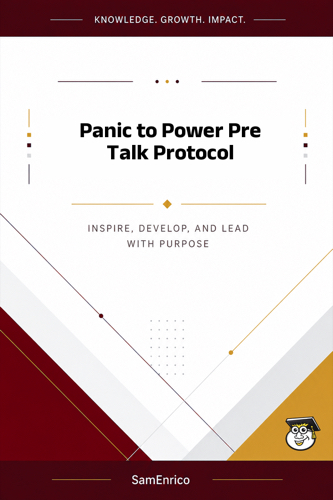
Panic to Power Pre Talk Protocol eBook
Convert debilitating physical symptoms into focuse
Convert debilitating physical symptoms into focused energy using a 4-7-8 breathing ladder.
Formats
Free sample
Chapter 1: Your Body’s Secret Language...--–- Your heart is hammering against your ribs like a prisoner demanding escape. Your palms have turned into miniature waterfalls. The person standing at the podium just said your name, and suddenly the room has doubled in temperature while the air has thinned to nothing. You have approximately sixty seconds before every eye in the room turns toward you, and every instinct you possess is screaming one word: run.This is not a sign that you are broken. This is not evidence that you are weak, unprepared, or fundamentally unsuited for public speaking.
This is your body speaking a language you have never been taught to translate. And by the time you finish this chapter, you will begin to understand that every single one of those terrifying physical symptoms is actually a message—a piece of data, a signal, an energy signature waiting to be decoded and deployed.The Moment Everything Changes Let us name what just happened. You experienced what researchers call anticipatory anxiety—the surge of physiological activation that occurs in the minutes or seconds before a high-stakes speaking event. For approximately seventy-three million Americans, according to the National Institute of Mental Health, this experience ranges from uncomfortable to utterly debilitating. But here is what almost nobody tells you: the physical symptoms of speech panic are not your enemy.
They are not a glitch in your otherwise functional nervous system. They are, in fact, the exact same physiological responses that elite athletes, combat pilots, and world-class musicians experience right before their greatest performances.The difference is not the symptom. The difference is the interpretation.Consider a simple experiment conducted by Harvard psychologist Alison Wood Brooks. She asked participants about to give a stressful public speech to say one of three phrases aloud: “I am calm,” “I am excited,” or nothing at all. Those who said “I am excited” performed significantly better—they were more persuasive, more confident, and more composed—than those who tried to calm down or said nothing.
Why? Because trying to calm down when your body is surging with adrenaline creates an impossible demand: your physiology says “go,” while your mind says “stop.” The resulting conflict produces more anxiety, not less. But reframing the same physiological state as excitement aligns your mind with your body, releasing the brakes and channeling the energy into performance.This chapter introduces the first pillar of the Panic to Power method: symptom translation. Before you learn the 4-7-8 breathing ladder, before you master the 60-second pre-talk protocol, you must first learn to read your body’s secret language. You must become fluent in the ten most common physical symptoms of speech panic—not as threats, but as signals.
By the end of this chapter, you will have completed your initial symptom map, identified your personal panic signature, and taken the first step from fear to fuel.The Top Ten Physical Symptoms of Speech Panic Let us be precise about what you are feeling. Speech anxiety manifests differently in every person, but research consistently identifies ten core physical symptoms that account for more than ninety percent of pre-talk distress. Read through this list slowly. Circle the ones that show up for you. Notice that you are not alone—and that your particular combination of symptoms is neither random nor shameful.1.
Racing Heart Your heart rate can spike from a resting rate of sixty to seventy beats per minute to one hundred twenty, one hundred fifty, or even higher within seconds of being called upon to speak. This is your sympathetic nervous system flooding your bloodstream with epinephrine (adrenaline) and norepinephrine. The result: your heart pumps harder and faster to send oxygen-rich blood to your large muscle groups—because your ancient brain still believes you might need to outrun a predator. Here is what most people miss: a racing heart does not impair cognitive function. In fact, moderate elevations in heart rate improve reaction time, verbal fluency, and mental clarity.
The problem arises only when you interpret the racing heart as a sign of impending failure.2. Tunnel Vision Your peripheral vision narrows. The room seems to shrink. You can see the faces in the front row but the back of the room becomes a blur. This is not your eyes malfunctioning.
This is your sympathetic nervous system prioritizing central vision over peripheral vision to help you focus on a single threat or target. In speaking terms, tunnel vision can actually help you block out distracting movements, visual clutter, and audience members who are checking their phones. The difficulty arises only when you mistake tunnel vision for a loss of control—when in fact it is a gain of focus.3. Shaking Hands Your hands tremble. If you are holding notes, they rustle audibly.
If you are gesturing, the tremor is visible. This is caused by increased muscle tension and circulating adrenaline, which primes your muscles for explosive action. Olympic shooters experience hand tremor before every competition. They do not eliminate it; they learn to fire between the tremors. Similarly, speakers with shaky hands can use that same energy for emphatic, precise gestures—if they stop fighting the tremor and start working with it.4.
Voice Tremor Your vocal cords are controlled by tiny muscles that are exquisitely sensitive to adrenaline. When those muscles receive a surge of sympathetic activation, they begin to oscillate irregularly, producing a quaver or shake in your voice. This is often the symptom that speakers fear most because it is audible to the entire room. However, voice tremor has a paradoxical effect on audiences: when listeners hear a slight tremor, they often perceive the speaker as more authentic, more emotionally engaged, and more likable—provided the speaker does not appear terrified. The tremor itself is neutral.
Your reaction to it determines whether it reads as vulnerability (connecting) or weakness (repelling).5. Sweating Your palms, forehead, armpits, or upper lip become slick with sweat. This is your body’s cooling mechanism, activated because your sympathetic nervous system has raised your core temperature in anticipation of physical exertion. Sweat also increases skin conductivity, which improves tactile sensitivity—meaning your sweaty palms can actually help you feel your notes or the podium more precisely. The social fear of visible sweat is almost always worse than the physical reality.
Audiences rarely notice mild to moderate sweating unless the speaker draws attention to it by wiping their hands excessively or commenting on it.6. Nausea or Stomach Churning Your digestive system is shutting down. Blood is being redirected from your stomach and intestines to your skeletal muscles. This produces sensations of butterflies, churning, or even nausea. Here is the key distinction: actual vomiting is extremely rare in speech anxiety.
The sensation of nausea is almost never followed by the act. Knowing this—really knowing it—can break the feedback loop where fear of vomiting creates more nausea, which creates more fear. Your stomach is not trying to reject your lunch. It is simply deprioritizing digestion in favor of action.7. Dry Mouth Your salivary glands reduce production because saliva is not essential for fight or flight.
The result is a dry, cottony sensation that makes it feel difficult to speak. Dry mouth is mechanically irrelevant to…
This is the end of the free sample. Get the eBook to keep going. Buy now
About this book
Details
- Author
- Mclendon Christopher
- Publisher
- SamEnrico
- Language
- English
- Genre
- Non-Fiction, Mental Wealth, Performance Psychology
- Released
- 2026-06-07
- Pages (approx.)
- 140
- Available as
- eBook, Audiobook

Read better in the ZLOADR app
Your eBooks on your phone or tablet. Sign in with your SamEnrico account and start reading.
More by Mclendon Christopher
 The Breath Counting MethodMclendon Christopher$11.99
 Relationship Stress and Social Media ComparisonMclendon Christopher$11.99
 Negative Inquiry Skill GuideMclendon Christopher$11.99
 Child Star Social Media AgeMclendon Christopher$11.99
 Apollodorus and the Greatness of Rome: The Architect Who Built an EmpireMclendon Christopher$11.99
 Understanding Loffredo–cennamo–cecio SyndromeMclendon Christopher$17.99
 How to Become a Septic-tank InstallerMclendon Christopher$11.99
 Grocery and CPG SpendingMclendon Christopher$12.99
 Multi Member LLC For Non ResidentsMclendon Christopher$12.99
 Family Office ManagementMclendon Christopher$11.99
You may also like
 Hong Kong Handover 1997Dunn Johnnie$11.99
 Zumba For Postnatal Recovery CourseNeal Christian$11.99
 Zumba for BeginnersLadner Nikia$11.99
 YouTube Comment Mining GuideHumes Pandora$12.99
 Worry Box MeditationCarlin Rudy$11.99
 Workplace Stress MeditationNguyen Lynn$11.99
 Workplace Stress and Sleep RepairHawley Ivory$11.99
 Workplace Perfectionism CureDelaney Jeffry$11.99
 Workplace Injustice Anger GuideWallen Isabelle$11.99
 Work Addiction and Burnout LinkGreenwood Ester$11.99
 Women in Yoga and WellnessBeattie Galina$11.99
 Women in Stand Up ComedyChun Evangeline$11.99