
Non-FictionHealth & WellnessRelapse Prevention
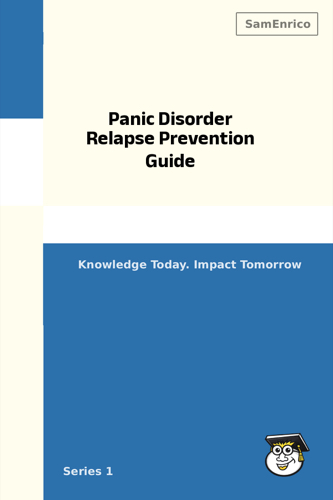
Panic Disorder Relapse Prevention Guide eBook
Maintain gains and prevent future panic episodes w
Maintain gains and prevent future panic episodes with ongoing practice.
Formats
Free sample
Chapter 1: The 72-Hour Rule--–- The phone buzzed at 2:17 AM. Sarah, a 34-year-old graphic designer who had successfully completed cognitive behavioral therapy two years earlier, sat upright in bed. Her heart was hammering. Not the gentle flutter of a nightmare fading—this was the full orchestra: racing pulse, shortness of breath, a sense of impending doom so real she could taste it. Her first thought was not "Is this a panic attack?" Her first thought was, "It's back.
I've failed. All that work was for nothing."She reached for her phone to call her sister, then stopped. She reached for her pulse oximeter in the nightstand drawer, then stopped again. For twenty minutes, she sat in the dark, torn between the terror of the sensation and the memory of everything she had learned. By morning, the symptoms had faded.
By noon, she felt normal. By evening, she was laughing at a movie with her partner. The panic had come, stayed for a few hours, and left. It did not stay for weeks. It did not bring back the daily avoidance of driving, the cancelled plans, the constant checking of her body.
It was, she later realized, a setback—not a relapse. But in that 2:17 AM moment, she had no way to tell the difference.This chapter exists to ensure that you will never again confuse a temporary wave for a permanent return of your disorder. If you have picked up this book, you have already done the difficult work of initial recovery. You have likely completed a course of cognitive behavioral therapy, perhaps used medication to stabilize, and you have experienced significant relief. You know what it feels like to go a week, a month, or even a year without a full panic attack.
But somewhere beneath the relief lives a quiet fear: What if it comes back? And what if I cannot stop it?The answer is not to promise you that panic will never return—that would be a lie, and this book does not traffic in lies. The answer is to give you a framework, a set of tools, and most immediately, a rule that will transform how you interpret every anxious sensation for the rest of your life. That rule is the 72-Hour Rule, and by the end of this chapter, it will be etched into your understanding of relapse prevention as deeply as your own name.The Epidemiology of Return: Why 60-70% of People Experience Setbacks Let us begin with a truth that most recovery books bury in the appendix: the return of fear is not a sign of personal failure. It is a predictable, well-documented, and entirely normal neurobiological phenomenon.
Research spanning three decades—including large-scale longitudinal studies of panic disorder treatment outcomes—has consistently found that approximately 60 to 70 percent of individuals who successfully complete initial treatment will experience intrusive anxious sensations again at some point in the following years. This is not a niche finding. It is replicated across the major treatment protocols, including the Mastery of Your Anxiety and Panic program (Craske & Barlow) and the naturalistic follow-up studies of CBT for panic disorder.Why so high? Because the brain does not erase its learning. When you developed panic disorder, you carved a deep neural pathway—a "well-worn path in the forest," as we will explore in Chapter 2.
Every time you panicked, that pathway got wider and easier to travel. Treatment did not erase that path. It built a new path, a calmer one, and taught you to choose it. But the old path remains. Under conditions of stress, sleep deprivation, illness, or hormonal fluctuation, your brain will default to the old path simply because it is familiar.This is not a design flaw.
It is efficiency. Your brain is constantly predicting threats based on past experience. If you once nearly died of a heart attack (or believed you did), your brain will forever flag a racing heart as potential danger. The good news is that you now have the skills to recognize that flag as a false alarm. The bad news is that the flag will still wave sometimes.
The goal of this book is not to stop the flag from waving—that is impossible—but to stop you from running every time you see it.The distinction between a setback and a relapse is the single most important distinction you will make in your maintenance journey. A setback is a short, triggered spike in anxiety—lasting hours to a few days—that arises in response to a specific stressor. It feels like panic, smells like panic, and tastes like panic. But it is time-limited, and crucially, it does not reinstate the full pattern of avoidance and catastrophic thinking that defined your disorder at its worst. A relapse, by contrast, is the full re-emergence of the disorder: daily panic attacks, chronic avoidance of previously mastered situations, constant body scanning, and a progressive shrinking of your life.The difference between the two is not the presence of symptoms—symptoms can appear in both.
The difference is duration and behavior. A setback uses symptoms as weather: a storm that passes. A relapse uses symptoms as a new permanent climate.The 72-Hour Rule: A Clinical Tool for Immediate Clarity The 72-Hour Rule is borrowed from relapse prevention models developed by Zuercher-White and Wilson, adapted specifically for panic disorder maintenance. Here is the rule in its simplest form: If the fear subsides on its own within three days without you resorting to old safety behaviors, it is a setback (a ripple), not a relapse (a wave).Let us unpack each element of this rule."Subsides on its own" means that the anxious sensations decrease in intensity and frequency without you taking extraordinary measures. You do not need to call a doctor, take an extra dose of medication, avoid leaving the house, or engage in elaborate rituals.
The anxiety follows its natural curve: it rises, it peaks, and it falls. Panic attacks, by their very biology, cannot sustain maximum intensity indefinitely. The sympathetic nervous system literally runs out of fuel. Even without any intervention, a panic attack will typically peak within 10 to 20 minutes and then begin to subside. A setback, involving perhaps multiple waves of anxiety over a day or two, follows a similar but longer trajectory.
If after 72 hours you notice that you are no longer preoccupied with the sensations, that you have resumed your normal activities, and that you are not scanning your body for signs of danger, you have experienced a setback."Without you resorting to old safety behaviors" is where most people trip. Safety behaviors are the subtle avoidance tactics you used during the height of your disorder. They might include: calling a friend for reassurance, checking your pulse, sitting near an exit, carrying a water bottle or medication "just in case," distracting yourself with your phone, leaving a situation early, or avoiding the trigger entirely. These behaviors feel helpful in the moment because they reduce anxiety immediately. But they are the enemy of long-term recovery because they send a silent message to your brain: "I would have panicked or died if I hadn't done that." Every safety behavior reinforces the belief that…
This is the end of the free sample. Get the eBook to keep going. Buy now
About this book
Details
- Author
- Burnett Margarett
- Publisher
- SamEnrico
- Language
- English
- Genre
- Non-Fiction, Health & Wellness, Relapse Prevention
- Released
- 2026-06-09
- Pages (approx.)
- 149
- Available as
- eBook, Audiobook

Read better in the ZLOADR app
Your eBooks on your phone or tablet. Sign in with your SamEnrico account and start reading.
More by Burnett Margarett
 Product Launch Presentation NervesBurnett Margarett$11.99
 Growth Hormone Boosting FoodsBurnett Margarett$11.99
 Autosuggestion Trance GuideBurnett Margarett$11.99
 Debtors Anonymous Twelve StepsBurnett Margarett$11.99
 The Berlin Shadow: The Spy Who Vanished in 1989Burnett Margarett$11.99
 The Cloud People of the Andes: Medieval Explorers of the SkyBurnett Margarett$11.99
 Understanding Brachym–brachytBurnett Margarett$17.99
 Middle East Coding ProgramsBurnett Margarett$12.99
 Luxury Ecommerce Outlook 2030Burnett Margarett$12.99
 How to Become a Car HopBurnett Margarett$11.99
 Galaxite MiningBurnett Margarett$11.99
You may also like
 Hong Kong Handover 1997Dunn Johnnie$11.99
 Zumba For Postnatal Recovery CourseNeal Christian$11.99
 Zumba for BeginnersLadner Nikia$11.99
 YouTube Comment Mining GuideHumes Pandora$12.99
 Worry Box MeditationCarlin Rudy$11.99
 Workplace Stress MeditationNguyen Lynn$11.99
 Workplace Stress and Sleep RepairHawley Ivory$11.99
 Workplace Perfectionism CureDelaney Jeffry$11.99
 Workplace Injustice Anger GuideWallen Isabelle$11.99
 Work Addiction and Burnout LinkGreenwood Ester$11.99
 Women in Yoga and WellnessBeattie Galina$11.99
 Women in Stand Up ComedyChun Evangeline$11.99