
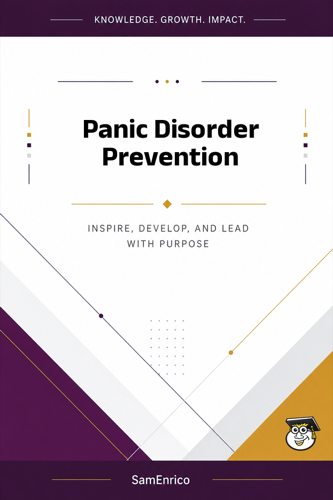
Panic Disorder Prevention eBook
Daily trance practice to prevent and manage panic
by Seidel Lorna
Daily trance practice to prevent and manage panic attacks.
Formats
Free sample
Chapter 1: The White Bear Problem--–- Let me ask you a question. Right now, as you read these words, I want you to try something. I want you to make a conscious, deliberate effort to not think about a white bear. Do not picture its fur. Do not imagine its shape.
Do not hear its breathing. Whatever you do, for the next ten seconds, absolutely do not think about a white bear.How long did you last?If you are like the thousands of people who have participated in this experiment since the Russian psychologist Lev Vygotsky first described it in the 1920s, and later Daniel Wegner systematized it at Harvard in the 1980s, you probably lasted about two seconds before the image of a white bear appeared unbidden in your mind. The harder you tried to suppress it, the more vividly it appeared. This is not a failure of your willpower. It is a fundamental feature of how your brain processes negative commands.Here is what makes this relevant to you, right now, in this moment: Every panic attack you have ever had began with the exact same neurological command.
Somewhere in the milliseconds before the first wave of dizziness, the first racing heartbeat, the first sense of unreality, your brain issued a silent instruction. That instruction was not "panic." That instruction was "don't panic."And your brain, being a brain, heard only one word: panic.The Paradox That Changes Everything Let me state this as clearly as I can. The conscious effort to not have a panic attack is the single strongest predictor that you will have a panic attack. This is not opinion. This is not motivational speaking.
This is reproducible neuroscience, confirmed across dozens of studies on thought suppression, anxiety disorders, and the neurobiology of fear.Consider the standard advice given to people who experience panic. You have heard it before, probably from well-meaning doctors, therapists, friends, and internet forums. "Just try to relax." "Don't think about it." "Stay calm." "Breathe deeply." Every single one of these instructions contains a hidden negative command. "Don't think about it" is the white bear problem dressed in clinical clothing. "Stay calm" implies that calm is something you must actively maintain, which immediately signals to your brain that calm is fragile and about to be lost.
"Breathe deeply," as we will explore in the next chapter, is particularly problematic because conscious breathing requires the very logical brain structures that go offline during a panic attack.What you are about to learn in this book is a radically different approach. Most books on panic disorder teach you how to manage a panic attack once it has started. They give you techniques to "ride out the wave," "float through the sensation," or "talk yourself down." These are not useless. They have helped many people survive countless attacks. But they share a fatal flaw.
They assume that the panic attack is already happening. They are fire extinguishers for a house that is already burning. This book is about building a house that does not catch fire in the first place.The central argument of The Trance Response is simple. Panic is not an emotion. Panic is not a thought.
Panic is a trance state. It is a narrowed, fixated, hypnotic absorption in internal bodily sensations, accompanied by catastrophic interpretation, that spirals into dissociation and terror. You cannot stop a negative trance by fighting it. Fighting a trance is like trying to argue with a dream while you are still inside it. The only reliable way out is to replace it with a different trance.
And the only way to prevent the negative trance from appearing in the first place is to train your brain, daily, to default to a positive trance state that is neurologically incompatible with panic.This is not self-help metaphor. This is brainwave physiology.The White Bear Problem in Your Daily Life Before we go deeper into the neuroscience, let me show you how the White Bear Problem operates in the specific context of panic disorder. I want you to recall your last panic attack. Not the sensations themselves, but the moments before the sensations. Think back carefully.
Were you thinking about panic in the minutes or hours before it happened? Were you scanning your body for unusual sensations? Were you checking your heart rate, your breathing, your level of dizziness?If you are like most people with panic disorder, the answer is yes. In fact, research consistently shows that people with panic disorder spend significantly more time engaged in interoceptive vigilance—the active monitoring of internal bodily states—than people without the disorder. This is not paranoia.
This is a learned survival strategy. Your brain has concluded, based on past experience, that panic attacks are dangerous and unpredictable. To protect you, it has assigned a small team of neural resources to constantly watch for the early warning signs of another attack. The problem is that this watching creates the very signs it is looking for.Let me explain with an example. Imagine you are sitting at your desk.
You are not anxious. But somewhere in the back of your mind, you are vaguely aware that you have not had a panic attack in three days, and you wonder when the next one might come. This is not a conscious worry. It is more like a background hum. Suddenly, you notice your heart beating.
Not because it is beating irregularly or too fast. You just notice it. Maybe you shifted position. Maybe you had a sip of coffee. But now your attention is on your heartbeat.Here is what happens next.
For a person without panic disorder, noticing the heartbeat is a neutral event. It lasts about half a second, and then attention moves elsewhere. For a person with panic disorder, noticing the heartbeat is a signal. It means, "Something might be starting." Immediately, the vigilance system kicks into higher gear. You begin to monitor the heartbeat more closely.
Is it getting faster? Is it skipping? Is this normal? The very act of monitoring changes the heartbeat. Anxiety increases heart rate.
So now the heart is beating faster, which confirms your suspicion that something is wrong, which increases monitoring, which increases heart rate further. Within sixty seconds, you are in a full panic attack, triggered by nothing more than the act of watching for a panic attack.This is the White Bear Problem applied to your own body. The effort to avoid panic produces the panic. The vigilance against sensations produces the sensations. The attempt to stay calm destroys calm.The Secondary Gain Loop Psychologists have a name for this phenomenon.
It is called secondary gain. The term is usually used to describe the hidden benefits that unconsciously keep a symptom alive. For example, a person with chronic back pain might receive sympathy and relief from responsibilities, which subtly reinforces the pain. But in panic disorder, the secondary gain operates differently. The secondary gain is the illusion of control.Here is what I mean.
When you are vigilant—when you are scanning your body for early warning signs—you feel, on some level, that you are doing something useful. You are preparing.…
This is the end of the free sample. Get the eBook to keep going. Buy now
About this book
Details
- Author
- Seidel Lorna
- Publisher
- SamEnrico
- Language
- English
- Genre
- Non-Fiction, Self-Help
- Released
- 2026-06-08
- Pages (approx.)
- 135
- Available as
- eBook, Audiobook

Read better in the ZLOADR app
Your eBooks on your phone or tablet. Sign in with your SamEnrico account and start reading.
More by Seidel Lorna
 Age Discrimination Anger GuideSeidel Lorna$11.99
 Daycare Nap Adjustment GuideSeidel Lorna$11.99
 Customer Service Self WorthSeidel Lorna$11.99
 Quora Answering Addiction GuideSeidel Lorna$11.99
 The Crown’s Wild Card: How Princess Margaret Almost Toppled the MonarchySeidel Lorna$11.99
 Understanding Microphthalmia, Lentz TypeSeidel Lorna$17.99
 Semiconductor Capital GuideSeidel Lorna$12.99
 Infographic Generation GuideSeidel Lorna$12.99
 How to Start a Bullion Dealer In Investment Grades Business (Beginners Guide)Seidel Lorna$11.99
 Antitrust (or Competition ) LawSeidel Lorna$11.99
You may also like
 Hong Kong Handover 1997Dunn Johnnie$11.99
 Zumba For Postnatal Recovery CourseNeal Christian$11.99
 Zumba for BeginnersLadner Nikia$11.99
 YouTube Comment Mining GuideHumes Pandora$12.99
 Worry Box MeditationCarlin Rudy$11.99
 Workplace Stress MeditationNguyen Lynn$11.99
 Workplace Stress and Sleep RepairHawley Ivory$11.99
 Workplace Perfectionism CureDelaney Jeffry$11.99
 Workplace Injustice Anger GuideWallen Isabelle$11.99
 Work Addiction and Burnout LinkGreenwood Ester$11.99
 Women in Yoga and WellnessBeattie Galina$11.99
 Women in Stand Up ComedyChun Evangeline$11.99