
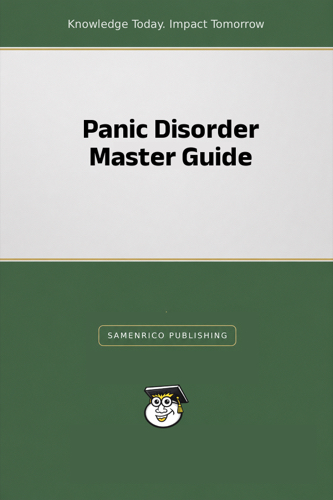
Non-FictionHealth & WellnessComplete
Panic Disorder Master Guide eBook
Complete reference on diagnosis, treatment, and re
Complete reference on diagnosis, treatment, and recovery.
Formats
Free sample
Chapter 1: The Smoke Alarm Lie--–- The first time my heart slammed against my ribs for no reason, I was standing in a grocery store aisle comparing pasta sauces. One second I was fine. The next, my vision tunneled, my throat closed, and I was absolutely certain I was about to die. I left a full cart in aisle four and ran to my car. I sat in the parking lot for forty-five minutes, gripping the steering wheel, waiting for the heart attack that never came.That was fifteen years ago.
I have since learned that I was not dying. I was not having a heart attack. I was not going crazy. I was having a panic attack—a false alarm from a brain circuit designed to keep me safe from predators that had long since disappeared from my suburban environment. But in that grocery store aisle, none of that mattered.
What mattered was the terror. What mattered was the shame. What mattered was that I spent the next three years shrinking my life around that moment of fear.This book exists because I wish someone had handed it to me in that parking lot. Not a clinical textbook. Not a pamphlet on deep breathing.
Not the well-meaning but useless advice to "just relax." A complete, honest, practical guide that explained what was happening to my body, gave me tools that actually worked, and then—most importantly—showed me how to get my life back.That is what this chapter begins. And we start with the single most important truth you will read in this entire book:Your panic attacks are not dangerous. They are not signs of a hidden illness. They are not evidence that you are weak or broken. They are false alarms.
And false alarms can be fixed.The Misunderstanding That Keeps You Stuck Let me tell you what you have probably heard from well-meaning people. You have been told to "calm down." You have been told that you are "overreacting." You have been told to "take a deep breath." You have been told that it is "all in your head." You may have even been told that you need to "pray harder" or "think positive thoughts."None of this works. And none of this is your fault.The problem with "just calm down" is that it assumes you have voluntary control over a biological process that is happening to you, not by you. Imagine telling someone having a seizure to "just stop shaking." Imagine telling someone with a fever to "just stop sweating." That is absurd. And yet we say the equivalent to people with panic disorder every single day.The truth is that panic disorder is a biological condition.
It involves specific brain circuits, specific neurotransmitters, and specific physiological responses. It is as real as asthma, as real as epilepsy, as real as any other medical condition you can name. The only difference is that panic disorder affects the brain's threat-detection system, and because we cannot see that system the way we can see a broken bone, we mistakenly believe it is "all in your head" in the pejorative sense.It is in your head. So is every emotion you have ever felt. So is every memory you have ever formed.
So is every decision you have ever made. Being "in your head" does not make something less real. It makes it neurological.Here is what the misunderstanding costs you: every time someone tells you to "just relax," and you cannot, you add a layer of shame on top of your fear. You start to believe that you are broken in a way that other people are not. You start to hide your symptoms.
You stop telling people when you are struggling. You shrink your life further and further until the only place that feels safe is your home—and eventually, not even that.This chapter ends that misunderstanding. By the time you finish reading, you will know exactly what panic disorder is, exactly whether you have it, and exactly why nothing you have tried so far has worked. Not because you failed. Because you were using the wrong map.What Is a Panic Attack?
(And What It Is Not)Before we can talk about panic disorder, we have to talk about the panic attack itself. A panic attack is a discrete period of intense fear or discomfort that comes on suddenly, peaks within minutes, and then—crucially—passes. It is not a heart attack. It is not a stroke. It is not a seizure.
It is not a psychotic break. It is a false alarm.Let me be specific about the timing. A panic attack typically reaches its peak intensity within ten minutes of onset. Some attacks last longer, some shorter, but the ten-minute peak is a biological fact. Adrenaline has a half-life of two to three minutes.
Your body cannot maintain full fight-or-flight activation indefinitely. The attack will end. It always ends. No one has ever died from a panic attack. No one has ever gone crazy from a panic attack.
No one has ever stopped breathing from a panic attack. Every single symptom you experience during a panic attack is uncomfortable but physiologically harmless.There are two types of panic attacks, and distinguishing between them matters for diagnosis. An expected panic attack is triggered by a known cue. If you panic every time you enter an elevator, those are expected attacks. A unexpected panic attack comes out of nowhere—while you are watching television, while you are sleeping, while you are sitting calmly at a red light.
Panic disorder requires unexpected attacks. (If you only have expected attacks, you may have a specific phobia, not panic disorder. More on that distinction below.)Now let me list the symptoms of a panic attack. You will recognize many of these. I want you to check off the ones you have experienced.Cardiovascular symptoms:Palpitations (feeling your heart pound or race)Accelerated heart rate Chest pain or discomfort Respiratory symptoms:Sensation of choking or being smothered Shortness of breath Feeling of having a lump in your throat Neurological symptoms:Dizziness, unsteadiness, or lightheadedness Trembling or shaking Tingling sensations (paresthesias)Derealization (feeling that things are not real)Depersonalization (feeling detached from yourself)Cognitive symptoms:Fear of dying Fear of losing control Fear of "going crazy"Hot flashes or chills Nausea or abdominal distress If you have experienced four or more of these symptoms in a sudden surge of fear that peaked within minutes, you have had a panic attack.
If you have had recurrent, unexpected panic attacks, you may have panic disorder. But we need more information than just the attacks themselves.The Four Diagnostic Criteria (DSM-5-TR)Panic disorder is not just having panic attacks. Many people have a single panic attack in their lifetime and never have another. Many people have panic attacks in response to specific triggers (like public speaking or flying) but never develop the pattern of fear and avoidance that characterizes panic disorder. The diagnosis requires a specific set of criteria.Here are the four DSM-5-TR criteria for panic disorder, translated from clinical language into plain English:Criterion 1: Recurrent unexpected panic attacks.You must have had…
This is the end of the free sample. Get the eBook to keep going. Buy now
About this book
Details
- Author
- Burrow Jaimee
- Publisher
- SamEnrico
- Language
- English
- Genre
- Non-Fiction, Health & Wellness, Complete
- Released
- 2026-06-05
- Pages (approx.)
- 146
- Available as
- eBook, Audiobook

Read better in the ZLOADR app
Your eBooks on your phone or tablet. Sign in with your SamEnrico account and start reading.
More by Burrow Jaimee
 British Somme Artillery StudyBurrow Jaimee$11.99
 Antarctic Winterover MindBurrow Jaimee$11.99
 Caregiver Grief Before DeathBurrow Jaimee$11.99
 CBT for Shopping AddictionBurrow Jaimee$11.99
 Gambling Addiction Financial AuditBurrow Jaimee$11.99
 Power Posing InfluenceBurrow Jaimee$11.99
 The Truck Stop SurvivorBurrow Jaimee$11.99
 Kali's Shadow: The Midnight Ritual of the Blood MoonBurrow Jaimee$11.99
 Iron and Ice: The Legend of Samuel de ChamplainBurrow Jaimee$11.99
 How to Produce a Home Theater StoreBurrow Jaimee$11.99
 Service Providers Guide to Closet OrganizationBurrow Jaimee$11.99
 How to Produce Tennis Fan AccessoriesBurrow Jaimee$11.99
You may also like
 Hong Kong Handover 1997Dunn Johnnie$11.99
 Zumba For Postnatal Recovery CourseNeal Christian$11.99
 Zumba for BeginnersLadner Nikia$11.99
 YouTube Comment Mining GuideHumes Pandora$12.99
 Worry Box MeditationCarlin Rudy$11.99
 Workplace Stress MeditationNguyen Lynn$11.99
 Workplace Stress and Sleep RepairHawley Ivory$11.99
 Workplace Perfectionism CureDelaney Jeffry$11.99
 Workplace Injustice Anger GuideWallen Isabelle$11.99
 Work Addiction and Burnout LinkGreenwood Ester$11.99
 Women in Yoga and WellnessBeattie Galina$11.99
 Women in Stand Up ComedyChun Evangeline$11.99