
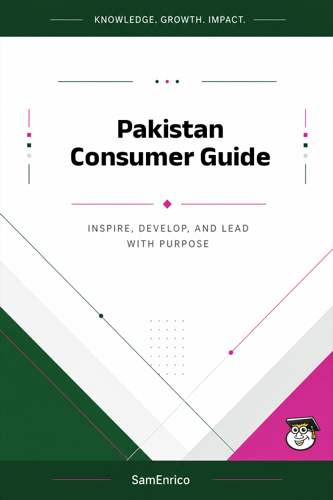
Non-FictionForecast & OutlookPakistan
Pakistan Consumer Guide eBook
Track household spending amid political instabilit
by Hutto Ariel
Track household spending amid political instability and IMF program conditions.
Formats
Free sample
Chapter 1: The Silent Collapse...–- For most of Pakistan’s history, the middle class was celebrated as the backbone of the nation—the salaried professionals, the small business owners, the teachers, the engineers, the clerks who kept the country running while dreaming of a better future for their children. That backbone is now fracturing. Not with a dramatic crash, but with a quiet, relentless erosion that happens every time you open your wallet. This chapter dismantles the official narrative of economic “stabilization” by showing that while macro indicators—foreign reserves, current account deficits, stock market indices—may improve, the Pakistani middle class is experiencing a silent collapse. The crisis you are living through is not your fault, but understanding its mechanics is the first step toward surviving it.The Distributional Crisis: Who Really Pays the Price?Walk into any government office or multinational corporation in Pakistan, and you will find salaried employees whose taxes are deducted at source, every single month, without fail.
These are the documented workers—the 2.5 million souls who file tax returns in a nation of 240 million. They are joined by small business owners who maintain proper books, pay sales tax, and register with the Federal Board of Revenue (FBR) because they supply to formal sector companies or seek bank financing. Together, this group now bears over 42% of the national tax burden, according to the FBR’s own annual reports and confirmed by IMF staff reports.Now step into the parallel economy that exists on every street corner. The wholesale cloth merchant in Karachi’s Bolton Market who deals only in cash. The real estate developer in Lahore’s DHA who registers his sale at half the actual price.
The agricultural landowner in rural Punjab who pays zero income tax on his crops. The retail shop in Islamabad’s F-10 Markaz who smiles and says “no receipt, five percent discount.” This is the informal economy—retail, agriculture, real estate, construction—and it remains largely untaxed. The IMF’s own reports consistently note that Pakistan’s tax-to-GDP ratio hovers around 9–10%, one of the lowest in the world, yet the burden falls disproportionately on those who cannot hide.This is what economists call a distributional crisis. It is not that Pakistan does not generate wealth. It is that the wealth is generated in the shadows, while the cost of running the state falls on the shoulders of the documented middle class.
Every time the government raises the sales tax from 17% to 18% (a common IMF demand), it is the salaried employee buying packaged milk and the small shopkeeper paying electricity bills who feels the pinch. The cash-only jeweler selling gold for undeclared rupees adjusts his prices upward and carries on. The real estate tycoon receiving payment in undeclared bank drafts sleeps soundly.This distributional crisis has a name in economic literature: regressive fiscal adjustment. It means that when the government needs to raise revenue or cut spending, it does so in ways that hurt the poor and the middle class more than the rich. Cutting electricity subsidies is regressive because the poor spend a larger percentage of their income on utilities.
Raising sales tax is regressive because the poor consume almost all of their income, while the rich save a portion. Freezing government hiring is regressive because middle-class families rely on government jobs for stability. The IMF knows this. The government knows this. They do it anyway because taxing the rich and the informal sector is politically difficult.
You, the salaried employee, are the path of least resistance.Purchasing Power: The 50% Erosion Nobody Talks About Let us move from abstractions to your household budget. The State Bank of Pakistan (SBP) publishes detailed household expenditure surveys. The Pakistan Bureau of Statistics tracks the Consumer Price Index (CPI). These sources reveal a devastating truth: adjusted for real inflation in food and energy, a typical urban family’s purchasing power has fallen nearly 50% in five years.Consider a concrete example that will appear throughout this book as a recurring case study. In 2019, Ahsan and Fatima, a salaried professional couple in Karachi earning a combined Rs 80,000 per month, could afford the following: a 1,000-square-foot apartment in a lower-middle-class area (rent Rs 25,000), utility bills of Rs 8,000, groceries for a family of four at Rs 20,000, school fees for one child at Rs 10,000, medical expenses of Rs 3,000, transport (car fuel or bus fares) of Rs 6,000, and they would still have Rs 8,000 left for savings or discretionary spending.Today, five years later, Ahsan has received two promotions and now earns Rs 60,000.
Fatima has also advanced and earns Rs 50,000. Their combined household income is Rs 110,000—a respectable 37.5% increase. They should be better off. They are not.Rent for a similar apartment is now Rs 50,000. Utility bills regularly hit Rs 25,000.
Groceries for the same family exceed Rs 40,000. School fees have doubled to Rs 20,000. Medical costs have risen to Rs 8,000. Transport costs Rs 12,000. The total monthly expenses for the exact same standard of living: Rs 155,000.
Their income: Rs 110,000. The monthly deficit: Rs 45,000.Where does that deficit come from in practice? It comes from cutting one meal a day—skipping breakfast or eating only daal and roti for dinner. It comes from removing their child from a private school to a government school, with all the attendant loss of quality. It comes from sleeping without air conditioning in Karachi’s August heat, using only a fan and a wet cloth.
It comes from borrowing from relatives or falling into credit card debt at 42% annual interest. It comes from skipping medical checkups and hoping the cough goes away on its own. This is not abstract economics. This is the lived reality of millions of Pakistani households, and the case study of Ahsan and Fatima will return in later chapters to illustrate specific strategies.The 50% erosion figure is not a rounding error. It is the cumulative effect of five years of compound inflation.
If inflation averages 12% per year (which is lower than the actual rate for many periods), prices double every six years. Your salary, meanwhile, has increased at perhaps 5% per year. The gap between price growth and wage growth compounds mercilessly. This book will teach you to calculate your personal inflation rate—because the government’s CPI may not reflect what you actually buy. If you spend more on food and energy than the average Pakistani, your personal inflation rate is higher than the official number.The Myth of “Stabilization”Turn on any business news channel—Dawn News, Geo News, ARY—or read the headlines in the financial press, and you will encounter a curious disconnect.
The government announces that foreign reserves have risen to $9 billion. The IMF praises Pakistan for meeting its primary surplus target. The State Bank reports that the current account deficit has narrowed. These are, technically, facts. But they describe a world entirely different from the one you inhabit.Let us decode each of these terms because understanding them is the only defense against propaganda.Foreign reserves are the dollars the government holds to pay for imports and service debt.
When reserves rise, it sounds like good news. But those dollars come from somewhere. They come from the Saudi loan that must eventually be repaid with interest—$3 billion at…
This is the end of the free sample. Get the eBook to keep going. Buy now
About this book
Details
- Author
- Hutto Ariel
- Publisher
- SamEnrico
- Language
- English
- Genre
- Non-Fiction, Forecast & Outlook, Pakistan
- Released
- 2026-06-08
- Pages (approx.)
- 136
- Available as
- eBook, Audiobook

Read better in the ZLOADR app
Your eBooks on your phone or tablet. Sign in with your SamEnrico account and start reading.
More by Hutto Ariel
 Stress And Type 2 DiabetesHutto Ariel$11.99
 Loci for Student SuccessHutto Ariel$11.99
 Sexual Trauma Trigger RecoveryHutto Ariel$11.99
 Influence for Healthcare ProvidersHutto Ariel$11.99
 The Great Emoji War: How a Tiny Symbol Sparked a Global DebateHutto Ariel$11.99
 Understanding PachydermoperiostosisHutto Ariel$17.99
 Lead Generation First CampaignHutto Ariel$12.99
 David Solomon InsightsHutto Ariel$12.99
 How to Start a Abaca and other Vegetable Textile Fibre Growing Business (Beginners Guide)Hutto Ariel$11.99
 AWS Architect PermanentHutto Ariel$11.99
You may also like
 Hong Kong Handover 1997Dunn Johnnie$11.99
 Zumba For Postnatal Recovery CourseNeal Christian$11.99
 Zumba for BeginnersLadner Nikia$11.99
 YouTube Comment Mining GuideHumes Pandora$12.99
 Worry Box MeditationCarlin Rudy$11.99
 Workplace Stress MeditationNguyen Lynn$11.99
 Workplace Stress and Sleep RepairHawley Ivory$11.99
 Workplace Perfectionism CureDelaney Jeffry$11.99
 Workplace Injustice Anger GuideWallen Isabelle$11.99
 Work Addiction and Burnout LinkGreenwood Ester$11.99
 Women in Yoga and WellnessBeattie Galina$11.99
 Women in Stand Up ComedyChun Evangeline$11.99