
Non-FictionSelf-HelpEquanimity
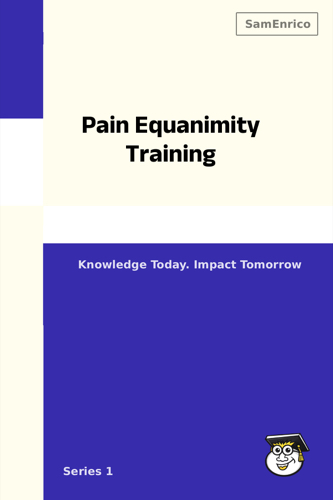
Pain Equanimity Training eBook
Develop balanced mind that neither clings to relie
by Yang Sharyl
Develop balanced mind that neither clings to relief nor rejects discomfort.
Formats
Free sample
Chapter 1: The Second Arrow--–- The first time Sarah tried to meditate on her pain, she lasted eleven seconds. She was lying on her bedroom floor, a yoga mat flattened over the beige carpet, her left hip burning with the familiar fire that had become her constant companion. Her fibromyalgia diagnosis was three years old, though the pain itself was older—a vague ache in her twenties that had solidified into a roaring certainty in her thirties. The meditation app on her phone instructed her to "bring gentle awareness to the sensations in your body." She did. And then she panicked.Her heart raced.
Her jaw clenched. A voice inside her—loud, urgent, and utterly convinced of its own righteousness—screamed: Get out. Get out now. This is unbearable. This will never end.
You are broken. She opened her eyes, gasped, and spent the next twenty minutes crying. The pain had not increased during those eleven seconds. Objectively, it was the same 6 out of 10 it had been for the past four hours. But subjectively, she had just lived through a catastrophe.This is the single most important fact about human pain that most people never learn: pain and suffering are not the same thing.
They are coupled, certainly. They travel together so often that we mistake them for identical twins. But they are separable. And the difference between them is the difference between a life consumed by chronic pain and a life that includes chronic pain without being defined by it.The first arrow is the sensation itself—the raw, pre-verbal, purely biological signal that something in your body demands attention. It might be a throbbing in your knee, a burning across your lower back, a stabbing behind your eye, or a diffuse ache that seems to live in your bones.
This first arrow is inevitable for any creature with a nervous system. It is not a punishment, a sign of moral failure, or evidence that the universe has singled you out for torment. It is biology. You did not cause it by thinking the wrong thoughts, and you cannot eliminate it by thinking the right ones. The first arrow simply arrives.The second arrow is the one you shoot into yourself.
It is the commentary that follows the sensation with the speed of light: This is terrible. This means something is wrong. I can't handle this. Why is this happening to me? It's going to get worse.
It's never going to end. I'm a victim. I'm a failure. My life is over. This second arrow is not biology.
It is psychology. And unlike the first arrow, it is entirely optional.Here is the paradox that will transform everything you think you know about pain management: you can be in pain without suffering. You can feel the first arrow—the raw sensation—without shooting the second arrow into your own heart. The training in this book exists for one purpose: to teach you how to stop shooting the second arrow, not by eliminating the first, but by changing your relationship to it.The Mistake Almost Everyone Makes If you have lived with chronic pain for more than a few months, you have almost certainly been offered some version of the following advice: "Just ignore it." "Distract yourself." "Think positive." "Don't focus on the pain." This advice comes from well-meaning people—doctors, spouses, friends—who believe that the problem is attention. If you would just stop paying attention to the pain, they reason, the pain would stop bothering you.This advice is not merely unhelpful.
It is actively harmful.Ignoring pain does not make it disappear. It makes it grow, like a weed in the dark. The nervous system is designed to escalate signals that are being ignored. When you try to push pain out of awareness, you are telling your brain: This sensation is so dangerous that I cannot even look at it. The brain, ever the loyal servant, responds by turning up the volume.
What began as a 4 becomes a 6. What began as a 6 becomes an 8. Avoidance is not a strategy. It is a guarantee of worsening.The opposite strategy—the one Sarah attempted in her bedroom—is equally flawed. Endurance, grim determination, white-knuckling through the pain until you collapse from exhaustion—this is not strength.
It is a different form of avoidance. Instead of avoiding the sensation, you are avoiding the feeling of fear that the sensation produces. You are trying to outrun your own nervous system. And the nervous system, as we will see in Chapter 2, is always faster.There is a third way. It is not ignoring and not enduring.
It is something else entirely. It is the path of the second arrow—not the arrow itself, but the recognition that you are the one holding the bow. And you can put it down.Sarah's Story: The Longest Eleven Seconds Because this book is a training manual, not a philosophical treatise, we will follow one person through the entire journey. Her name is Sarah. She is forty-two years old.
She teaches high school English in a small town in Oregon. She has been married for fifteen years to a man named David, who loves her and does not understand what is happening to her. She has two children, ages ten and thirteen, who have learned to be quiet when Mom is having a bad day.Sarah's pain began in her late twenties as a mysterious ache in her hips that she attributed to teaching—standing all day, carrying stacks of essays, the general wear and tear of a body in motion. She ignored it. She bought better shoes.
She stretched. The ache became a throb. The throb became a burn. By thirty-five, she had seen four primary care physicians, two rheumatologists, a neurologist, and a pain specialist. She had been tested for arthritis, lupus, multiple sclerosis, and Lyme disease.
All tests came back normal. Normal. The word felt like an accusation.At thirty-nine, a rheumatologist finally said the word fibromyalgia—a diagnosis that means, roughly, "your nervous system is amplifying pain signals for reasons we do not fully understand." Sarah was given a prescription for gabapentin, advised to exercise more, and sent on her way. The gabapentin helped slightly, turning the 8 into a 6. The exercise made everything worse.
She stopped exercising.By forty-one, Sarah had developed a full repertoire of pain behaviors. She woke up stiff and stayed that way. She canceled plans with friends because she could not predict how she would feel. She stopped hiking, which she had loved since childhood. She stopped having sex with David because the pain in her hips made it unbearable.
She stopped laughing, though she did not notice this until her thirteen-year-old daughter asked, "Mom, when was the last time you actually laughed?"The eleven seconds on the bedroom floor were a turning point, though not the kind she expected. She had downloaded the meditation app because a pain psychologist had suggested it. The psychologist had said, "Mindfulness can help you change your relationship to pain." Sarah had heard the words but not understood them. She thought changing her relationship meant making the pain go away. When it didn't—when…
This is the end of the free sample. Get the eBook to keep going. Buy now
About this book
Details
- Author
- Yang Sharyl
- Publisher
- SamEnrico
- Language
- English
- Genre
- Non-Fiction, Self-Help, Equanimity
- Released
- 2026-06-08
- Pages (approx.)
- 146
- Available as
- eBook, Audiobook

Read better in the ZLOADR app
Your eBooks on your phone or tablet. Sign in with your SamEnrico account and start reading.
More by Yang Sharyl
 Nairobi Logistics Startup ManualYang Sharyl$11.99
 Body Scan for Postnatal RecoveryYang Sharyl$11.99Body Scan for Postnatal RecoveryYang Sharyl$11.99
 Testosterone and Bone DensityYang Sharyl$11.99
 Commute Stress Transformation GuideYang Sharyl$11.99
 The Teenage Time Bomb: How 1960s Students Almost Toppled a DictatorYang Sharyl$11.99
 The Last Spin of the WhipYang Sharyl$11.99
 Understanding Chaotic Atrial TachycardiaYang Sharyl$17.99
 Digital DeveloperYang Sharyl$11.99
 Partner Skills PR Points GuideYang Sharyl$12.99
 Proposal for Creative ResearchYang Sharyl$12.99
You may also like
 Hong Kong Handover 1997Dunn Johnnie$11.99
 Zumba For Postnatal Recovery CourseNeal Christian$11.99
 Zumba for BeginnersLadner Nikia$11.99
 YouTube Comment Mining GuideHumes Pandora$12.99
 Worry Box MeditationCarlin Rudy$11.99
 Workplace Stress MeditationNguyen Lynn$11.99
 Workplace Stress and Sleep RepairHawley Ivory$11.99
 Workplace Perfectionism CureDelaney Jeffry$11.99
 Workplace Injustice Anger GuideWallen Isabelle$11.99
 Work Addiction and Burnout LinkGreenwood Ester$11.99
 Women in Yoga and WellnessBeattie Galina$11.99
 Women in Stand Up ComedyChun Evangeline$11.99