
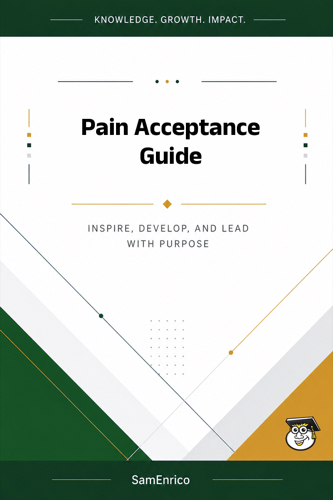
Non-FictionHealth & WellnessACT
Pain Acceptance Guide eBook
Teaches letting go of struggle against chronic pai
Teaches letting go of struggle against chronic pain.
Formats
Free sample
Chapter 1: The Quicksand Pact--You are standing at the edge of a clearing in a dense forest. The air is humid and heavy. In the center of the clearing, there is a wide, flat expanse of sand that looks almost solid—dappled with sunlight, scattered with dry leaves, deceptively peaceful. You have been told that somewhere in this forest there is a path to freedom, but between you and that path lies the sand. You take a step forward.
Your foot sinks. Instinct takes over. You pull back hard, lifting your leg with desperate force. The sand tightens around your ankle. You pull harder.
You sink deeper. Now your knee is submerged. Panic floods your system. You thrash, kick, scream, fight with everything you have. And the sand, patient and indifferent, pulls you down to your waist, then your chest, then your chin.
The last thought that passes through your mind before the sand covers your face is this: Why did fighting make it worse?This is not a metaphor for quicksand. This is a metaphor for chronic pain.Every person who has lived with persistent pain for months or years knows this feeling intimately. Not the feeling of sinking into sand, but the feeling of fighting harder and harder against something that only seems to tighten its grip in response. You have tried everything. You have seen specialists, undergone procedures, taken medications, tried alternative therapies, modified your diet, changed your sleep position, bought the special pillow, the ergonomic chair, the expensive mattress.
You have pushed through pain on good days, telling yourself that you will not let pain win. And then you have collapsed on bad days, telling yourself that you have failed. You have researched obsessively at 2 a.m., convinced that the right answer is out there if you just look hard enough. You have negotiated with your body: If you just let me have this one day, I will rest tomorrow. You have pleaded, bargained, raged, and wept.And despite all of that effort—all of that heroic, exhausting, relentless fighting—the pain has not gone away.
In fact, for many of you, it has gotten worse. Not just the pain itself, but the suffering around it. The despair. The isolation. The sense that your life has become smaller and darker with each passing year.Here is the truth that this entire book exists to deliver: You are not failing at fighting your pain.
You are failing because you are fighting your pain. The war itself is the problem.The Great Lie of Modern Pain Culture Before we go any further, let us name the enemy. It is not your body. It is not your diagnosis. It is not your doctor, your family, or your past.
The enemy is a story—a story so pervasive, so deeply embedded in our culture, that you have likely never even questioned it. Here is the story:Pain is a problem that must be eliminated. A good life is a pain-free life. If you are still in pain, you have not tried hard enough, or found the right treatment, or unlocked the secret. Keep fighting.
Keep searching. Do not give up.This story is sold to you by the medical system that profits from endless tests and procedures. It is sold to you by the wellness industry that promises the perfect supplement, the correct alignment, the miraculous cure. It is sold to you by well-meaning friends who say, "Have you tried…?" It is sold to you by your own terrified mind, which equates pain with danger and interprets its persistence as a sign that something is terribly, catastrophically wrong.And this story is a lie.Not because pain is not real. It is excruciatingly real.
Not because you should stop seeking medical care for treatable conditions. You should not. But because the equation at the heart of this story—eliminate pain = begin life—is fundamentally backward. It has trapped millions of people in the quicksand of chronic suffering, convincing them that the only way out is to fight harder, when in fact the only way out is to stop fighting altogether.Let us be very clear about what this book is not saying. This book is not saying that pain is all in your head.
It is not saying that you should stop all medical treatment. It is not saying that you should simply "accept" a life of misery. What this book is saying is far more radical, far more difficult, and far more liberating: The relentless pursuit of a pain-free life is the very thing that is keeping you trapped.Clean Pain Versus Dirty Pain To understand why fighting makes things worse, we need to make a distinction that will serve as the foundation for everything that follows. It is a simple distinction, but it will take time—maybe years—to fully internalize. Here it is:There is clean pain and there is dirty pain.Clean pain is the raw, unfiltered physical sensation that arrives in your body.
It is the burning in your lower back. The stabbing in your knee. The throbbing in your head. Clean pain is not pleasant, but it is also not complex. It is just sensation.
It arrives, it stays for a while, and eventually—if you do nothing—it changes or fades. Clean pain is the first arrow, as an ancient Buddhist parable puts it. It is what life shoots at you. You do not choose it. You cannot always prevent it.
But clean pain is not the real problem.Dirty pain is everything you add on top of the clean pain. Dirty pain is the story you tell yourself about what the pain means: This is never going to end. I cannot live like this. Something is seriously wrong with me. I am a burden to my family.
I used to be strong, and now I am weak. Dirty pain is the fear you layer onto the sensation: What if it gets worse? What if this is the beginning of the end? What if I lose my job, my relationships, my identity? Dirty pain is the struggle you engage in: the pushing through, the avoiding, the obsessing, the negotiating, the catastrophic thinking at 3 a.m.
when sleep will not come.Here is the crucial insight that changes everything: Clean pain is inevitable for many people. Dirty pain is optional.You cannot always control whether the first arrow arrives. But you have far more control than you think over whether you shoot yourself with the second arrow. The problem is that for most people with chronic pain, the second arrow has become so automatic, so habitual, so deeply ingrained that it feels like part of the pain itself. You do not even notice that you are shooting yourself.
You just feel the suffering and assume it belongs to the pain.It does not. The suffering belongs to the struggle. And the struggle is something you can learn to stop.The Struggle Behaviors Inventory Let us make this concrete. Below is a list of common "struggle behaviors"—actions, thoughts, and habits that transform clean pain into dirty pain. As you read this list, do not judge yourself for recognizing…
This is the end of the free sample. Get the eBook to keep going. Buy now
About this book
Details
- Author
- Zimmer Blaine
- Publisher
- SamEnrico
- Language
- English
- Genre
- Non-Fiction, Health & Wellness, ACT
- Released
- 2026-06-07
- Pages (approx.)
- 134
- Available as
- eBook, Audiobook

Read better in the ZLOADR app
Your eBooks on your phone or tablet. Sign in with your SamEnrico account and start reading.
More by Zimmer Blaine
 Imposter Overwork FixZimmer Blaine$11.99
 Reconstruction of Asphyxiation DeathsZimmer Blaine$11.99
 Pomodoro for CodingZimmer Blaine$11.99
 Sudden Death Shock RecoveryZimmer Blaine$11.99
 Inaccessible Website Lawsuit WinZimmer Blaine$11.99
 Memory Palace For Law CasesZimmer Blaine$11.99
 Drew Barrymore Firestarter ChildZimmer Blaine$11.99
 The Bloodstained Letters: The First DNA Breakthrough in a Serial Killer Case (1888)Zimmer Blaine$11.99
 Mastering The Biceps BrachiiZimmer Blaine$11.99
 How to Produce a Portable DVD PlayerZimmer Blaine$11.99
 How to Produce a Drawbar (Haulage)Zimmer Blaine$11.99
 STEM Applicant Essay GuideZimmer Blaine$12.99
You may also like
 Hong Kong Handover 1997Dunn Johnnie$11.99
 Zumba For Postnatal Recovery CourseNeal Christian$11.99
 Zumba for BeginnersLadner Nikia$11.99
 YouTube Comment Mining GuideHumes Pandora$12.99
 Worry Box MeditationCarlin Rudy$11.99
 Workplace Stress MeditationNguyen Lynn$11.99
 Workplace Stress and Sleep RepairHawley Ivory$11.99
 Workplace Perfectionism CureDelaney Jeffry$11.99
 Workplace Injustice Anger GuideWallen Isabelle$11.99
 Work Addiction and Burnout LinkGreenwood Ester$11.99
 Women in Yoga and WellnessBeattie Galina$11.99
 Women in Stand Up ComedyChun Evangeline$11.99